Category Archives: reviews

Species Domain, Vol. 1

By Shunsuke Noro. Released in Japan by Akita Shoten, serialization ongoing in the magazine Bessatsu Shonen Champion. Released in North America by Seven Seas. Translated by Krista Shipley, Adapted by Karie Shipley.

Monster Girl titles are here to stay, and have tended to come in two varieties. Thankfully, this is the second variety, and so fanservice and borderline content is not on the menu. Instead, this is something that should appeal to fans of series like My Monster Secret or Interviews with Monster Girls, as it has much the same flavor. It can be a bit odd and off kilter, though not so much that it reaches the out there weirdness of A Centaur’s Life. Its strongest qualities is its dialogue, of which there is a lot – this is a series with a group of classmates who talk and talk and talk, and it’s a relief we find the talk funny. And there are the usual manga cliches present within – the elf girl is a misunderstood tsundere, the angel girl is overenthusiastic and puppydog-ish, the dwarf girl is low key and stoic, etc. It’s solid and unassuming.

This is not a “I must hide my secret from the world” sort of book – there are several fantasy types at the school, and it’s accepted as simply being part of how the world works. That said, Kazamori, the elf girl on the cover, is battling the fact that everyone assumes she’s an elf who can use cool wind magic and has powers – except she’s been raised by humans, so has nothing of the sort. What’s worse, she feels the need to act haughty and proud as an elf should, even though the turmoil of emotions that stir within her is a more accurate read of her character. It also leads to most of the humor in the book, particularly when she collides with Ohki, a normal boy who denies that magic exists – everything can be explained with science. Which is fine, except all of the ‘science’ he demonstrates is ludicrously impossible to anyone but him.

This is the start, but refreshingly we also do focus on the other characters. It’s hard not to look at Unli the dwarf and not think of Terry Pratchett’s Cheery, as she’s essentially a cute small schoolgirl with a full beard and a penchant for meat. I was very amused at the relationship between her and her human classmate Tanaka, which everyone interprets as romantic and then when they find out it’s really not all hell breaks loose in terms of their suppositions. The title really seems to enjoy making fun of audience expectations – there’s an omake chapter that has Kazamori dream of what would happen if she was the cool girl with elf powers she wants to be, and Ohki was the fired up “I will prove it is science” shonen lead, and it’s hilariously boring.

Like many recent licenses these days, this will not win any awards for originality or surprises, but it’s fun and likeable, the sort of manga that you read with a smile on your face, even if it sometimes turns into a bit of a smirk. The translation and adaptation are excellent as well, which is key for a series that depends so much on its conversations. A good debut, recommended for fans of the ‘monster girl’ genre or comedic school manga in general.

Flying Witch, Vol. 1

By Chihiro Ishizuka. Released in Japan by Kodansha, serialization ongoing in the magazine Bessatsu Shonen Magazine. Released in North America by Vertical Comics. Translated by Melissa Tanaka.

Relaxed and easygoing titles have always been a thing in Japanese manga to some extent, but over the last ten years or so it really seems to look like they’re coming into their own, or at least coming to North America more often. Whether it’s school life, village life, or workplace life, there is a growing need for watching a cast of mild to strong eccentrics go about life at their own pace, usually with at last one “straight man” to boggle at their antics. And as you may have gathered, Flying Witch continues in this genre, showing us a young witch who moves out into the sticks in order to train, and her laidback adventures with a group of (mostly) normal villagers.

Makoto is the witch, and she’s a bit of an airhead, although not to the extremes that some of these series try to go. She wants to do her best to be a better witch, but is easily distracted, has a Ryouga Hibiki-like sense of direction, and also has absolutely no idea how to hide her identity as a witch, which is supposed to be a secret, from anyone at all. She’s moved in with her cousins, and on the very first day she’s trying out a new broom in front of the youngest one, not particularly noticing that she isn’t supposed to be floating in the air. The cousin, Chinatsu, is probably my favorite character in the book; at first shy and a little reluctant to like this new girl, she gradually warms up once she realizes Makoto is a witch, and is a nicely realistic young girl.

Less successful is Kei, the main male lead, who unfortunately is not straight-laced enough to be the main “tsukkomi” that this series needs. (That falls to his classmate Nao, who holds up her end of the bargain admirably, and is the recipient of the manga’s funniest and also possibly creepiest moment.) Kei is simply too laid back and relaxed, and as a result has a tendency to have no personality. He seems to be a ‘minder’ sort, like Yotsuba’s dad, but these girls are too old to really need to take charge of, so mostly he exists so that the series isn’t made up entirely of girls. I was pleased to see that the witch aspect was not forgotten – this felt like one of those series that would settle into slice-of-life and forget its roots, but each chapter does have a small element of the supernatural in it, from the terrifying mandrake root to the Harbinger of Spring (whose matter-of-fact introduction reminded me of some of the better Zetsubou-sensei chapters) to Makoto’s older and more accomplished sister, who arrives, makes chaos, and then leaves.

There’s not much to grab a hold of here, and I doubt a “real” plot will form. But who wants a real plot to form anyway? Flying Witch is filled with cute, nice, slightly weird girls living their everyday life and doing witchcraft. If you enjoy slice-of-life eccentricity, it’s right in your strike zone.

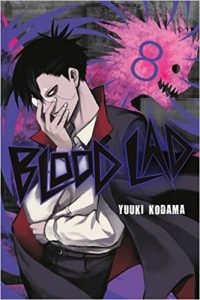
Blood Lad, Vol. 8

By Yuuki Kodama. Released in Japan by Kadokawa Shoten, serialized in the magazine Young Ace. Released in North America by Yen Press. Translated by Melissa Tanaka.

It’s been over a year since we last looked at the world of Blood Lad. Such is life when you’ve caught up to a series’ Japanese releases, even more so when Yen puts this out as an omnibus. But the manga has now finished in Japan, so we shouldn’t have quite as long to wait for the final volume. In the meantime, we get this new omnibus, which does exactly what I suspected it would, which is get taken up by a huge fight between the villain and everyone else, showing off all the minor and secondary characters to a decent degree, but putting the emphasis squarely where it’s been (more or less) since Day One: on the odd relationship between vampire leader Staz and busty newly dead ghost Fuyumi. It even gives Fuyumi something to do!… though that’s somewhat problematic as well.

If you look at my past reviews of Blood Lad, you’ll see that Fuyumi’s lack of character development has been a bit of a bugaboo for me. She’s improved, but still tends to be reactive rather than proactive. That doesn’t change here, much as I’d like it to. The solution to how to defeat the bad guy involves Staz fusing with Fuyumi’s body, effectively making her the action heroine, but since it’s really Staz in the driver’s seat, the effect is lost, no matter how often we hear ‘Super Fuyumi Kick!’. Her best moment in this volume may come in a ‘dreamscape’, as she yells at him for being tactless and not understanding her feelings while literally dressed up as a giant 50-foot bride. Fuyumi is ‘the love interest’, and sadly Blood Lad’s biggest lost opportunity.

Thankfully, we’ve got something that makes up for that: humor. A good deal of this volume is hilarious, especially towards the end. Much as I disliked the Staz/Fuyumi fusion as character development, as an homage to giant robots it’s wonderful, especially as more and more people end up getting added and Staz’s Fuyumi Gundam rapidly turns into a Fuyumi Yamato. And, let’s be honest, the sight of Fuyumi with Staz’s teeth and attitude is also highly amusing. It helps to distract a bit from the brutality of the villain, who I think we abandon all hope of ever turning back to the other villain he used to be here. He’s a good villain, but also a bit one-note. Still, he provides tension.

Blood Lad in the end works best if you view it as one of those summer action blockbusters you see in the theater. While you’re watching it you’re captivated by the cool fight scenes and great quips, but it tends to fall apart when you go home and think about the plot afterwards. So don’t think about it too hard. Just sit back and enjoy a manga written by an artist who is clearly enjoying the hell out of himself, and grin along with Staz as you pilot a giant robot version of the girl you like in order to defeat a madman.