Attack on Titan, Vol. 17

By Hajime Isayama. Released in Japan by Kodansha, serialization ongoing in the magazine Bessatsu Shonen Magazine. Released in North America by Kodansha Comics.

It’s no secret that the development of Historia’s character has been one of my favorite parts of Attack on Titan, and this volume continues to feature that, as she refuses to be treated like precious china merely because she has the Reiss lineage, saddles up to help defeat a titan who is actually her father, takes credit for it to further Erwin’s plan to stabilize the city, and finally is crowned Queen, though arguably her best moment comes shortly afterwards, where she somewhat falteringly punches Levi as a callback to where he abused her in order to get what he wanted. Of course, he has, and his genuine smile of thanks is rather touching here.
titan17

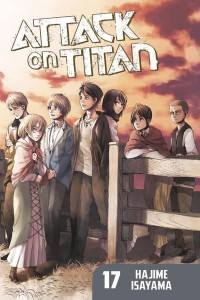
Moreover, we see what the effect of being ruled by someone who did not get controlled by the Firt King is that actual progress is allowed to be made. Underground inventions are allowed to come to light, leftovers from the giant titan battle are used in new and exciting ways, and Historia herself spends most of her time seemingly running an orphanage on a farm outside the city. (See: front cover, which looks like it should be called Little Titan on the Prairie.) This comes after the rest of Kenny Ackerman’s flashback, where he meets a young, starving orphan Levi and teaches him how to fight and get by in the streets. Again, Kenny’s search for something to strive for is relatable, and I like the description of everyone being “drunk on something”, but in the end he’s still a villain.

And then there’s Eren, who spends a lot of time being his usual emo self, then sees what Historia has been doing and literally punches the whine out of himself. This might come back to haunt him, of course, as following this we see him overextending himself to the point of physical exhaustion, as he realizes that right now he is the only one who can do these things. I suspect he sees Historia more as an inspiration than as someone to be romantically interested in, though naturally Mikasa takes offense at anyone female getting remotely close to Eren. I’ve sort of given up on the idea that Mikasa’s feelings for Eren are going to remain familial, as the author has far too much fun with her repressed jealousy, but I don’t enjoy it. There was some genuine amusement late in the volume involving Marlowe, who has transferred to the Survey Corps despite Hitch’s tsundere exhortations, which everyone but he and Eren can see through (Eren being similarly clueless about any romance).

There’s still quite a bit of mystery here, which I suspect will get solved a bit more in 18, when we go back to training to visit our old instructor. In the meantime, this is a nice solid Titan volume, with a good fight, the usual somewhat questionable politics (yay, isn’t military rule great?), the usual questionable art (Isayama is good at terror, not so good at non-terror), but excellent plotting and characterization, and makes you want to keep reading.

Is It Wrong To Try To Pick Up Girls In A Dungeon?, Vol. 4

By Fujino Omori and Suzuhito Yasuda. Released in Japan as “Dungeon ni Deai o Motomeru no wa Machigatte Iru Darou ka?” by Softbank Creative. Released in North America by Yen On.

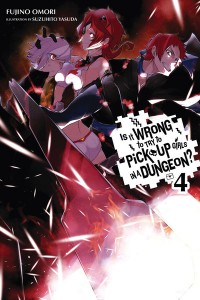
This volume of Bell Cranel and his ongoing adventures has the main story only take up 2/3 of the book, the rest being filled in by two character developing short stories. While both stories are enjoyable, and I did like the main tale, it does feel a bit like the author wanted to hold off on the next big twist till Vol. 5, but could not quite come up with enough material to squeeze into this volume to pad it out. Welf Crozzo’s backstory is mostly given in an infodump, and his issues are resolved simply by having Bell be who he is – Bell is the sort to not go after someone for his own personal gain, and Welf has had nothing but that most of his career.

danmachi4

Welf adds a needed dynamic to Bell’s group, though, especially given this is essentially a shonen manga in light novel form. He adds the loud, brash type who rushes in first, which complements Bell’s extremely skilled but self-loathing personality and Lilly’s savvy yet cynical not-a-hobbit-honest girl. Which is good, as it’s also made apparent in this volume that in order to delve further into the dungeons they’ll need more people – don’t be surprised if Vol. 5 brings us another regular, and I bet she’s female. As usual, the story is presented smoothly and with a minimum of fuss, showing off an amusing sequence where the gods give Bell a nickname (and remind us of Freya, otherwise absent from this book) and a brief look at Aiz, who is trying to go beyond the impossible as Bell has and finds it’s not as easy as he’s making it seem.

The two short stories both have large amounts of Hestia in them, which makes up for – once again – a fairly small part in the main book. Hestia can’t go dungeon crawling with Bell, which given that’s the main thrust of the book means she’s always going to be getting the beginning, the end and not much else. The better short story was the second one, a simple character piece showing us Hestia three days after taking Bell in, and how she starts to fall in love with him. The other piece develops a small house that specializes in potions, and how unfortunate circumstances have led them to try to put one over on easy suckers – meaning Bell, who luckily has Lilly with him to be genre savvy. The best part of this story had Hestia and Lilly describing how oblivious Bell is and how the two of them are delegated to ‘goddess who isn’t even female’ and ‘cute little sister’ in his eyes. Given the ‘rivalry’ scene in the last volume, I’m pleased to see them bonding over lack of affection.

While not as strong as the other volumes of the series, this is still a very easy read, and I suspect we’re due for a major crisis point soon. Also, for fans of the anime, they adapted this into a single episode, so pick it up to see how much was cut out.

Black Bullet: Against A Perfect Sniper

By Shiden Kanzaki and Saki Ukai. Released in Japan by ASCII Mediaworks. Released in North America by Yen Press.

Tempting as it may be, I can’t simply point to my review of the first volume of Black Bullet and say “Exactly what I said before, only with an added loli.” And it is tempting. Black Bullet’s strengths – its action scenes and politics – are still very strong, and its weaknesses – all of its anime cliches – are still there and pandering. There were mercifully a few less pedophilia jokes this time around, but that was made up for by added harem and boob jokes. But its strengths are quite strong, and given that this is a text medium and the illustrations aren’t too bad, it’s easier for me to ignore the service and focus on the grim dystopia of this world and the shiny, shiny young woman attempting to change things despite everything.

bb2

We get far more of what makes Seitenshi tick in this volume, and like Rentaro, I can appreciate what she’s doing while worrying about her good sense. People like her tend to have low survival rates in crapsack worlds like this one, and when she’s up against a stronger politician like the leader of Osaka, she doesn’t give in but does seem to be working from a weaker position. It’s very telling that Rentaro tells her to her face that her main force of bodyguards are basically goons, and by the end of the book… they’re still her bodyguards, they just got yelled at for trying to kill a who had, admittedly, tried to kill Seitenshi numerous times.) As I did with Kisara in the first novel, I wish we could get more from Seitenshi’s POV, but I know better than to expect something like that.

The other new character is Tina Sprout, a Cursed Child whose character arc, while heartwarming, is almost entirely predictable. She befriends Rentaro without either of them knowing who the other one is, and he becomes the one person who doesn’t treat her horribly. She’s also very broken, as all the Children are, and tries to avoid killing when she doesn’t have to (though she manages to take out Enju enough that she’s absent from the 2nd half of the book – which allows her and Rentaro to have a one on one battle). And naturally, he is able to see the good inside of her and decides to save her. As I said, there’s nothing particularly bad about her story as it’s written, it’s just that if I described the character and asked a reader to tell me what happens to her, most could do so without even looking.

This is still a grim book series, and the humor that it has tends to revolve around a) people thinking Rentaro is a lolicon, or b) Kisara and her rival, the student council president girl introduced here, getting furious with each other and attempting to seduce a deliberately oblivious Rentaro. That said, I did laugh out loud at one passage, possibly my favorite in the book, where Seitenshi and Rentaro are preparing to meet with the leader of the Osaka area. Rentaro has met him before when he was a child and being trained to rule the world (or at least that’s what his training seems like from flashbacks). Seitenshi asks him nicely not to get angry or say rude things. He then walks in and is even ruder than I expected him to be, gets even angrier, and never even bothers to apologize. It’s possibly the most emotion he shows all book, and I hope we get more of this sort of thing next time around.