Accel World: The Floating Starlight Bridge

By Reki Kawahara and Hima. Released in Japan by ASCII Mediaworks. Released in North America by Yen Press.

My last review mentioned that I was more interested in the worldbuilding than the characters with this series, and it’s possible the author heard me, as this fifth novel, the first to not yet be animated, is filled with character development. Haruyuki’s personal issues still exist, but we are reminded that he’s not the only one having a bad time, and Kuroyukihime and Fuko are both dealing with devastating traumas, both involving Brain Burst and the real world, though we get minimal information on the latter. Luckily, this book isn’t simply piling up the angst – there’s a lot of fights going on here, and a race to the top of a brand new level which has a lot to offer everyone.

aw5

And there’s also that cover, as you are reminded yet again that this is a series filled with very young teens. That said, it fits well with the plot, as the overly dramatic ‘everything is terrible’ mood swings that kids get when they’re between 11 and 15 allows for dramatic speeches and loud screaming without feeling like you’ve stepped onto the cover of Shonen Jump too much. We get more development of the ‘Incarnate’ powerups, and they’re public now, so that’s a new worry. But the biggest worry is with our hero, who (as was becoming obvious) is not quite free of the killer possessive armor from Book 2, and one way that you can tell this is going to be a long-running series is that the volume is content to leave most everything up in the air.

It also resolves issues left over from the previous book about Fuko, who is at last doing something with the team, but really isn’t using her full potential due to her latent trauma over what she did to her legs in the game. I’d wanted more with her and Kuroyukihime, and I got it here, as it’s clear that both of them take the blame for the pain that each one suffered, and it’s up to Haruyuki to demonstrate that they are not a horrible person (Kuroyukihime) or to show off what her powers and avatar really is used for (Fuko). Haruyuki is very empathic, and (except of course for the increasing number of girls crushing on him, which he doesn’t get mostly for plot reasons) understands almost unconsciously what needs to be done to help people achieve their potential.

Brian Burst, for all its drama, twisted revenge antics, and continued suggestions of a dark evil villain side using it for bad things, is a game, and a fun one at that. The battles featured here are probably the best writing in the book, as they’re fast, exciting, dramatic, and uncertain. Yes, you could predict that our heroes would win, but how they won was certainly not expected, and I loved that it also required an assist from Blood Leopard and Ash Roller – breaking apart the boundaries of the ‘teams’. Given what happens near the end of this book, Haruyuki and company are going to need all the allies they can get. I’m eagerly looking forward to the next volume.

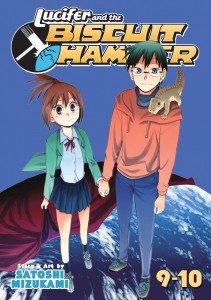
Lucifer and the Biscuit Hammer, Vols. 9-10

By Satoshi Mizukami. Released in Japan by Shonen Gahosha, serialized in the magazine Young King Ours. Released in North America by Seven Seas.

This final volume has a lot of fighting and backstory in it – in fact, a good 4/5 of the book could be described as fighting and backstory, even the epilogue with Akane. But it’s a credit to the author that the backstory always feels natural and not like an infodump, and the fights never wear out their welcome, even when they’re supposed to. We get the villain’s main motivation (delusions of godhood), the relationship between him and Anima, and why Samidare is so desperate to smash the world. And, spoiler, the world is not smashed, which means that we also find out what happens afterwards – we hear in an afterword that Mizukammi always wanted to find out what happened to characters after the final battle ends, and that’s what we see here. It’s heartwarming as heck.

lbh9-10

With the exception of Nagumo, our cast have for the most part been from middle-school to early college age, and their mindset and problems have stemmed from that – immaturity, frustration, pent-up emotions, and budding sexuality. We now see that Animus and Anima’s battle has remained what it is again due to a very childish reason – Animus has psychic powers, as does his sister, and when a doctor calls him a god, Animus gets one of the most creepy ‘insane grin’ faces I’ve seen in manga, and proceeds to prove his godhood by destroying first the space station they’re on, then the Earth. Anima, who was trying to convince him that powers or no he’s still a human, is desperate to stop him.

If this sounds vaguely familiar it’s because it’s mirrored in the relationship between Samidare and Yuuhi, who as I predicted is not really going to let her smash the world with her giant projected fist after all. That said, he does pretend he is for some time, which leads to a number of battles where he shows off how much he’s been holding back until now, and basically curbstomps all the other knights bar Mikazuki, who’s still down from the battle against Animus. Samidare goes on like a lovestruck girl (which she is) about how cool Yuuhi has become, and it’s true – his emotional growth in this series has been nothing short of stunning. And now with Samidare, who has discovered that she has something to live for after all, the emotional growth is a catharsis.

The 10 years in the future epilogue is a bit Harry Potter-esque, particularly the part where we find out that Shimaki and Yayoi got married despite very little interaction in the main series at all – Anima’s “Hmm?’ and blank stare reminds me of my own when I heard Luna was marrying some offscreen guy I’d never heard of. But as Yuuhi points out, that’s how life works, and is the nature of ‘where are they now?’ epilogues. More importantly, Samidare is healthy again, and everyone has been moving forward. Even Akane, in many respects the most emotionally broken of the group, gets a separate section to show off how much he’s changed – though the Hawaiian shirt is perhaps a bit much. (He also gets the best “love confession”.) The fighting is dine, our heroes are content, and so am I. This was a great ending to a terrific series, one of the more realistic takes on superhero battles out there. Get someone all of it for Christmas.

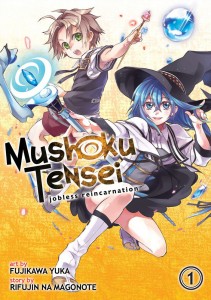
Mushoku Tensei: Jobless Reincarnation, Vol. 1

By Fujikawa Yuka and Rifuin Na Maganote. Released in Japan as “Mushoku Tensei – Isekai Ittara Honki Dasu” by Media factory, serialization ongoing in the magazine Comic Flapper. Released in North America by Seven Seas.

Never let it be said that companies don’t know their core audience. Someone like Viz might have simply called this ‘Jobless Reincarnation’ and be done with it, but Seven Seas knows that the folks most interested in it also wouldn’t recognize it unless it had its original Japanese title. Hence the hyphenated name. And Media factory knows their audience as well, which is why the front cover stars the cute teenage girl who’s a mere mentor for our hero, with our hero himself in the back. That said, some of the editorial decisions, while I can sort of guess why they happened, baffle me a little bit, the first one being why we have this story’s framing device at all.

mushoku1

Our story starts off with a chubby goateed guy at his computer eating instant ramen. He’s quickly kicked out on the streets by his family, as it turns out he’s a NEET with no job or desire to get one. As he bemoans his useless life, he sees a truck barreling towards an arguing young couple and decides to rescue them, even as it means the truck kills him. He dies with a desire to do his life over properly. We next cut to a standard ‘fantasy’ world, where Rudy, our hero, is a 3-year-old precocious brat learning swordfighting, but he can also do magic. He’s that guy reincarnated, but he still has all his prior memories. Now he buckles down and learns as fast as possible, so that he can live a life he’s proud of.

This is all very well and good, but aside from creepy moments when we see a little kid perving on a young teenage girl, or the odd traumatic reference to his death from the start of the book, there’s no real reason why this had to happen at all. Why not just have it be a story of a bright and precocious young kid in a fantasy universe? I fear the answer may be that ‘ordinary guy gets trapped in a fantasy universe’ is the in thing right now, and the author knew it. It’s based on a series of light novels, so that wouldn’t surprise me. It could also be a way to ward off criticism of his hero, who’s doing things at 3 years old that most folks can’t pull off till their teens.

That niggle aside, this was better than I expected, and shows off Rudy’s boyish young charms (when he’s not being a 34-year-old otaku) very well. His conflict resolution is also based off his prior memories, and while this does give him a vocabulary no little kid should have yet, it does actually resolve the conflicts to some degree. There’s also a suggestion that this might get into some darker areas, not least of which is the cliffhanger. I’ll check out the second volume, but I wish the series had simply dumped the wraparound and been a straight up fantasy.