Kimi ni Todoke, Vol. 21

By Karuho Shiina. Released in Japan by Shueisha, serialization ongoing in the magazine Bessatsu Margaret (“Betsuma”). Released in North America by Viz.

I’ve been reviewing this title in the ‘Bookshelf Briefs’ section for a long time. There’s been a lot going on since my last review, but one thing that amused me is that I was discussing Kento never shutting up, saying the wrong thing, and generally being extroverted all over the pages of what’s trying to be a quiet, peaceful manga. And hey, guess what’s still happening! After a brief period where I was beginning to like him and hoping he and Yano would work out, he’s back to being my least favorite. Meanwhile, another old villain makes a reappearance, and as she has in the past, spurs Sawako to try to apply herself and chase her dreams.
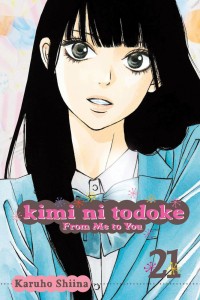
knt21

Given how Kurumi was originally introduced to act as a contrast to Sawako’s purity and general niceness, it’s highly amusing to see that they both want to pursue similar careers – though only Kurumi really gets this, and she is properly annoyed by it. In fact, Kurumi spends most of the volume on a low boil, possibly as all the main characters have hooked up with each other and she’s watching them all be happy. But Sawako has bigger concerns – she’s finally found happiness with Kazehaya, and while she doesn’t want to leave the town, she does envision going to a college that would temporarily separate them. While Kazehaya knows this and decides to try to pull his grades up so that he can go to college as well, he makes it clear to Sawako that this is her choice and she should feel confident in it. As always, they’re both really sweet.

Yano has never been described as sweet, but she’s usually tried to be the most mature of the bunch, and the most level-headed. Now we’re starting to see that facade crumble, particularly around Pin, who is easily able to see through her facade to the anxious teenager beneath it. And it’s fairly clear that, while Yano is happy with what she currently has with Kento, he’s not really factoring in what she really wants – college in Tokyo, a much farther distance away than the others are talking. It’s also far more difficult, and Pin admits she needs to pull her grades even higher if she wants sure success. (Pin is pure awesome in this volume, by the way, and while teacher/student romances are iffy, I totally get why this is also a ship.)

So while Yano frets, Kento is there… to propose to her, saying he wants to spend the rest of his life waking up next to her. Kento has always been forward and blunt, but my jaw actually dropped at this moment, and I wondered if it was a setup for something more. I got my answer later in the volume, where Pin has a disastrous meeting with him, where Kento admits he’d like to study interior design, but going to the same college as Yano is more important. His face in this scene is a sort of goofy, happy-go-lucky type that makes me want to hit it, as he’s not thinking about Yano here at all. To make things worse, she actually hears this outside the teacher’s office. Kento wants Yano as his girlfriend/wife, but seems to take it as read that she’ll be OK with this. And she isn’t.

A cliffhanger seems to show Kento starting to realize that something is wrong, but we’ll have to wait for a bit to see if it sinks in, or if things continue to go south. In the meantime, this remains must-read shoujo, and if you dislike angst, there’s always Sawako and Kazehaya, whose stressful situations are resolved through honest communication. Funny, that.

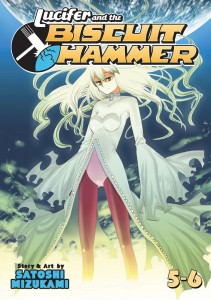
Lucifer and the Biscuit Hammer, Vols. 5-6

By Satoshi Mizukami. Released in Japan by Shonen Gahosha, serialized in the magazine Young King Ours. Released in North America by Seven Seas.

Well, I can’t say I didn’t warn myself in my last review, where I described everything coming to a halt so that the author could do plot setup. And now that it’s set up, the guns are fired, with lots of cool action scenes, character development, and the introduction of Animus’ sibling Anima, who doesn’t talk much and seems to be able to grant even more superpowers. The series also continues to show off the connection between having cool superpowers and teenage angst and grief, which as fans of old school superhero comics know if the classic way to go about things. I have to say, however, that perhaps the most ridiculous yet tragic thing about my last review is when I was discussing Hanako’s oddness and suggested that she might not survive the series. Wow, in hindsight that is the worst thing ever.

biscuithammer56

This is not a series afraid to kill off its main characters, and to be fair I should have realized what was coming. Taro was one of the most ‘normal’ of the cast, and we weren’t sure what his wish was. The one thing we were sure of was that he was totally in love with Hanako and hadn’t told her yet. And, despite what her familiar tells her, he dies in a heroic, amazing way. Yes, he made his wish to resurrect her if she was killed and then tried to stop her getting killed anyway. But that’s love for you, and I thought it was fantastic. I also liked how Taro’s impact was felt on other characters through his food – his other main personality trait besides ‘likes Hanako’. I’m not sure how much I like the observation that his death is Hanako’s punishment for what her wish was, though – I think that’s placing too much of a burden on her.

I’d mentioned above that Anima has started to give powerups to the various Knights, and we see Yuuhi fight to ensure that he gets one… and lose. Yuuhi has always been at the low end of the totem pole when it comes to kicking ass, and I don’t see that changing as I think it’s perhaps the only thing keeping him likeable. We do see his growth here, though, as he encourages Samidare to talk with her estranged mother (who can’t seem to balance work and family well at all) even as he’s still estranged from his own grandfather. I’m still of the opinion that the Earth is not going to be destroyed, and I suspect it will be because he stops being such a nihilist. Leave that to the resident Nihilist Knight… I mean Owl Knight.

In the end, the scene that sticks with me most is the final one of the volume, where Hanako uses her ice powers to take out one of the golems in a fit of suppressed grief and rage, showing the emotions on her face that we haven’t seen since we met her. It extends to the others as well, as the death of Taro’s killer and Hanako’s sobbing allows all the other knights to show their own grief… even Yuuhi. It’s a good sign for the future. I eagerly await the next omnibus.

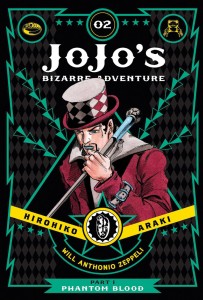
JoJo’s Bizarre Adventure: Phantom Blood, Vol. 2

By Hirohiko Araki. Released in Japan as “Jojo no Kimyou na Bouken” by Shueisha, serialized in the magazine Weekly Shonen Jump. Released in North America by Viz Media.

It is possible, I suppose, that someone out there read the first volume of this series, featuring grandiose over the top histrionics galore, and felt “well that was OK, but it was just far too sedate and naturalistic. What would really make the series take off is if one of the characters came back as an immortal vampire”. Well have I got news for you! Araki ups his game here, turning the amp from 11 to 12 and delivering more action, more histrionics, and a whole lot more death and violence, while also adding a few trickster mentors and loathsome underlings. It’s still not a parody, honest: JoJo’s Bizarre Adventure just is.

jojo2

The highlight of the book may very well be the beginning, where Dio cuts loose and starts to not only kill people and steal their lifeforce but bring them back to life as hideous zombies. JoJo’s still looks up to Fist of the North Star after all, so there’s lots of heads exploding and eyes popping in slow motion here. That said, probably the most grotesque moment of violence comes later on, when Jack the Ripper (yes, that one – Dio takes him on as a disciple) attack the horse and wagon our heroes are in, kills the horses (and driver) by cutting their heads off, and then hides inside a horse corpse so that he can emerge, womb-like, from the neck like your worst nightmare. It’s around that time that you realize how “Tom Brown’s Schooldays” the first volume really was.

If there is any break from the nonstop action and hysteria, it comes in the form of Erina Pendleton, who went to India for several years to study nursing and attend the Tsukasa Hojo School of Heroine Design, and arrives just in time to attend to a dying Jonathan’s wounds. We see once again the steel that’s underneath her soft exterior, and even Speedwagon is forced to withdraw coolly (yes, Viz kept that, thank goodness) in her presence. Sadly, when he starts training and getting attacked by evil minions, Jonathan thinks he can’t let Erina get involved in this, and she vanishes once more. The same cannot be said for Speedwagon, who is both the ‘normal guy’ and Greek Chorus in this series – although how normal someone is when they use the power of their flaming hot abs to heal Zeppeli’s arm is a debate for another time.

I should also probably mention the narrative voice here, or rather the multiple ones. Araki has third person narration drop in from time to time, telling us how glorious everything is in full! blown! CAPSLOCK! But then Jonathan, Speedwagon and Dio also seem to have their own inner monologue, functioning as a narrative voice as well, and just as dramatic. It’s as if you took all the characters and gave them microphones so they could turn to the audience and soliloquize for a while. Honestly, the only normal thing in this entire volume is Zeppeli, whose attitude towards training has been used over and over in so many shonen manga (and yes, he probably got it from Ashita no Joe or something) that you don’t even bat an eye when he threatens Jonathan. But that’s OK, Speedwagon is there to bat them for you.

You can’t really casually read a title like this – you have to leap in full body and drown yourself in it. If you do, not only do you get top notch action and horror, but you also get things like Elizabeth I’s evil face as she condemns two nights to their deaths, where she looks like a yanki punk. I can’t wait for the conclusion of this arc.