Legal Drug Omnibus

By CLAMP. Released in Japan by Kadokawa Shoten, serialized in the magazine Asuka. Released in North America by Dark Horse.

I had first read Legal Drug when it came out from Tokyopop back in the day, but I have to admit it didn’t leave as strong an impression on me. Possibly it was too BL for my tastes (I was so much younger them), or possibly I wasn’t taken with the lack of forward plot progression. These days, though, it’s hard not to read Legal Drug and think to yourself “…this is just xxxHOLIC, only a lot gayer, right?” Legal Drug went on ‘hiatus’ in 2003, right around the time CLAMP were arguing with Kadokawa about the ending to X. Coincidentally, around the same time, xxxHOLIC started in Young Magazine, and also featured a grumpy hero who likes to shout and his cooler, more stoic friend solving supernatural mysteries at the behest of an eccentric mentor.

legaldrug

When this series first came out, CLAMP’s work sort of subdivided into two main groups separated by art: there were the books that looked like Magic Knight Rayearth and X, and the books that looked like Suki and Legal Drug. The latter have Tsubaki Nekoi as their chief artist – as did xxxHOLIC, come to that. Her style has evolved a lot over the years, though, and it felt nostalgic to go back and see the cuteness in the character designs for Kazahaya and Rikuo. This isn’t as fluffy as Suki, though – there’s a lot of deep subtextual backstory here, very little of which is actually wrapped up. Rikuo is desperately looking for a woman everyone thinks is dead. Kazehaya is hiding from his sister, who he seems to love dearly, and who loves him just as dearly – in fact, possibly a bit too dearly? As for the owner of the shop where they work, Kakei, he seems familiar, and you might find yourself wondering if he’s from another CLAMP title.

Speaking of which, there was actually less crossover from other CLAMP works than I’d expected here. The most obvious one is from Suki, but that makes perfect sense in a meta way: the plot requires Kazehaya to have a high school girl give him her uniform at graduation, in exchange for a cute outfit. There is literally NO ONE IN THE WORLD who would be naive enough to do this – except Hina, of course. CLAMP readers who might have found this unbelievable now smile and nod, as all is right in the world.

I joked in some earlier posts about the BL quotient of Legal Drug compared to xxxHOLIC, but re-reading it really brought it home. Compared to this series, xxxHOLIC is straight as an arrow. Kazehaya is a social misfit (from what little background is revealed, he seems to have grown up with only his sister and no one else till about 6 months ago), and Rikuo doesn’t seem to care about much (though does show a preference for teasing Kazehaya). But Kakei and Saiga are clearly a couple, which is why I was trying to figure out what series they’d been in before, and the last third of this omnibus is set in a boys’ school where one of the students straight up admits they all get into relationship0s as there are no girls around. (Given the sheer amount of yuri titles that use the same approach, it’s nice to see things reversed here.)

The supernatural mysteries are excellent, and sometimes creepy, as you’d expect from a series whose spiritual sequel was xxxHOLIC. But the main reason to read Legal Drug is the character interaction, which can range from hilarious to heartbreaking. And now, of course, we get to see the actual sequel, as Drug & Drop began in Young Ace (thus changing genres from shoujo to seinen, though there appears to be no difference in content) in 2011. We’ll come back here soon to see how the years have changed our two leads.

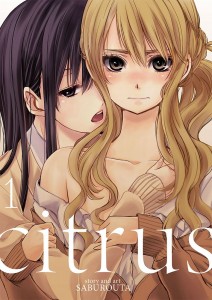
Citrus, Vol. 1

By Sabu Routa. Released in Japan by Ichijinsha, serialization ongoing in the magazine Comic Yuri Hime. Released in North America by Seven Seas.

I was in a somewhat cranky mood when I read Citrus, so wasn’t as appreciative of it as I could have been. The cover makes it seem a bit more salacious than it actually is, though that may change later. The back cover copy tells us it’s reminiscent of Girl Friends and Strawberry Panic, which is certainly true in terms of genre. But as I read it, I realized it felt more like standard shoujo with a female lead who fights back against the system and changes in her life. If it weren’t for the yuri, this could have been written by Natsumi Ando. And thus the difference between this and, say, Girl Friends is the level of drama it brings to the table.

citrus1

Yuzu has just moved to an all-girls’ school, and finds that the strict regulations pretty much demand she change everything about herself. Things aren’t helped by the class president, Mei, who appears to be rather uptight and straightlaced, but is apparently having a secret relationship with the teacher. She then returns home to find that her mother, who has recently remarried (the father is absent, and honestly the mother seems a bit not all there), has asked her new stepdaughter to stay with them. No prizes for guessing who it is. Then when Yuzu, who acts worldly but isn’t, talks about a magical first kiss, Mei shuts her up by kissing her.

I like Yuzu. She’s a good heroine, easily outraged, emotional and exasperated. She is perhaps portrayed as a bit too naive, but the whole “ah, so this is what love feels like” situation is a staple of shoujo manga. In fact, most of the situations we see here are staples of shoujo rather than yuri (though the genres overlap quite a bit): outing the sleazy teacher, the threat of expulsion for doing what’s right rather than following the rules, the jealous classmate catching the lead couple in the classroom and staring at the cliffhanger ending of the volume with an “I will DESTROY her” expression…

Mei is harder to like right away, but that’s because she’s the repressed, stoic one. Her kissing of Yuzu seems oddly out of character, and you get the impression she did it entirely to drive her away and shut her up rather than out of any lingering affection. The trouble is that she also lit a fuse in Yuzu, and now has to take responsibility for Yuzu’s turbulent feelings. (This makes up the other half of the cliffhanger in Vol. 1.) She’s not quite the Sachiko-type – not enough oneesama tendencies for that – but close, and I fear that dealing with Yuzu and all her extroversion will lead to Vol. 2’s crisis point.

So as I said at the start, Citrus is a decent shoujo potboiler of a manga. It’s not very original, but that’s not unusual. If you like dramatic shoujo, and don’t mind the leads both being girls, this is a title you may want to check out. If you like yuri, of course, you’ve probably already read it by now.

(Oh yes, and Harumin is fantastic. She’s the Tsutako of the series, and plays her role admirably.)

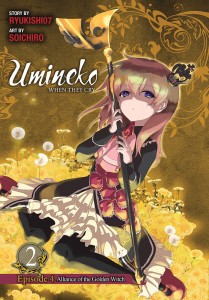
Umineko: When They Cry, Vol. 8

Story by Ryukishi07; Art by Soichiro. Released in Japan in two separate volumes as “Umineko no Naku Koro ni: Alliance of the Golden Witch” by Square Enix, serialized in the magazine Gangan Online. Released in North America by Yen Press.

This review is a couple of months late, partly as so many others things came out at the same time, but mostly as this particular Umineko arc is so hard to read. Like Higurashi’s third arc, the Curse Killing Chapter, this arc deals extensively with abuse, particularly child abuse. Ange is bullied at school to the point where she wishes out loud for death, and the “magic” that she was once able to manipulate is lost to pure despair. Likewise, Maria can’t simply paper over her relationship with Rosa anymore, and when her mother goes too far, Maria’s wellspring of rage threatens to overwhelm the entire book.

umineko8

One of the key features in Umineko is ridiculous over-the-top melodrama, and for the most part it’s been well-balanced between ridiculous light-heartedness and Grand Guignol awful violence. This volume, though, like the previous one, alters the original visual novel’s structure. The first omnibus was almost all Ange, with Battler and Beatrice relegated to the very end. Here it’s Ange’s struggles in 1998 that are missing – you’d be forgiven for thinking that she had genuinely been transported to Battler’s game, as we see nothing of her search with Amakusa to find the truth of what happened 12 years earlier. While I realize that these manga are done with the approval and supervision of Ryukishi07 (though not as much as the heavily rewritten 7th and 8th arcs), I wish that they’d kept the timeline of the original work.

Thematically we get more examination of what Magic is and how it can help you… and when it can’t. One of the most important scenes in the book is when Ange, tormented by the constant bullying she gets at school, orders the Stakes to kill all her classmates. It’s up to Mammon to state the obvious – they can’t do it as Ange is unable to commit murder. Magic may be able to hide actions in some other guise, but the responsibility remains with whoever uses it. And this shatters Ange, whose struggle to avoid crushing sadness and loathing is lost here. Likewise, once Maria faces the severed head of Sakutarou, ripped apart by Rosa in one of her angry rages (speaking of which, I wish we had a better look at Maria seeing it as a human severed head Rosa is holding up – censorship, I suspect, but another lost opportunity), there’s nothing left for her but dark magic, the magic of murdering people. And the fact that she kills her mother over and over again in the magical world shows she has the killing intent Ange doesn’t.

The other very important scene here is the one between Ange and Lambdadelta. Lambda has been shown to be cruel when it serves her purpose, and she’s incredibly cruel to Ange here, but she’s also trying to tell her the truth, which Bernkastel is avoiding in order to make Ange the perfect pawn. Nothing Ange does here can affect her own future. This isn’t Higurashi, where everything snaps back each time. Even if Ange somehow arranges it so no one dies in 1986, the her of 1998 can’t go back. This Ange is essentially doomed, something Lambda gleefully points out, before offering her own deal – keep the game going forever, with no winner or loser. It’s a sign of how much Ange has lost that she’s sorely tempted.

Of course, there’s also the problem of October 4th, and Beatrice’s game. We get a new Truth introduced here, the Blue Truth (again, colored ink is expensive, so have a different font). It allows the game to move faster, but I suspect won’t end well for Beatrice. We also get more sacrifices, and a focus on George and Jessica, who have to fight to prove they can be family head, and also for their loved ones. (For those who were expecting a focus on Kyrie, while she does get more attention here, there isn’t nearly as much as there was on the other three mothers in the first three arcs. It’s almost suspicious…) Of course, this whole volume is devoted to cruel reality. And thus, we do not end with Jessica and George being awesome, but rather with their sudden death.

We’ve got one more omnibus to go (well, for this arc – fear not, End is solicited), and at this point it’s all up to Battler. He’s been given a lot of help, things have been made more obvious, but does he really have the desire to win? And does he know what winning will cost him? As for this manga adaptation, I’ve mentioned my reservations with this adaptation, but that’s mostly as I’ve read the visual novel. For new readers, they may not notice. In the end, this is a hard arc to read, but it’s essential to understand what’s going on.

(One last whine: the manga left out the ridiculous parody fight between Krauss and the Goat. I may never forgive it for that.)