I’ve been meaning to do this for some time, but every time I prepared to write up the new licenses, some other publisher would announce that they were going to make new announcements in a few days and I’d decide to put it off again. But they’re really piling up now, and what with the con season starting soon I thought I’d best just get in what I have right now. Let me know if I missed anything. If nothing else, we can safely assume that the manga market ‘recovery’ is in full swing.
Two new Shonen Jump licenses. The first is Kagamigami, by the author of Psyren. It’s a supernatural detective series, and thus fits nicely into the rest of what’s currently popular in Shueisha’s shonen titles. It just debuted.
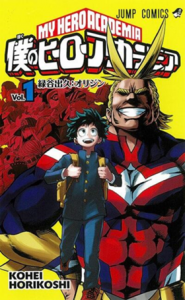
The other license is very unsurprising, as it’s the new breakout Jump hit. Boku no Hero Academia is from the author of Barrage, if anyone remembers Barrage. No? Right, moving on… it’s about a world of superheroes, and a young man who’s one of the select few who DOESN’T have them. Is he bullied? Take a wild guess. There’s a lot of over-the-top hot-blooded shouting, and the whole thing is a pile of fun.
There’s also four new Shojo Beat licenses. QQ Sweeper is a Shogakukan title from Betsucomi, by the author of Dengeki Daisy. I don’t know much about it, but the mere fact that it’s by the creator of Dengeki Daisy makes it a must buy.
Another title is from a very familiar author, it’s the latest from Arina Tanemura. 31 Ai Dream (Idol Dreams for NA) is about a woman who, regretting her choices in life and seeing her high school crush at their reunion with another woman, considers suicide. But then she gets a second chance (as one inevitably does). This is actually running in Hakusensha’s Melody (a shoujo/josei hybrid magazine) rather than her usual Ribon or Margaret stuff for Shueisha, so I suspect it may be a bit darker or more mature.
And recently they announced two more. From Kadokawa’s shoujo magazine Asuka we have Bloody Mary, which, well, vampires.
More interesting to me is Honey So Sweet, despite seeing ‘meek girl, gruff seemingly scary boy’ as the premise. It runs in Bessatsu Margaret.
Crunchyroll has a new digital license, Persona Q: Shadow of the Labyrinth. I assume this is based on the Persona series of video games, about which I know very little except that many of my friends and acquaintances are obsessed with it. There seem to be two versions, one for P3 and one for P4, that run in Shueisha’s Bessatsu Shonen Magazine and Shonen Sirius, respectively.
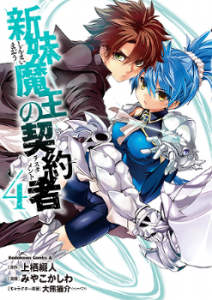
Seven Seas had a tabletop game announcement, and good luck to them. Moving on: they also announced some manga. Shinmai Maou no Keiyakusha (The Testament of Sister New Devil) is based on the light novel of the same name (no, they haven’t licensed that – you do know this company, right?), it features a young man who finds his father has remarried and he has two new sisters – only they’re a demon lord and a succubus. It runs in Kadokawa Shoten’s Shonen Ace, and will definitely appeal to those who read that description and did not roll their eyes.
Jitsu wa Watashi wa roughly translates as “Actually, I’m a…” and the cover features various characters all holding fingers to their mouths in the standard Ssssh! gesture. It apparently features a young man who is known for being unable to lie, and his run-in with various girls who all have secrets to keep, mostly supernatural. If you guessed that a harem ensues, you’re right. Hijinks also ensue. The art is very popular as well, though be warned those are some big mouths. This runs in Akita Shoten’s Weekly Shonen Champion, which rarely gets much attention over here.
Vertical had some new stuff to talk about. Ninja Slayer is a novel series supposedly created by two Americans, though many suspect this is just a cute marketing gimmick on Enterbrain’s part. In any case, it also has several spinoff manga, one of which, Ninja Slayer: Machine of Vengeance, ran in Kadokawa’s Comp Ace magazine. I believe it’s complete in one volume.
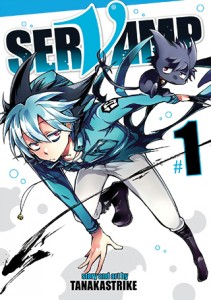
Seraph of the End is a manga series that Viz has licensed, which features, you guessed it, vampires. But it’s based on a novel series that Kodansha puts out, and Vertical have licensed the original novels. I wasn’t wild about the manga, but might give the books a try.
Lastly, and most importantly, we have Kizumonogatari, part of the long-running Monogatari series by Nisioisin, creator of Medaka Box, which you may have heard me banging on about once or twice, and Zaregoto, a series I deeply loved that did very poorly indeed over here. This is actually the third of the series, but takes place before any of the others, and the agent recommended starting with it. I absolutely cannot wait for it. By the way, Vertical have said they’ve ONLY licensed this book – they may license more if it sells well. Ergo, please buy this book. I will be pushing it hard. (And we all know how much my opinion drives sales.) I’d give you a cover image, but it’s part of the ‘Kodansha Box’ line, so the covers are all boxed art.
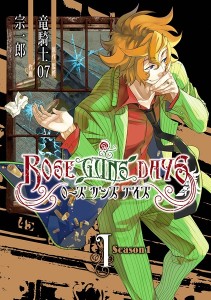
And Yen Press also has a few new things. To my delight, we have a new manga based off of Ryukishi07’s sound novels. This time it’s Rose Guns Days, which is not connected to the same universe as Higurashi or Umineko. Telling an alternate history of post-war Japan, Yen has licensed ‘Season One’, which ran in Gangan Joker. The artist is Soichiro, who also did Alliance of the Golden Witch in the Umineko series.
Final Fantasy Type-0 Gaiden: Hyōken no Shinigami could possibly be a part of the massive Final Fantasy universe. Something about the name suggests that to me. It ran in Shonen Gangan.
Horimiya has an intriguing history. There was a webcomic called Hori-san to Miyamura-kun which GFantasy picked up and released 10 volumes of, and it also spawned an anime. Now it’s getting an official manga with a different (most say better) artist, and that’s 6 volumes and counting and also running in GFantasy. The plot seems to be a sweet and sometimes angsty romantic comedy, and it has the usual ‘is this shonen or shoujo?’ feel you see in many GFantasy titles.
Lastly, Yen On had a new announcement, one many of us have been expecting for some time: The Irregular at Magic High School. This was the #1 light novel franchise over the past year, even managing to beat out Sword Art Online and Kagerou Daze. Its male lead seems to be the emotionless stoic badass, which I suspect may be part of its appeal after years of average schlubs starring in these sorts of vehicles. It’s got quite a few volumes… but honestly, after Index, nothing surprises me anymore. It has a couple of manga spinoffs… oddly, Yen haven’t licensed the Square Enix one, but have instead opted for the Dengeki Daioh version, The Honor Student at Magic High School, retelling the story from a different perspective. This might work out well – I’ve dropped a few manga adaptations that just tell the novel straight up.
That should do it for now. Which of these has you most excited?