Genshiken: Second Season, Vol. 5

By Shimoku Kio. Released in Japan by Kodansha, serialization ongoing in the magazine Afternoon. Released in North America by Kodansha Comics.

I’ve reviewed the last couple of volumes of this sequel to Genshiken in Bookshelf Briefs, and have remarked several times that it almost feels like they’re trying to aim for a new demographic with all of the new cast being of a more BL tilt, and the graduation of most of the previous players. That said, there are still characters dropping in and out throughout, and Madarame has been a constant, if smaller presence. Well, that changes here. The new volume starts with a definitive ending to the most talked about plotline of the old series, and helps to set up a new one that will also star Madarame, who has never been the viewpoint character but has always been the face of Genshiken, so to speak.
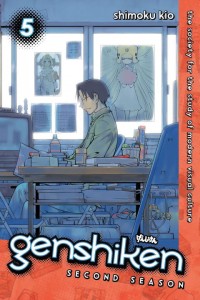
genshiken2-5

The old plotline is, of course, Madarame’s crush on Saki, and the fact that she’s been sort of aware but ignoring it. Last volume she admitted this, and the rest of the club set things up so that they could be alone and he could confess. No one – not even Madarame – seriously expects anything but a rejection. After all, Saki has been dating Kousaka since the series began, and while the majority of fans aren’t really thrilled with that, their love for each other has never been in question. (In fact, the scenes with Kousaka here are some of his best, as I finally begin to understand a character I’ve always had trouble with. As for the “confession” itself, it was very Genshiken, being both hilarious and heartwarming, and the aftermath slips to purely being the latter.

It feels like an ending, as Kio himself lampshades, but there’s still a lot of things to resolve. For one, as Saki notes, Madarame is busy obliviously gathering a harem of his own. Keiko gets a lot more face time here, and we see more of why she’s interested in someone with all the baggage that Madarame has – baggage that gets worse when he decides to quit his job, saying himself he wants to see how far he can fall. As for Hato, his crush on Madarame, if it is one, is still wrapped up in his own identity, which is in flux. This is painful for him, and it’s almost reminiscent of Wandering Son at times, except Hato is far less accepting of his own desires. Having Hato and Madarame intersect like this is a perfect plot – they’re the two most interesting characters of all of Genshiken.

Other than that, it seemed appropriate to devote a chapter to Ohno and Tanaka, who are almost the forgotten couple of the manga (partly die to Tanaka mostly being together about thin gs – even here he’s the adult.) This is also quite cute, and has a nice heartwarming scene that could be construed as a proposal – that’s certainly how the club takes it. And while there isn’t much Sue, the cliffhanger makes me think we may get more of her next time. Genshiken hasn’t forgotten about its old fans, but still has plenty for new readers. If you enjoyed the series before, this volume will not disappoint you.

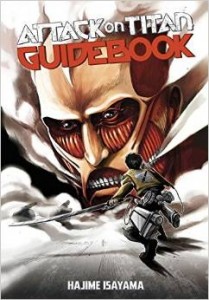
Attack on Titan Guidebook

By Hajime Isayama and the editors at Kodansha. Released in Japan by Kodansha in two separate volumes, “Inside” and “Outside”. Released in North America by Kodansha Comics.

Shonen manga in Japan get quite popular, and as you’d expect, fans want to know absolutely everything about their favorite characters, things that wouldn’t necessarily come up in the manga proper. For those people, there are guidebooks like these – they consists of bios, recaps, examinations of all the little fiddly bits, character popularity polls, favorite quotes, etc. They allow the creator to reveal some information that would likely fit awkwardly if it had to be inserted into the story proper, and let fans understand the characters and story better – OMG, Jean is an Aries! Just like me!

tit

For those familiar with these sorts of guides, the style is unsurprising, but if you aren’t, be prepared for lots of superlatives. At times it reads like a gossip magazine, with lots of punchy headlines and exclamation marks as it tells the story of the 104th training squad. These are two books released separately in Japan joined together, and sometimes you’re able to see that – the book has spoilers through Vol. 11 of the series, but much of the first half seems to have spoilers only through Vol. 9. It can also be somewhat inconsistent – the book takes pains not to discuss Reiner and Bertholt’s secrets in their bio, but has no issues revealing Ymir’s.

There’s a long interview with Isayama where he discusses the major influences on the series – many may be surprised to here one of the biggest was Muv Luv Alternative, though those who have read the visual novel itself may be less surprised – it’s darker than Higurashi. I was less surprised to hear about the influence of Saving Private Ryan in regards to the emotional reactions of the soldiers. The workings of the manga industry are briefly shown, as Isayama discusses how he was asked to move to a more expensive apartment so that he could fit his assistants in it – but then had to make the series a success or he couldn’t afford the apartment!

Where the guidebook excels is in giving a name and backstory to the minor characters like “girl who dies in Volume 2” or “that one guy whose name I can never remember”. Isayama’s art is terrible, especially at the start, and this guide is a boon for those who can’t really tell apart the 5-6 different soldiers with short blond hair. There’s also a lot of discussion of the mechanics of titans and how the vertical gear works, and to show it’s not all grim darkness there’s also some cute fake interviews with the cast, and Isayama drew some AU art based on reader suggestions, such as Sasha, Connie and Reiner forming a band.

Obviously this is not something that you want to pick up if you’re new to the series and wish to see what it’s about. Read the actual manga instead. For those who are fans of the manga, though, this gives you lots of facts and figures, reminds you of your favorite moments, and is a good go-to reference guide. Also, I think the original must call Sasha a boke about 80,000 times. “Airhead” is the translation here.

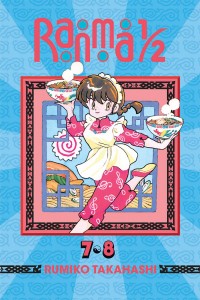
Ranma 1/2, Vols. 7 & 8

By Rumiko Takahashi. Released in Japan by Shogakukan, serialized in the magazine Shonen Sunday. Released in North America by Viz.

I’ve joked several times in the last few weeks about warning people that this volume features the debut of Happosai, but there’s a kernel of truth to that warning: Happosai is repugnant, and a polarizing figure both within Ranma fandom and within the series itself. Not because anyone really likes him – even his fans think he adds some fun comedy but don’t like him personally – but whether the comedy he adds to the series is really needed. Because Happi is defined by being a pervert – yes, an incredibly strong martial arts master pervert, but a pervert just the same. He feels up women, he steals their underwear, he literally gains strength through contact with females. He is a walking trigger warning. He’s meant to be the male version of Cologne, but Cologne’s actions all serve a greater purpose – at least so far – and Ranma learns a great deal from her. For all that Happi is supposed to be training Ranma as his successor, there’s no lessons, no training, and no point. He is a pox on Ranma 1/2, and will be here till the end of the series. He doesn’t even make horrible puns, like Cherry, his spiritual predecessor from UY, did.

ranma7-8

(breaths out) I feel better. Now let’s talk about what was fun this volume. Ranma has settled into doing what it does best, which is ‘almost anything goes in the name of comedy’. (It’s not *quite* as over the top as UY, so I added the ‘almost’.) There’s lots of martial arts battles, as we see Ranma, Akane and Shampoo compete in martial arts takeout delivery, as well as Akane and Ranma fighting to defend the name of their supposed school when a Dojo Destroyer comes to town (the Destroyer himself looks like a ridiculous over the top stereotype, and barely speaks, but I’ll gloss over that for now. And there’s plenty of comedy, as Ranma’s class puts on a production of Romeo and Juliet, which means a lot to Akane (who was Romeo as a kid, but now finally gets to be Juliet), but little to any of the various competing Romeos, including Ranma. (I was highly amused to see her yelling at Ranma for not reading the play, as in the end all Takahashi takes from the original is ‘balcony scene’ and ‘kiss’.)

There’s quite a lot of time devoted to Ranma (and sometimes Genma) trying to find a cure for the curse, and there are a few temporary cures but nothing really permanent. While this will still play out across the series, as we get further in Ranma simply gets more accepting of his dual nature, and seeing the desperation shown here is interesting. As for Ranma and Akane themselves, they’re both quite attracted to each other and sympathetic to each other’s pain once they pause to think – but they hardly ever do that anymore, so when we do see such moments (Akane bringing Ranma warm food and drink in the backlot), it’s nice and heartwarming. (The box Happi hides under in that scene, by the way, has a reference to Nura: Rise of the Yokai Clan. Wrong company! Shogakukan should be turning in its grave! Don’t tell me they aren’t dead, I’ve seen what Sunday sales in Japan are like lately.)

Miscellaneous thoughts: At one point, when Genma is at his absolute sketchiest, Kasumi calls him annoying. For Kasumi, this is a devastating comment, particularly this late in the series. Both Genma and Soun come off particularly badly in this volume, both as former disciples of Happi who want to be free of him but can’t do anything about it, and as parents who try to trick their children into marrying each other. Nabiki still exists mostly as the “normal” character – we see her deny she’s related to her family more than once in this volume – and Takahashi’s habit of showing her constantly eating is in full force here. Kuno and Gosunkugi are also as loopy as ever – Gosunkugi in particular suffers so much and is loathed by so many you can’t help but laugh at his pathetic awfulness.

Another solid volume of Ranma, though those who found the series beginning to grate at this point and hoping for more plot resolution are only going to get more annoyed as it goes on. Next time around we’ll introduce our final main cast member, and one who’s even more polarizing in her own way. Not because of her own characteristics, but because of how she gave fans who hate Akane a real alternative, and the ship wars truly began in earnest. Next time, we’ll talk Ukyou Kuonji.