Black Rose Alice, Vol. 1

By Setona Mizushiro. Released in Japan by Akita Shoten, serialized in the magazine Princess. Released in North America by Viz.

I’m usually quite fond of series that try to get by on pure mood, even if the plot is not one that reaches out and grabs me. This odd shoujo series definitely falls into that category. It’s not exactly something I would read to see what happens next – the entire time I was reading the first volume, my thoughts were “Didn’t I read this in a Kaoru Yuki title 5 years back?” – but the aesthetic is glorious and gruesome, with the corpses stacking up and anguish present on every face. It’s dark, gothic grand guignol shoujo, and marks a welcome return of Akita Shoten’s titles to out shores (as well as the author of After School Nightmare).

blackrosealice

Most of the first volume is prologue to what we’ll be seeing from now on. One hundred years earlier, we meet Dimitri, who is not of noble blood but is possessed of a remarkable singing voice. He loves Agnieszka, a young and innocent noblewoman, but she’s betrothed to his friend Theodor, who, while he has been doing his best to advance Dimitri’s vocal career, will only go so far. It’s the sort of storyline that makes you await the inevitable tragedy, and sure enough, a runaway horse seems to kill our hero. But he’s not really dead, as it turns out that his body is now being used by Bradley, a vampire! If the plot sounds melodramatic, well, I hope you knew that when you purchased it.

This is a horror title, by the way, in case my use of the words ‘gothic’ and ‘vampire’ did not clue you in. There are many, many mass suicides about halfway through, and some grotesque shots of blood. Oh yes, and there’s the spiders, which is the way that Dimitri acquires blood after his victims have obligingly offered themselves to him. They’re supremely creepy, but also very effective at showing the horror of what Dimitri is becoming. There’s also a sexual assault, as a desperate Dimitri, who wants nothing more than to die when he hears what he has become, rapes Agnieska to try to achieve this. It doesn’t work.

The main part of the book looks like it’s set in present day Japan, and features a more prosaic teacher-student romance, which is no less forbidden and yet intoxicating than the previous one. Koya is trying to convince his teacher Azusa that she is not merely a schoolboy crush to him, and she’s trying to push him away but desperately unable to. This leads to her making quite a nasty bargain, whose effects we don’t quite see in this volume but I’ve no doubt will prove to resonate down the line. Also, Dimitri, who was so horrified at the prospect of turning evil in Vienna, seems to have warmed up to it now that he’s in Japan. Ah well.

I’m not sure that I’m the audience for this book, really. But I’m sure that there is a huge audience for it. Those who enjoyed the darker, more sensual side of Shojo Beat’s titles, and want another supernatural romance with vampires who are likely quite bad for you, won’t be able to put it down. The spiders may be horrible, but it’s the doomed yet overpowering love that will draw them in.


Kokoro Connect, Vol. 1

By Sadanatsu Anda and CUTEG. Released in Japan by Enterbrain, serialized in the magazine Famitsu Comic Clear. Released in North America by Seven Seas.

Generally speaking, if you’re going to be releasing a manga series based on a light novel that stars a group of high school students in a strange club, you’d better have something extra to bring to the table in order to distinguish yourself from packs of similar series. And Kokoro Connect does have a premise that shows promise, particularly if it goes the dramatic direction that it seems to be hinting at. Three girls and two boys are friends in a club, till one day they discover that the five of them have begun to randomly switch bodies, without warning and for unknown periods. After having the reason explained to them by an exposition who happened to be walking by, they have to figure out how to deal with this, particularly as they are all rather fragile teens, and many have hidden secrets.

kokoro1

The leads are all likeable but flawed. In fact, in possibly the most annoying part of the volume, we have the flaws explained by Himeko, the ‘serious student’ of the club. Our hero is told how he tends to put the needs of others before himself, and in fact is directly called a “self-sacrificing bastard”. The trouble is we’ve only known him for about 90 pages before this, and the only evidence we see is that he volunteered for cleanup duty because no one else wanted to. Likewise, one somewhat insecure, thought-provoking monologue does not really measure up against the previous scenes of a girl being happy and outgoing, so hearing that Iori is “the most likely to crack” seems a bit out of nowhere. Kokoro Connect has a “tell rather than show” problem.

This is a bodyswap manga, and so it can sometimes be difficult to recall who is in which body at the time. The usual manga shorthand is to see either a ghostly presence of the real person behind the swapped one, or to show a SD-caricature of the real person in the speech balloon. This volume does both, and I think the latter works better, as the doubling can look confusing. Other than that, though, the artwork is appealing and cute. There’s also a healthy dose of humor scattered throughout. I could have done without the ‘oh my god teenage boys are perverts’ stuff, but if I wanted to avoid that I’d have to drop manga altogether. And the “solution” to Yui’s issues with men did make me laugh, I will admit. As for romance, it seems to be a ‘one guy and two girls who kind of like him’ story, with a ‘backup couple’ thrown in. The backup couple get the most development here, which tells me that the majority of what’s to come will likely focus on Iori and Himeko.

Mostly, though, I think this first volume made me hope that things improve in the next four (It’s a 5-volume series). It’s an intriguing premise, and I think it does show promise that it could take advantage of that, but right now it feels like it’s trying too hard. Let’s hope it finds its feet in the next volume.

D-Frag!, Vol. 1

By Tomoya Haruno. Released in Japan by Media Factory, serialization ongoing in the magazine Comic Alive. Released in North America by Seven Seas.

An action manga can get away with a chapter or two with no fighting. A romance manga relies on there being little to no resolution for volumes at a time. But a gag manga has to have gags, or else it runs the risk of failure even after only a chapter. Being funny, on a long-term basis, can be quite difficult. Most writers therefore try to balance out their humorous manga with other elements, such as the aforementioned fighting or romance. When you do see an author that tries to pull off straight-up gag manga, then, it’s an impressive thing. Particularly if it’s been licensed in North America, whose gag manga litter the shores of the river Styx. D-Frag! is not quite PURE gag manga, such as Bobobo-bo Bo-Bobo or Cromartie High School, but it comes pretty damn close.

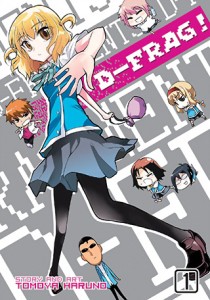
d-frag1

I’m not exactly sure what the title is supposed to signify, as the manga has nothing to do with defragmenting your hard drive. Instead it’s a variation on ‘straight man guy joins a really weird club’, only without the strong personality of a Haruhi or Kyon. Kazama wants to be a delinquent, but is honestly too nice and well-meaning. He’s tricked into joining the “Game Development Club”, whose members include a thug (who’s also student council president), a jock, a space cadet, and the teaching advisor, who is usually mistaken for one of the students. The plot, such as it is, starts when he finds out there’s already a Game Development Club – the ‘real” one, so to speak – and that the club he’s now joined is a fake offshoot.

If this doesn’t sound like much to hang a plot on, well, you’re right there. The only member of the real club who matters is Takao, who fell out with one of the fake club members and is trying to make up with her by being stubborn and screaming a lot, in the traditional manga way. She also has a large chest which is frequently commented on, lest you worry that Comic Alive had suddenly turned into some other magazine. Seeing her interaction with Roku is nevertheless a highlight of the volume, and leads to the only (very brief) serious moments. Much of the rest of it is the eccentric personalities of everyone involved, and Kazama’s tsukkomi reaction to their antics.

Another impressive aspect of this first volume: there’s little to no romance suggested. Now, this may change, but I greatly enjoyed that this manga is not a harem manga with gag elements, but devoted entirely to being weird and silly. Kazama is far too busy trying to figure out how to deal with anyone to find them attractive (his preferences are apparently towards big breasts, but even this is used as gag fodder), and girls such as Roku seem more content to simply have him around then have an unrequited crush.

This sort of series is dangerous to read, because if it loses its humor and pacing, it could crash very fast. But Vol. 1 is a solid start, and I laughed out loud several times. I’m interested in seeing where it goes.