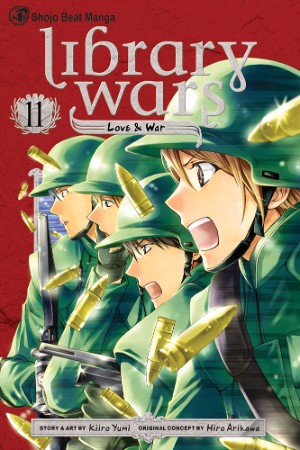
Library Wars: Love & War, Vol. 11

By Kiiro Yumi, based on the novel by Hiro Arikawa. Released in Japan as “Toshokan Sensou: Love & War” by Hakusensha, serialization ongoing in the magazine LaLa. Released in North America by Viz.

While there are an unlimited amount of things that you can do when you write a shoujo manga, it has to be said that when a typical reader thinks of one, they tend to think of a basic ‘type’. Kids in high school, girl likes guy, guy eventually likes girl, will they get together, etc. Violence, if any, tends to be emotional brutality or done for comedic purposes. (I recall I Hate You More Than Anyone having to include a ‘note: genuine shoujo manga’ remark after one of its typical over the top gags.) Library Wars runs in LaLa, a magazine which has a large number of these sorts of shoujo manga. So it’s startling to see a full-scale military assault, with blood, casualties and a shaking up of our main cast, with a couple of people seemingly written out of the series.
librarywars11

This is not to say that the series subtitled Love & War is entirely devoid of love this time around. It’s just driven or inspired by the aftermath of the Ibaraki Art Exhibit. Things start off bad with one of the library team’s men getting his arm sniped so he can’t shoot, and get worse when a desperate frontal assault by the enemy means that Iku is forced to shoot them. No one is killed in that particular attack, but it still leaves her a complete wreck – and she’s not the only one, as Dojo points out. The battles we’ve seen before were not like this. It doesn’t even end there, as once everything settles down, a lone man coming in to destroy the exhibit finds himself stopped by Genda… who he them shoots multiple times through the chest.

Amongst this, we have the love. Iku has finally realized her feelings for Dojo are love, much to the satisfaction of Shibazaki, who has known this for ages. Shibazaki and Tezuka get into a brief fight over what his brother was planning, and how much she knew about it (it also has an excellent point about when to reveal info that could potentially devastate the troops – the answer is not before a major battle). Even Genda and his estranged lover have a sort of reconciliation at his hospital bed. There are warm fuzzies here to be found if you so desire.

But mostly what I take away from this volume is what it means to be a soldier, and how trying to defend your beliefs can lead to the use of force. The opinions given here are biased towards the library soldiers, of course – they’re our heroes. The ‘nonviolence’ protestors are papers tigers for the most part, serving mostly to get Iku really, really angry. As we reach the end of this volume (which finishes adapting the 3rd novel), you sense there’s a major shakeup in the works. Commander Inamine is forced to resign, and I get the feeling that the implication of Genda’s 2-rank promotion is that he won’t be back either. I’m not sure where this battle-filled shoujo manga is going, but this was one of its most gripping volumes. Readers who thought it started slow may want to give this a try.

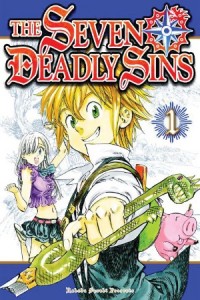
The Seven Deadly Sins, Vol. 1

By Nakaba Suzuki. Released in Japan as “Nanatsu no Taizai” by Kodansha, serialization ongoing in the magazine Weekly Shonen Magazine. Released in North America by Kodansha Comics.

This is a title that’s been getting a lot of buzz recently, so it does not surprise me that Kodansha picked it up for release over here. It has a lot of what makes a successful Shonen Magazine title. The hero is incredibly strong and also cheery and outgoing, the female lead gets involved in a lot of fanservice moments and also gets to be cute and determined, there’s a talking animal put in there for no real good reason, and a big good guys unite to defeat the bad guys plot, with the twist that the good guys *are* the bad guys of the past. Supposedly.

sevendeadly1

This is a fairly new manga, having started last year. I note this because while reading it, the thing that struck me was how old-fashioned it felt. Meliodas is a giant pervert who tends to feel up the heroine and steal her panties, which could be out of any ecchi shonen comedy from the 70s and 80s. The trouble is he seems so blase about it – there’s no sign he’s actually aroused or anything, a la Ataru Moroboshi. It’s just his character trait. Likewise, Elizabeth does occasionally get embarrassed when fanservicey things happen to her, but compared to most heroines today, she’s strangely passive about things. Both of them clearly have more to their past that hasn’t come up yet, Meliodas especially, but there’s just that something about them here in the first book that seems like the author wants to use modern tropes, but in a 1980s sensibility.

We’re definitely in ‘shonen fantasy land’ here, what with talking pigs and giants. Diane is introduced right towards the end, and seems to be in love with Meliodas, though given their respective sizes I can’t imagine this relationship is anything but frustrating. On the other side, we meet a Holy Knight, Gilthunder, who seems to radiate an aura of smugness that just begs to be removed. Which is all you can ask of your villain, really. The action scenes are mostly well done, with a few 2-page splashes that show off the artist’s talent. By the way, Suzuki began in Jump, then moved to Sunday for his popular Kongou Bancho series (which I would love to see Viz license, but it’s a delinquent series, so no…), and is now in Magazine with his breakout hit.

If there’s anything wrong with this series, it’s stuff that seems to be ‘first volume problems’. The characters are just getting introduced and so lack the depth we know they will gain. Meliodas seems to be a bit blase for a hero, but then again this runs in a magazine where he’d be compared to Natsu from Fairy Tail anyway, so perhaps it’s best not to get him too fired up. I could also do without the panty flashes and boob grabs, but then he did move to shonen Magazine, so he has to meet their basic standards of fanservice. In most respects, however, The Seven Deadly Sins is a promising debut with two quirky but likeable leads. I’ll see where it goes.

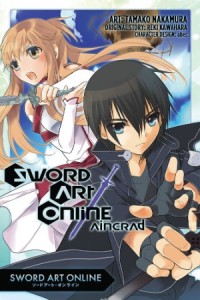
Sword Art Online: Aincrad

By Reki Kawahara, abec, and Tamako Nakamura. Released in Japan in two separate volumes by ASCII Mediaworks, serialized in the magazine Dengeki Bunko. Released in North America by Yen Press.

I have to admit that this one took me entirely by surprise. I wasn’t really expecting much when Yen announced this. “Oh no, we are trapped in a virtual reality game where we must fight or die” is something that has become almost as overdone as “oh no, what are these strange feelings I have for my older brother” in anime/manga, and watching people cut things with swords has never been my thing. I also don’t game. It’s also based off of a light novel series, and I was thus expecting the manga spinoff to be somewhat rushed (and indeed, it does feel rushed) and filled with fanservice (actually very little of this, save one “oh no, I accidentally fell into her breasts” scene that just made me sigh loudly). However, it was the relationship between the two leads that drew me in. Because it is a genuine relationship. Wasn’t this a harem manga?

sao1

Backing up a bit, the premise has 10,000 players in a new immersive fantasy game trapped by its sadistic creator, who wants them to get to the 100th level of the game. Oh yes, and if they die in the game, they die in real life. Our hero is Kirito, who was one of the game’s beta testers (but unaware this was going to happen), and is fairly cool and aloof to everyone he meets. Our heroine is Asuna, a nice girl with drive and purpose who wants to join forces with Kirito so they can finish this faster and finally go home. Clearly they are destined for each other, despite a rocky start. I wonder how many volumes it will take before they realize their true feel… oh, wait, OK, that was fast.

For all the flaws that occurred to me after I finished the volume, the thing I loved most was the relationship between Kirito and Asuna. There’s an immediate attraction, they both risk their lives for each other, and because there is a setting in the game for ‘let’s have sex’, they do so (non-explicitly) about halfway through the book. And then get married. And even briefly have an adopted kid, though it turns out this is more than it seems, and ends in tears for both of them. They’re just really likeable kids, and bring out the best in each other – Asuna is someone that Kirito desperately needed, particularly after his last attempt at working with others.

I’m not sure that this is the sort of relationship that will last when they end up back in the real world and aren’t dealing with adrenaline rushes and near death experiences. The volume ends with Kirito (sorry, Kazuto… damn fake names) awake in a hospital, resolving to find Asuna but it’s very open ended, and given the series is 13+ light novels in Japan, I expect it may not be as simple as it seems. I’ve also been told that future volumes of this series (or at least the anime adaptation thereof) are far more… contested, shall we say. And I will admit that Kirito does seem to have the scent of ‘boring invincible hero’ to him, though honestly, I’ve read Index/Railgun, and it’ll surprise me if anyone tops Touma. As for me, I am quite content with what I saw in this volume, and will be eagerly awaiting the light novel when it appears next month. Despite all the swords, this was sweet and romantic.