By Rumiko Takahashi. Released in Japan by Shogakukan, serialized in the magazine Shonen Sunday. Released in North America by Viz.
(pre-review note #1: I use ‘Ryouga’ and ‘Ukyou’ when I romanize, though otherwise stick to Viz romanization. It’s a 90s fanfic writer quirk that I am unlikely to break the habit of, as I am stubborn.)
(pre-review note #2: Few comment on my reviews anyway, but just in case: please do not character bash in the comments, at all.)
It’s quite odd seeing reviews of the new Ranma 1/2 omnibus from people who haven’t read it before, as they talk about all the craziness that simply doesn’t register with me anymore. I am almost saturated with the first two volumes of Ranma contained here. Not only have I read it when Viz first released it in 32-page pamphlet comics, and then again as collected works, but so much Ranma fanfiction uses the same opening as a springboard for its own ideas (or lack thereof) that I can almost recite some of the dialogue. “And I’m better built to boot!” “She’s really a sweet girl, she’s just a violent maniac.” And so many others. So, in a sense, there’s no real way I can review this for a newbie. As such, this is more of a look at Ranma in retrospect, and will be liberally laced with spoilers. Short review for those who don’t want to read on: Ranma 1/2 is a lot of fun, and in these first two volumes you can see Takahashi shift her characters to where they are funniest.
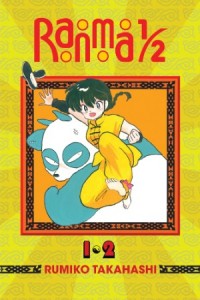
For those who picked up the last iteration of Ranma, the scans used do look better – there’s still no color pages (there weren’t in the Japanese volumes either), but it’s not as dark and muddy as it once was. The translation is ‘spiffed up’ a bit, but is still essentially the same, so anyone who wants honorifics is out of luck. There’s a bubble order error on Page 1 (which everyone has noticed), but otherwise things seem well put together.
It’s worth noting that this was the new series Takahashi had in Shonen Sunday to replace her breakaway hit, Urusei Yatsura. For all that it repeatedly failed in North America, the manga was an instant classic in Japan, and I imagine there was some pressure on her to keep the comedy she did best while making things slightly different. Akane in these first couple of volumes is not all that far off from Shinobu Miyaki, Ataru’s long-suffering childhood friend and ex-girlfriend. Same general sweetness when not placed in stressful situations, same hair-trigger temper, same ability to beat up anyone who activates that hair-trigger temper. As such, it’s refreshing that Ranma is so different – at least at first. Sure, he shoots his mouth off without thinking, but he’s quite observant here, noticing people’s emotional states without commenting and playing off that. Most importantly, Ranma’s interest in scoring with women is zero, and this will not change for the next 18 omnibuses after this one. Ataru was a giant lech who wanted every cute girl in the universe. Ranma has issues dealing with girls, and tends to prefer fighting instead.
As for the others, Genma comes from a line of horrible Takahashi fathers that extends from Mr. Fujinami all the way to Rin-Ne’s horrible debt-ridden dad. Genma is obsessed with fighting and training, but is too dumb to listen when people tell him there’s a cursed spring ahead – though, to be fair, so is Ranma. He also tends to stay in his panda form almost as much as Ranma does his girl form, possibly for the same reason – he looks cuter that way. Meanwhile, Soun is something of a nonentity, and this will not change much either – his observation is the opposite of Ranma, as he is in the bath when P-chan leaps in and Ryouga leaps out, but presumably does not ever think “should I stop this man with a pig curse from sleeping with my innocent daughter every night?”.
Kasumi and Nabiki seem quite different at the start of the series. Nabiki is the ‘normal’ girl, who’s clearly OK with being engaged if the guy is cute, but is unwilling to put up with the guy being weird – which Ranma definitely is. Kasumi seems actually vexed at several points in Chapter One, and talks about how she prefers older men – clearly meant to hint at the start of her plot with Dr. Tofu that goes nowhere. As the volume moves on, though, we see the light bulb go off over Takahashi’s head as to how they’ll be handled in the future. With Nabiki it’s selling the photos to Kuno, something for which she is gleefully unapologetic. It’s the start of something big. And Kasumi gets to visit Dr. Tofu, but he’s so oblivious to anything and everything while she’s around that it’s obvious to anyone what she does to him – obvious to anyone but her. Kasumi’s breezy Yamato Nadesico-ness, and her tendency to think the best of everyone while missing the darker points, will become her standard character trait.
So far, the only supernatural aspect of Ranma we’ve seen is the curse itself, as opposed to Urusei Yatsura’s aliens bringing the excuse for any sort of plot whatsoever simply by virtue of being from another world. But that’s OK, as Ranma is far more focused on fighting. Not only are Ranma and Genma perfecting their own style of Japanese martial arts – which utilizes many different styles, most of which I suspect are ‘what looks really cool?’ – but we also get to see Akane’s kempo-influenced style (her family and Ranma’s supposedly have the same ‘anything goes’ background, but Akane has not been training around Asia for the last 10 years either) and Kuno’s kendo training with a wooden sword. Ranma is shown to be an excellent fighter, but is thankfully not perfect – he tends to underestimate his opponents, such as Kuno and Ryouga here, and ends up not giving his best effort till he’s already injured as a result.
Speaking of Kuno and Ryouga, let’s talk about them. Shutaro Mendou had his moments of complete idiocy, but could at heart behave like a normal person if pressed or girls were watching him. Tatewaki Kuno has no such normalcy filter, for reasons that we won’t find out for some time but are essentially similar to Ranma’s – “boy, my entire family is screwed up”. It’s worth noting that he and Nabiki interact purely by dint of being in the same class, and he even notes casually that he despises her at one point. Well, that’s one ship sunk. No one could possibly write Tatewaki/Nabiki after reading that. :) As for Ryouga, what most struck me wasn’t all of the anger he possesses – Ryouga is an out-of-control berserker here, with none of the sweetness and depression that will flesh him out later – but how much he looked like Ataru. It won’t be as obvious to those who haven’t seen the final few volumes of UY – Takahashi’s art evolved exponentially during that series – but put a bandana on Ataru by the end of UY and he’s basically Ryouga here. Ryouga, notably, DOES have a libido, but knows better than to do more than snuggle in Akane’s boobs as a pig – we don’t have a true lecherous pervert in the series. Yet.
I was amused at Ryouga not caring about Akane at all during the first fight – Ryouga tends to be focused only on fighting and revenge in this volume, and it’s only when Akane kisses his pig-form that he’s smitten – possibly as it’s the most affection he’s ever gotten from anyone. Ryouga’s sense of direction also comes up for the first time here, and it’s already exaggerated to its maximum – we see him at the Northern and Southern ends of Japan. As for P-chan, his arrival in the Tendo household sets up an obvious tension about how long it will be before his secret is revealed and Akane finds out who he is. The answer, of course, is never – this never comes up, likely as Takahashi knew it would require a response that would be too serious to cope with in the series.
Other characters we’re introduced to include Dr. Tofu, who’s an excellent doctor who’s useless once he sees Kasumi. This was once an amusing running gag, but seeing Tofu suffering the same effects when he sees a middle-school Kasumi show up with her elementary-school aged Akane feels horribly creepy now, and I won’t be sorry when he’s quietly phased out of the manga in a few more volumes. We also meet Kodachi, though she barely gets to appear before the omnibus ends. It’s still enough time to see that she’s a little bit crazy, and also tends to win her matches by crippling the opponent beforehand. As for her own family situation, it will have to wait till next time.
Lastly, it’s worth noting how well Ranma and Akane get along, despite the bickering and occasional misunderstandings. Usually everything is resolved in a chapter or so, and Ranma is not QUITE as thoughtless as he gets later on. They have common interests, and tend to work well when fighting together. Takahashi had gotten burned on UY when Lum became so popular she had to change the story to make her the lead girl, and though she came to approve of that, it wasn’t going to happen again. So here we get two whole volumes setting up how well Ranma and Akane go together, with the villains/rivals that we see so far mostly being comedic and/or focused entirely on revenge against Ranma for non-romance reasons. It will take a villain of a higher caliber to really create the first big rift between these two, one that will leave self-confidence and trust issues that never really get settled throughout the series. But Shampoo is in the next volume. For now, we’re introduced to Ranma Saotome and the craziness that surrounds him, and there’s a lot of it. If you’ve read Ranma, read it again. If you haven’t, go read it. And for God’s sake, please don’t take it seriously! That’s the WORST thing to do with this series! (looks up at backscroll, coughs a bit)