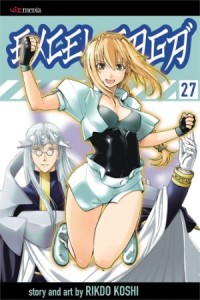
At last, after 11 years, we have the 27th and final volume of Excel Saga translated. To sum up my review, I was pretty much satisfied with the ending. it still managed to be very confusing, and I’m still a bit iffy on the details of Il Palazzo’s origin and the Cores, but emotionally, the story hits all the right beats, and thematically, it resolves itself beautifully. With that in mind, let’s go through some things one by one and see if we can dig deeper into things, though in no particular order.
Misaki and Iwata, first of all. We started the series off with Misaki as pretty much the only one in the entire group who had normal reactions. Indeed, the one time we were supposed to infer that she was upset and blushing deeply, she had her back to us so that we couldn’t see her expression. I have no doubt that Rikdo was doing this deliberately to save it all for this ending. Misaki’s had a very bad last few days, and her nerves were already starting to get a little shredded even while they were trapped in ACROSS’s base. Then she has to deal with Iwata, who she’s always had complicated romantic feelings towards, having sacrificed himself for her. Except… as they arrive back at their own base, it turns out that this was in fact a robot controlled by Iwata while his body healed – a fact that Umi is rather surprised everyone was not aware of.
While Iwata’s robot body has, at times, been occupied by various opposing forces, I think we have to accept that some of the time we’ve seen him act more maturely it has actually been him acting more maturely. Character development in Excel Saga is rather hit-and-miss, to be honest, but if we can accept that Misaki has come to terms with her feelings for Iwata – as she seems to do after the big reveal here – than we have to accept that Iwata has become less goofy and more heroic because of his own feelings for her. Honestly, saving her at the cost of his own life is the sort of super sentai thing that Iwata would love anyway, and I suspect even if that was his real body he’d have done the same thing.
In any event, after seeing Iwata’s malnourished but very much human body, alive and reasonably well, Misaki snaps and gives him a Big Damn Kiss. And then a Big Damn Beatdown. And then she finally cracks, sobbing helplessly in a full-page closeup, as we finally see everything catch up to her in the best/worst way possible. Naturally, for someone like Misaki this is the most humiliating thing imaginable, so it’s not surprising she immediately bolts. That said, after recovering she and Iwata have seemed to come to terms with whatever it is they have, and he’s even living with her (Mostly as he’s still legally dead), which she can deal with with only the most minor of blushes. It’s very heartwarming.
Watanabe and Sumiyoshi get less focus, but each also gets resolution in their lives, even if they can’t quite escape working for Kabapu. (I will leave the revelation that they’re all his descendents to the side, and then walk away and leave it to be thrown out by the waitress afterwards.) Watanabe gets his heart’s desire, only to have it ripped away from him when ACROSS revives and takes over the world. But then, at the very end, he does get Hyatt back, or at least “Ayasugi”. (This is actually a change from the ending in the Young King Ours magazine, but I’ll get into that later). Likewise, Sumiyoshi is alive and well, though how much he actually wanted the return of Ropponmatsu 2 into his life is questionable.
As for Shiouji and Umi… sigh. This is one of the bits of the ending I’m not thrilled with, to be honest. Shiouji being a lolicon has been with us since the moment he was introduced, though, and even though Rikdo tried to dial it back a bit and explain it through the introduction of Miwa, it’s never really gone away. As for Umi, well, she’s in love with Shiouji, and if he’s found a way to loli-fy her FOR SCIENCE, I can see her going along with it just to make him happy. But it’s not remotely healthy, as he himself indicates. I find it more interesting that Menchi ends up with Umi… I suppose it might be the closest thing to Teriha that Excel can give her. (This was also changed for the book ending.) In any case, let’s leave the scientist and his loli off to the side as well.
Momochi, it turns out, was nothing more or less than the most capable executive assistant in the world, and though I wish she’d gotten more depth, I will content myself with that. As for Kabapu, I’ve never really liked him, mostly as he’s not all that likeable. There’s a brief fakeout here where you think that Rikdo might actually kill him off, but in the end he’s back to laughing insanely and plotting wars against Il Palazzo, mostly as he really doesn’t know how to do anything else. It ends in his abject surrender much faster than usual, though, and he’s forced to dress in an embarrassing costume (not that he is remotely embarrassed by it) and join ACROSS himself Even post-invasion, he’s bored and wants to blow stuff up. Kabapu is an eternal child, really.
Hyatt and Elgala get to survive and live on Earth having some modicum of a regular life. This is a change, as I’ve noted earlier, from the original magazine ending, where Hyatt, Elgala and Menchi were forcibly abducted and taken on Il Palazzo’s ship along with Excel. It was an amusing ending, but it was a bit too cynical and comical, I expect. Seeing Hyatt get the change to start over with Watanabe (who is thankfully no longer remotely evil) and Elgala grump about life but at least no longer being a fugitive from justice, is more heartwarming. There’s also some interesting dialogue that implies that Hyatt and Elgala are similar to Excel in many ways, and it notes that Excel “fixed” them by returning them to the apartment complex like this – indeed, the core notes they were “unique failures”. Both have occasionally exhibited supernatural endurance – in Hyatt’s case, though undeath, and in Elgala’s by merely surviving being near Excel. They are untapped potential. I wish them well.
Sigh. OK, let’s talk Cores. There is still much of this I don’t quite get, I will admit, but suffice it to say that there seem to be multiple cores that can control multiple artificial humans. This is complicated by Tenmangu, Shiouji’s father and the maddest of the mad scientists we’ve seen. (Notably, his face is never quite shown, leaving him to look a lot like the hero of a dating sim – perhaps School Days, given what a loathsome man he is at heart.) He’s the one who’s seen controlling Il Palazzo – basically, he’s the “competent” Il Palazzo. There are also two cores, a chaos and an order core. The chaos core is the one that’s put into Miwa’s body – through Tenmangu – but I think it’s also what was “let out” by Excel’s hand at the cliffhanger for Vol. 26. This is the ‘horndog’ Excel we briefly see here – the core is enjoying being back in a human body, and is quite willing to experiment on Misaki, Umi, Il Palazzo, or anyone else who might want to get it on.
This leads me to a side note – how much does this tie into Holy Brownie? Holy Brownie is an untranslated/unscanlated fantasy series that Rikdo wrote for the tie-in magazine Young King Ours+ at the same time he was writing a lot of Excel Saga. It stars two ‘Brownies’ – Piola and Fio – who are sent to Earth by God to try and advance humanity by urging them to attempt impossible tasks. It was filled with nudity, sexual situations (sometimes involving minors), and comedic violence, and was a lot darker than the premise suggests, so do not ever expect to see it over here – it’s also out of print, so scanlations are also unlikely. In any case, the relationship between Il Palazzo and the Chaos Core possessing Excel reads a lot like Holy Brownie, it changes Excel’s hair black and develops ‘flat line’ eyes much like Holy Brownie, and things aren’t helped by the Core calling Il Palazzo ‘Pio’. Honestly, I expect even if I had read Holy Brownie translated, I’d still be confused, but clearly there’s a tie in somewhere here.
In any case. The Chaos Core has a lot of memories that look familiar to us – we’ve seen them as far back as Vol. 4, when Excel first got amnesia – and seem to imply that much of what went on throughout Excel Saga was carried out for the benefit of Il Palazzo. That said, Excel doesn’t really care much about any of this. We see a sort of ‘Herman’s Head’ landscape in her mind (yes, yes, go Google it), where the ‘default’ snarky Excel watches those memories and rails about how confused she is (probably speaking for the reader, to be honest). We also see Teriha, who is only concerned for the safety of Umi and the others – and once ‘reabsorbed’ into Excel, Excel suddenly grows concerned as well, so therefore we might think of Teriha as her conscience in some way. We also see a crabby military sergeant Excel type, who seems to represent the ACROSS soldier in her. The end of the manga implies she has almost infinite personalities that she can control, and the two amnesia arcs we saw in the series were different ones coming to the foreground.
Excel makes a very good point to Tenmangu here, though – she isn’t a follower who simply trails after Il Palazzo. She’s his John the Baptist, blazing a trail so that he may pass without hindrance. She’s the advance guard. And more to the point, her love for Il Palazzo is pure and innocent (given her implied creation by Il Palazzo, I think this is a good thing), so what really gets her to fight back and take over her own mind once more is the chaos core starting to make out with him – this makes her cry tears of blood. But take control she does, and once Excel is back in the house, there’s no stopping her. Remember the incompetent goofball of Vol. 1? Yeah, she’s long gone. Excel can eliminate the Chaos Core, beat the crap out of Tenmangu and make him her lackey, start a war (with many mini-Excels also strongly reminiscent of Holy Brownie) to take over Fukuoka, and eventually use a robot army to take over the world. This is how far she’s come.
…and then they’re ll bored, and decide to abandon earth and leave. Il Palazzo and Kabapu’s boredom has been an issue throughout the series, with each noting that, as Mai famously put it, “Victory is boring.” Excel has no desire to actually FIX Earth, despite its corrupt nature, or even run it via their secret organization. World Conquest is simply the end goal, and once that’s done, there’s nothing keeping her there (old ladies aside – nice final joke there, Rikdo). What matters is that she’s succeeded and pleased Lord Il Palazzo, and that the others who helped her are as reasonably happy as they can be. With that, it’s off to outer space, because that’s where Il Palazzo wants to go. It’s not a satisfying ending in terms of the plot so much as a satisfying ending in terms of the mood. The themes of Excel Saga are resolved.
Favorite moments in this volume:
—Possessed Excel groping Elgala and Misaki, one last blast of fanservice from our perverted author.
—the aforementioned crying blood
—the shot of Excel holding her arm back from killing everyone in the room
—”Umi, you’ve got to call her name LOUDER!”
—”Is it your core that feels sad?”
—’Il Palazzo’s dramatic rope pull to save the day (briefly)
—all of what follows, as Excel reaffirms her core values and defeats the Chaos Core
—”Whoa, check it out! It’s like a solidified mass of my abstract loyalty!”
—”Doing things is what I, Excel, do!” (What would Elgala say about Excel stealing her speech patterns?)
—the cliffhanger with Misaki falling into the abyss
—Iwata’s Big Damn Hero moment
—Misaki’s complete breakdown
—Elgala and Hyatt’s faith in Excel, complete with “she wouldn’t die even if you killed her”.
—Kabapu falling asleep, looking as ancient as he ever has.
—”IS THIS THE DRUNKARD’S DEN?!”
—seeing Dr. Black Jack and his nurse, as well as our favorite Matsumoto parodies, one last time
—the last third of the book essentially being Excel Saga’s Greatest Hits
—Golgo 13 Hyatt, with little chibi-Excels
—the “fuck everything” expression on Misaki, Iwata and Sumiyoshi’s faces
—Elgala strapped into a dangerous death machine, just because we needed her humiliated one last time
—”Suicide bombers are so lame.”
—Misaki dressed as an ACROSS member
—Kabapu’s ridiculously tight-crotched outfits.
—Excel browbeating Tenmangu
—the Excel Robot Army conquering the world in two pages
—Watanabe and “Miss Ayasugi” meeting cute – again – and Elgala’s disgust at this
—the final two page spread of Excel, happy and content in Il Palazzo’s arms
I offer tremendous thanks to Carl Gustav Horn, Kyoko Kondo, Viz Media, and everyone involved in bringing us this series. My love knows no bounds. It’s also entirely available digitally in North America, for which I thank Shonen Gahosha giving permission. I love this series to death. Go buy it. HAIL IL PALAZZO!