By Hajime Isayama. Released in Japan by Kodansha, serialization ongoing in the magazine Bessatsu Shonen Magazine. Released in North America by Kodansha Comics.
(Note: this review is based on a copy provided by the publisher. Also, this review spoils this volume even more than my reviews normally do. I recommend reading it first. Also, don’t discuss post-Vol. 10 spoilers in comments.)
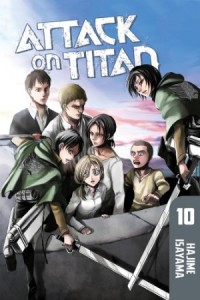
This is not exactly a relaxing, peaceful volume of Attack on Titan. Not that we’ve seen any of those to date, but this one in particular is pretty much wall-to-wall action, with only a few flashbacks to distract us from what’s going on. We get a few more Survey Corps deaths, as the Titans show that when they’re led by a clever bastard (the Beast Titan), they can be nastily effective. Luckily, so can our heroes, as even without gear on, they manage to take on a couple of Titans and survive, though not without injury.
This does lead to one of my favorite funny bits in the series, where Krista tears her skirt to make Reiner a sling/bandage and Ymir, watching silently from the sidelines, says “Hey, Krista, my hand got skinned.” Those of us watching Ymir from the start, however little attention has been paid to her until the previous volume, know that whenever she’s seen she’s looking at Krista, or protecting Krista, or otherwise does not have context without being next to Krista. After this volume, I think it’s pretty safe to say that Ymir is in love with Krista. (Indeed, the author’s website notes it is a romantic attraction.) Of course, this being Attack on Titan, that doesn’t mean it’s a healthy or pure love. Ymir and Krista both have issues beyond simply fighting Titans.
I must admit, I’m not really sure how well Krista’s martyr complex has actually been telegraphed in the story besides Ymir simply stating it. We do get a flashback after the fact to try to explain it, where we see more of what I’ve taken to be their usual relationship – Ymir being cutting and nasty, Krista being stubbornly nice to the point of near-death – as they try to rescue a wounded colleague in the middle of nowhere during the winter. Of course, the other characters are just as surprised by Ymir’s words as we are – they’ve never really seen much of Krista beyond “beautiful, angel, goddess”, etc.
As for Ymir’s secret, well, she’s a Titan Shifter. Not particularly a surprise given the hints and buildup we got leading up to it, though her being the Titan who destroyed Reiner and Bertolt’s hometown was a bit of a shocker. Needless to say, the reason this gets revealed is that they are at the very bring of death – or rather Krista is, I’m not sure that Ymir would really do this for any of the others, though she does show them affection. Ymir’s battle is pretty badass, even if she ends up seriously wounded – she clearly has experience doing this sort of thing. Also, given Krista’s reaction to Ymir’s fighting, I think it’s safe to say that Ymir’s feelings are not simply one-sided. Though in this series, a happy ending is almost impossible.
Speaking of Reiner and Bertolt… if Ymir’s reveal was given lots of buildup and flashbacks with Ilse’s Notebook and such, leading to a bit dramatic fight scene, then here we have the polar opposite – a conversation so casual that you turn the page before you even realize what was just said. It’s almost comedic in its own way – “Oh, by the way, Eren, we’re the Armored and Colossal Titan.” There is at least some attempt to show how so many Titan shifters managed to make it into the same squad – Annie, Reiner and Bertolt are all from around the same place, and the records were lost or damaged so it took hem this long to figure things out. Also they were damn good soldiers. Indeed, they still seem to be – Reiner and Bertolt’s motivations are somewhat murky here, and I presume future volumes will show why they feel that thanks to Eren, they can stop destroying humanity. Also, why they need Ymir, unless it’s revenge for what she apparently did to them as kids.
With more and more Titan shifters showing themselves, the question now becomes “are all the Titans transformed humans?” And if so, how innocent are they meant to be? A few of the Titans seen in the battle act much like kids would playing around their dad, and one shudders to think whether that’s really the case. There’s a nice little cliffhanger here, with the Shifter Titans on the run – some unwillingly – from the rest of the Military. Mikasa, for one, is likely to take this badly. Assuming she’s able to move – come on, some of these near-fatal wounds must slow her down, at least? In any event, despite some awkward exposition designed to move the characters around on the board to where the author needs them to be, the series remains as addicting as even. Beware, though – the speedup is almost over.