The Disappearance of Nagato Yuki-chan, Vol. 5

By Nagaru Tanigawa and Puyo. Released in Japan as “Nagato Yuki-chan no Shoushitsu” by Kadokawa Shoten, serialization ongoing in the magazine Young Ace. Released in North America by Yen Press.

So when does one choose to end a cash cow? Particularly if the cash cow is a spinoff of an even bigger cash cow whose author seems to have dwindled down to 2 books a decade? Well, the answer is that you don’t – you need to keep the audience interested in these characters for as long as you possibly can, and if the main Suzumiya Haruhi series is on hiatus while its author deals with trying to wrap yup the monster he’s created, and the manga has to end as it can’t make up new Main Storyline stuff – well then, you keep the spinoffs going for as long as they are able.
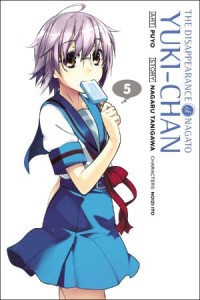
nagato5

(For the record, I have generally assumed that when dealing with spinoff titles like these, the main plot is being created by the artist, with the writer only signing off on suggestions and censoring plots he wants to handle himself. Thus I assume that Puyo is in charge of both this and the Haruhi-chan manga, but I could be wrong.)

This volume really reads like the author was intending to wrap it up here. Yuki and her AU counterpart have a talk in her mind, after which she’s back to normal with no memories of what happened before… which is a bit of a pain to Kyon and Ryouko. Luckily it’s summer vacation and Haruhi returns to drag everyone through a series of fun activities. You can see Puyo starting to wrap things up. Haruhi reveals how things changed for her 3 years prior, and shows how she developed in a different, slightly more sedate direction due to Kyon’s unthinking response. There’s a sense she’;s moving on from him here. Likewise, Kyon manages to resolve the awkwardness he feels around Nagato, and we finally get to the big confession…

…except there are fireworks, so she doesn’t hear him. And he immediately pulls back, noting that it’s OK if he said it, and now they can go back to their happy carefree days. We then move on to a slight homework arc, and return to the school for the 2nd half of the year, which features Haruhi trying to figure out how to inveigle herself into the culture festival despite not going to that school, and the return of a very familiar face.

Yes, if you write a spinoff featuring the most popular Haruhi character in a starring role, it makes sense to bring in the big breakout character of the last few years as well. So Sasaki’s back. What will her return mean for the relationship between Yuki and Kyon? Probably not a lot, to be honest. But it will at least keep it dragged out for another couple of volumes, which is all Kadokawa asks, really.

I really do enjoy this title. I wish the art rose above mediocre, but given the popularity of Attack on Titan, mediocre art is not a big setback anymore. Puyo specializes in quiet, introspective emotional moments, and the humor here is gentle and mild – it’s probably to contrast with the Haruhi-chan 4-koma he also writes. But I simply can never get out of my head the fact that this is a cash grab for a large anime franchise, and the addition of Sasaki and pullback from an obvious ending do nothing to assuage my worries in that regard. As always, recommended for Haruhi fans.

Even More Licenses

I swear companies check my blog to make sure I’ve posted, then do announcements.

So yes, 2 new titles from Kodansha today (well, technically 3, they’re putting out Attack on Titan 1-5 in a giant 1000-page omnibus). Let’s investigate.

gdgd

First, we have another Ema Toyama title. Despite hitting high above its supposed age bracket, Missions of Love has been doing pretty well for the company, and they already did an omnibus of I Am Here!. Now we get a series that cries out for a translated title, GDGD-DOGS (Kodansha will release it as Manga Dogs). Running for 3 volumes in Aria magazine, this series about a teenage manga artist and her pretty boy wannabe students seems to be light and fluffy, and I wonder if Kodansha will do it as one big omnibus or 3 separate volumes.

As for Noragami, that’s 10 volumes and counting, and may be the next big thing to come over here from Monthly Shonen Magazine. This one has an anime currently airing, which is likely a big reason they’re taking a chance on the series. The author is best known over here for Alive, the post-apocalyptic manga that Del Rey put out 8 volumes of before it became part of the Giant Del Rey Title Purge. The plot sounds oddly a bit like Kamisama Kiss. Looking forward to see where it goes.

Also, although I’m not sure Yen has officially announced this, but the 3rd Durarara!! arc, subtitled Yellow Flag Orchestra (that sound you hear is Baccano! light novel fans crying), will be beginning this fall. Like Umineko, Durarara!! seems to be a series that Yen enjoys, but is only licensing in chunks. Makes sense, given it’s pretty much caught up with Japan. This arc focuses more on Kida’s troubled past and wavering loyalties.

Soul Eater, Vol. 18

By Atsushi Ohkubo. Released in Japan by Square Enix, serialization ongoing in the magazine Shonen Gangan. Released in North America by Yen Press.

Soul Eater is an ensemble cast, but as with most ensemble casts, some characters are more lead than others, and so Soul Eater really stars Maka and Soul. Throughout the series we’ve seen the growing closeness between the two, and the confidence that they now have. Which is why the chapters on Envy and Sloth that they both go through are so traumatic. It’s such a shame that Maka, deep down, really has these issues with her. Of course, Maka is all of us, and you can never quite get rid of that core of self-loathing, no matter how much confidence you have. Luckily, Maka has Soul to snap her out of it.

soul18

As for everyone else, the Lust chapter actually plays out a lot faster than everyone thought, once the basic ‘what if they all changed sexes’ gag is done. Naturally, the more repressed a person is, the longer it takes to change back, which gives us an excuse to watch Tsubaki and Liz be humiliated. Gluttony, Wrath and Pride are excuses for character-based humor, as Black*Star and Patti pig out and we have to deal with the return of the most annoying sword in the world, which even Liz can’t wield in order to save Kid. (There’s some amusing 4th wall breaking here, as it’s noted that Black*Star screaming at Excalibur is buried in the gutter of the book.)

Speaking of 4th wall breaking, the art itself undergoes a change in the Sloth chapter, fitting in with what Maka and Soul are going through. This is probably the most disturbing part of the book, as Giriko shows up and threatens to rape Maka using extremely crude language, which (being in an existential crisis) she just sits there and takes. Luckily, Soul is there to come to her rescue, and she’s able to supposedly kill Giriko, though this may prove trickier than they expected. “People don’t explode when you kill them!” Is this meant to be another commentary on shonen tropes?

And then there’s Kid. We’ve had his obsessive-compulsive disorder used for humor for so long that it’s a bit jarring to see it be so serious now. And, truth be told, it’s a great way to get Kid to turn to the side of evil – point out that the best way everything can truly be symmetrical forever is to make everything become nothing, the empty symmetry of nonexistence. It’s chilling. Luckily, we have the one man whose ego is so big that facing off against something like this is nothing, and the cliffhanger sets us up for the big fight between Kid and Black*Star. The first time they fought, Kid wiped the floor with him, but I suspect things will go differently this time.

Soul Eater is slowly makes its way towards a big confrontation, but the journey is also fun, and this continues to be one of the best shonen titles out there.