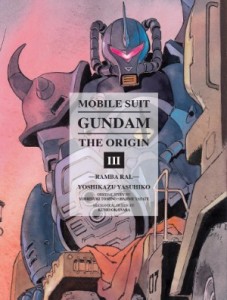
Mobile Suit Gundam: The Origin, Vol. 3

By Yoshikazu Yasuhiko; Original Story by Yoshiyuki Tomino and Hajime Yatate; Mechanical Design by Kunio Okawara. Released in Japan by Kadokawa Shoten, serialized in the magazine Gundam Ace. Released in North America by Vertical, Inc.

In the first 2 volumes of this Gundam manga it’s been fairly easy to root for our heroes. They’re fighting against an empire with fascist tendencies, and the two main antagonists we’ve gotten so far are a smug schemer and a daddy’s boy who looks to be in over his head and is dispatched fairly easily at the end of the last volume. Char will no doubt continue to be a headache, but Garma is no more. Of course, this means we need a new minor villain, and it’s not going to be Char, as he’s too busy smirking. And so we get to the title character of this book, Ramba Ral.
gundam3

Make no mistake about it, Ramba Ral is exactly what this book needed at this point. Even if Char is a very popular character with fans, the fact is that the heroes and villains have been more black and white than they needed to be. This is particularly evident at Garma’s state funeral, which Gihren quickly starts using as a political rally to mobilize the troops. This, combined with the funeral choreography and the uniformed fascism, makes the Principality of Zeon look like Nazi and the Naztones to a degree. Ramba Ral is different, and reminds you that this isn’t “fighting aliens” – all of these people are ultimately human beings with human flaws and human virtues. He’s a captain who loves him men, loves to fight, and is very good at it. His wife is second in command and clearly much of the brains behind the operation. It’s a shame that the plot decrees his fate at the end of this book, as I’d much rather he have been the main antagonist.

And counterbalancing Ramba Ral being a villain who is easy to respect and admire, our heroes are having a very rough time of it. Amuro has always been a petulant teenager, but here his temper tantrums get dealt with in detail, and he runs away. Bright, meanwhile, is doing his best to try and think like a commander, but making decisions that are the right thing to do is proving to be unpopular… not only with his men, but with Mirai. As for Sayla, she’s finding that being a double agent is a lot harder than it looks, particularly when you’re not working for the villains. All three of these characters make somewhat dumb decisions, pay for them, and later learn to read people’s hearts to see what the better option is.

There’s still lots of what makes everyone love Gundam in the first place. The battles are taking up more and more space in the book, but are still very exciting. And the political back and forth and constant attempts to get the upper hand is even better. Char excels at this, of course, even when captured for insubordination. He’s just a man who wants his sunglasses. That’s all. Add in an afterward by Shimoku Kio, who draws the female cast, and has the Genshiken meet Amuro, and you have absolutely no reason not to pick this up. An excelletn volume.

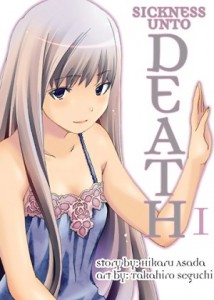
Sickness Unto Death, Vol. 1

By Hikaru Asada and Takahiro Seguchi. Released in Japan as “Shi ni Itaru Yamai” by Hakusensha, serialized in the magazine Young Animal. Released in North America by Vertical.

This manga starts in right away telling you that it’s going to be a tragedy. The very first scene shows us our hero, as an adult, visiting the grave of the heroine. It’s very stark, especially considering how much emphasis the rest of the text puts on trying to save her from her inner demons and her despair. But given how the efforts to save her are, much of the time, exactly the wrong thing to do (or being handled by the wrong person), it shouldn’t come as too much of a surprise. This isn’t a romantic comedy, it’s ‘watching a car crash in slow motion’ manga. Still, that can be riveting, and it in here.

sickness1

We get most of the story, as I said, in flashback. Kazuma, a young man going to college so he can study psychology, answers an ad providing lodging for him if he could care for a sick person. Said person is Emiru, an emaciated young woman whose hair has turned white and who seems to exist in a perpetual state of “almost dying” without actually doing so. Kazuma is immediately attracted to her, and decides that he’s going to try his best to get her out of this gloom that her life has become. As I noted above, this is a giant mistake. Emiru’s butler, who should step in as a mature adult and say this, doesn’t say anything as he’s beholden to the family, and also gets conveniently written out. Kazuma’s teacher helps him understand the psychological aspects of Emiru’s mindset, but thinks he’s speaking in the abstract. And then things get more intimate…

I’ll be honest with you, it’s hard for me to read this work without thinking of another manga that revolves, supposedly, around despair. It doesn’t help that as an adult, Kazuma bears a distinct resemblance to Itoshiki-sensei, the lead teacher in Sayonara Zetsubou-sensei, and that manga too has him dealing with young women with psychological problems. This is an altogether darker work, though, and where it best succeeds is focusing on Emiru’s all-encompassing pain and despondency. It doesn’t help that we see flashbacks to her about two years ago, and she’s a cute, outgoing young high school student – the sort of girl who would be the love interest in some shonen harem manga. Now her hair has turned white, she’s so thin you can almost see through her, and she lives on the verge of despair. Of course, this is a two-volume series, so we don’t actually find out her tragic past till next volume, but I can hazard a few guesses…

I greatly enjoyed this volume, but I have to admit that a lot of the time I was screaming at Kazuma “No, no, don’t do that, argh, are you stupid?!” But hey, he’s a young smitten teenager who’s fallen for someone who seems to be drifting away from him even as he meets her. It’s no wonder he’s so desperate. And so here, in this volume, we have the Sickness. I can only presume Volume Two will bring the Death. It looks to be riveting.

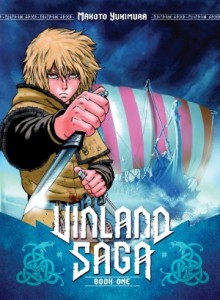
Vinland Saga, Vol. 1

By Makoto Yukimura. Released in Japan as two separate volumes by Kodansha, serialized in the magazines Weekly Shonen Magazine, then Afternoon. Released in North America by Kodansha Comics.

At last, after years of fans begging for a license, we have one of the most anticipated titles of the year. Makoto Yukimura was released over here previously with his sci-fi garbage scow series Planetes, but that was another “critically acclaimed poor seller” that fans love and publishers hate. Nevertheless, the author’s skill is demonstrable in that series, and his art and storytelling have only improved since then. This tale of Thorfinn, a reluctant Viking warrior/prisoner-of-war and his tragic backstory is absolutely riveting, and makes you yearn for the next book in the series to come out so you can read on. Honestly, if it weren’t already in an omnibus (a handsome, hardcover one, by the way, looking very nice), I’d feel even more impatient.

vinland1

We open with Thorfinn already a young adult, then flash back to tell his backstory. This helps to amp up the tragedy as we can see what a cold-blooded killer Thorfinn can be… and how he pales in comparison to the captain who controls him, Askeladd. For all that this series may be Thorfinn’s, Askeladd is the one who captures the reader’s attention right off the bat, and I suspect he won any reader polls Japan had. Cheerful, clever, sly, and ruthless all in one, Askeladd makes a great anti-hero to contrast with Thorfinn’s sullen warrior. He even has his own moral code, such as it is – one we see in the second half of the book, when we find out just how Thorfinn lost his father Thors and was captured.

By the way, for those who love Berserk, you’ll love this too. It’s not QUITE as bleak and ultraviolent – at least not in this first volume – but there’s a lot of the same feel, and the battle scenes are fantastic (despite the presence of one of the worst Star Wars jokes I’ve ever seen). The art isn’t only good in the battle scenes either – the author has taken great care to be as historically accurate as possible in a fictional manga world, and I loved the attention to detail we see here.

I was expecting this to be a totally male-dominated book – and honestly, it still may end up that way – but there are two very good female roles here. First of all, the book’s only light relief is provided by Thorfinn’s older sister Ylva, a tsundere trapped in 11th century Iceland, who has all the boys of the village falling at her feet but would much rather stomp around and be grumpy. As for Thorfinn’s mother, she mostly exists on the sideline supporting her husband… till we see a flashback to Ylva’s birth, where Thors is prepared to simply nod and leave, and his wife looks like she’ll leap out of the bed and throttle him unless he names their child. The manga is filled with little moments like this.

This is not going to be a cheery romp – expect the majority of the cast to die – but it’s gripping stuff, and incredibly hard to put down. I really enjoyed Planetes, but you can see how Yukimura has evolved further here. The story carries you along effortlessly, makes you care about these people even as it then hurts them horribly, and is simply filled with badass men being badass. It was worth the long wait to get this.