
So, which of this title will you be getting this week?
(It’s OK, wait till November, the Manga Avalanche Month.)
So, which of this title will you be getting this week?
(It’s OK, wait till November, the Manga Avalanche Month.)

By Yun Kouga. Released in Japan by Ichijinsha, serialized in the magazine Comic Zero-Sum. Released in North America by Viz.
Another license rescue, this time of a very popular josei-ish series that’s still running, albeit at a crawl, in Japan. So I picked up the first omnibus thinking, why not? Generally I don’t read much BL, if any, but the author herself has said she doesn’t think it’s BL. Actually, if I’m honest, there’s not only a huge genre of ‘BL only not quite’, but several magazines devoted entirely to it, of which one is Comic Zero-Sum. (The most famous is probably Shinshokan’s Wings, whose manga I always classified as ‘whatever Wings is’ back in the day.) Given the cover, however, which features what seems to be an abused catboy being aggressively fondled by an unseen party, I’m going to guess that Loveless falls into ‘it may not be BL, but its fans sure are’. You know, like Naruto.
That aside, Loveless is basically a fantasy thriller with psychological overtones. Our hero, Ritsuka, is trying to start his life over after his older brother was apparently brutally murdered. He also has amnesia, and so is trying hard to figure out what he used to be like – something not helped by his mentally unstable mother, who keeps assuring him over and over again that he’s wrong and horrible and she wants her son back. To make matters worse, he ends up being stalked by another guy, who was close to his brother. Now he has to fight various members of an evil organization, figure out why his brother was killed, and deal with these strange feelings he gets whenever he’s around Soubi, the aforementioned stalker.
There’s very little setup here, with the author deciding it would be easier to simply drop you into the middle of her world and let you figure out how it works. So far it’s crossing between high school drama and fantasy. In this world, virgins have cat ears and a tail, which fall off after they lose their virginity. This mostly seems to be an easy way to mark off who’s meant to be innocent and naive and who isn’t so far, including Ritsuka’s ‘Christmas Cake’ teacher, Hitomi. Notably, she’s the only one actively mocked for said virginity, if only by the villains. Aside from this, there’s a lot of battle sequences where Ritsuka and Sougi must pair up to defeat whoever’s attacking them. This was easily the poorest part of the manga, with generic combat and spells/power words/whatever. The idea of your partner taking whatever damage you get could lead somewhere in the future, but at the moment it just seems to be there to make Ritsuka suffer more nobly.
When the manga isn’t focused on combat, it’s a lot better. Ritsuka is a messed-up young kid, and his hot-and-cold running emotions, even for a teenager, are jarring. He’s not quite sure about this whole ‘love’ thing, or why he’s so attracted to Sougi, but then again he’s not all that good at friendships either – it’s cute seeing him have to deal with someone as bright and talkative as Yuiko, the tall girl in his class who slowly befriends him. In case anyone’s curious, I absolutely loved Yuiko. I knew going in she was a heavily bashed character, so those who know me probably guessed this, but even more than that, she helps to lighten up the book and prevent the psychological drama from getting too depressing. I hope (but am not optimistic) she sticks around as events ramp up.
Loveless is a very odd duck, and I kept alternating between being fascinated and creeped out by its storyline. Soubi, who I barely mentioned at all, is likely the main reason for this – I just don’t like him yet, and thus it’s hard to see his disturbing devotion to Ritsuka, who is meant to be 12. The shotacon aspects are partly intentional, of course, but I’m pretty sure it’s only meant to be partly – which disturbs me. I keep waiting for the other shoe to drop. Still, there’s no denying that the author has skills and power to draw you in. It’s easy to see why this series is popular. And I do wonder what happens next. (Will Ritsuka abandon his shotacon stalker for cute tall-girl love? Mmmmmmm, probably not…)

By Toru Fujisawa. Released in Japan as “Shonan Jun’ai Gumi” by Kodansha, serialized in the magazine Weekly Shonen Magazine. Released in North America by Vertical.
And so, after much delay and a rescue by our friends at Vertical, the GTO Early Years series is now complete.It’s been a ling ride, and you can visibly see how much Fujisawa has improved and refined his art – Shinomi, for one, is almost unrecognizable compared to how she looked when we first saw her, and most of the characters have that ‘GTO’ look that we’re more familiar with from the sequel. What’s more, knowing he has to wrap things up, Fujisawa devotes much of this volume to our heroes’ two love-interests, showing how each of them compares and contrasts with their man. In particular, Shinomi demonstrates that, in her own way, she can screw everything up just as much as Eikichi.
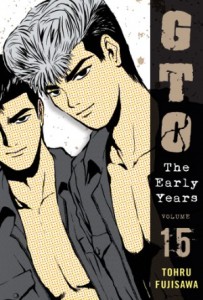
When I reviewed Vol. 14, I noted that I wasn’t sure if the cliffhanger reveal would be played for comedy or drama. Very cleverly, this is actually used in-story – Shinomi, in a fit or misplaced jealousy, is ready to mock Eikichi mercilessly, only to suddenly find that he’s far more affected by everything than she had anticipated. In fact, things get so bad so fast that she desperately confesses to him – which he seems to pretend not to hear, something that he’s very good at indeed. (Note that in GTO 14 Years he’s *still* pretending not to hear Shinomi at times…) After a heart to heart and a good cry with an old mentor, Shinomi decides to go all out and give herself body and soul to Eikichi. This ends up going horribly wrong in the best GTO tradition, and in the funniest scene of the entire book. I had always been a fan of Onizuka getting together with Azusa, given I read GTO first, but Shinomi is making me waver a bit. She’s a perfect complement to his idiocy.
Nagisa, meanwhile, is having troubles of her own. Mostly that Ryuji is using their dates to have sex with her and not much else. And the sex isn’t bad, but Nagisa is a romantic. So when a guy at a nearby high school confesses to her, she’s depressed enough to actually go out with him. Again, Ryuji has always been slightly (but only slightly) more mature than Eikichi, so it would make sense that his own complement is the same. As we see later in the book, she’s trying to study and get into college so she can become a therapist and deal with… well, people like herself. (It’s likely been long forgotten, but Nagisa has disassociative identity disorder). Getting Ryuji to realize that she’s not just there for him to stick it in is tough. Luckily, she’s still completely devoted to him, and it all works out.
And so we get to the final battles. There’s a group of new freshman entering high school, all of whom have heard about the famous exploits of the Oni-Baku Duo, and all of whom are now ready to pledge their lives to them and take over all of Shonan. This is somewhat disquieting to our heroes, who while they always unquestioningly defend their friends, and certainly enjoy being in a gang, fighting, and driving around on bikes, have never really had the ambition to take over the city. Or indeed do much at all. Ryuji sees his girlfriend’s fierce study and is blown away – he’s starting to wonder what to do with his life once he graduates. Onizuka is not quite at that stage (indeed, it will take until the start of GTO to push him there), but the two definitely realize they don’t want to be gang leaders the rest of their days, and something needs to be done.
As ever in the GTO series, events spiral out of control into complete madness, and talking everyone down is no longer an option. So the two of them decide to pull off an elaborate final fight (between each other, of course), and leave this world once and for all. Now clearly we’re not buying what they’re doing – we’ve seen GTO, after all, which shows them both as adults – but I think even readers seeing this back in 1996 knew this was all an elaborate put-on. And sure enough, it’s not even 15 pages before the reveal. Those 15 pages, though, are styled like a documentary/remembrance, with reactions ranging from anger to disbelief to genuine grief (Shinomi and Nagisa).
GTO and its prequels/sequels ran in Weekly Magazine rather than Weekly Jump, and the audiences are fundamentally different. But in the end, you can’t deny that GTO: The Early Years brings you some of the best in shonen ideals. Kids having fun, getting into goofy antics, and trying to get laid are contrasted with holding on to your dreams, always being there for your friends, and enjoying your youth while trying not to destroy it. Eikichi and Ryuji have walked a fine line between those ideals at times, but in the end have shown the main way to accomplish these ideals: a good heart. (And also possibly being a badass biker with ungodly stamina.)