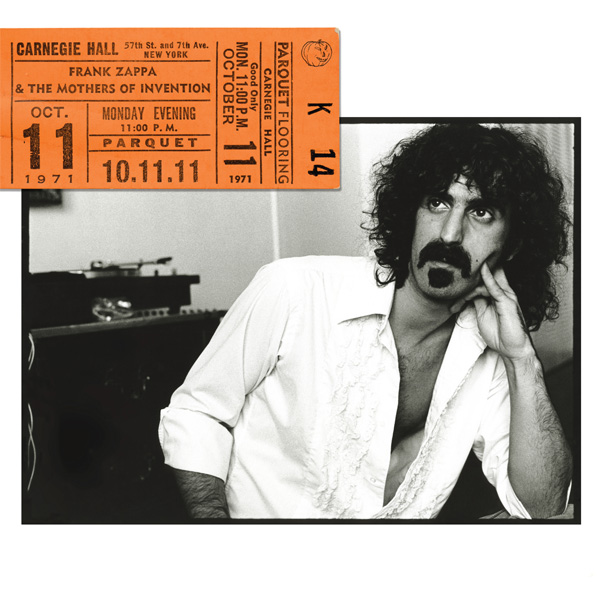
It has to be said, many of the complete concerts we’ve seen since Frank’s death 18 years ago would not have been released were he alive. Frank was very fond of cutting, fixing, overdubbing, and replacing, and generally rarely liked complete performances enough to put them out on record. Since his death, however, we’ve seen several complete concerts from the folks handling the Zappa family trust, with concerts from Australia in 1976; Philadelphia in 1976 and Buffalo in 1980, as well as a collection from several concerts at the Hammersmith Odeon in 1978.

This particular concert, though, is unique for many reasons. It’s Frank’s only appearance at the esteemed Carnegie Hall. Apparently the venue was tricked by a promoter into thinking that Frank was performing with an orchestra, which he had previously done in 1970. Instead, Frank was touring with the ‘Flo & Eddie’ version of the Mothers of Invention, and things were definitely more in a rock and roll-oriented comedy group vein. We get both the early and the late show at Carnegie, something that is possible mostly as Frank’s setlists are not as long as they would later get. It’s in mono – probably a reason Frank never saw fit to release it, as stereo was the norm for most everything by 1971. It also, uniquely for a Zappa record, features the opening act – acappella doo-wop group The Persuasions, whose first album was released on Zappa’s record label.
The makers of this CD set apologized for the less than stellar sound, and this is most apparent during the Persuasions set, which is more muffled than the main set. It’s quite listenable, though, and it’s always a pleasure to hear acappella groups. They take a tour through several old 50s and 60s classics, including many obscure records as well as some hits still beloved today, such as Tears on My Pillow and The Great Pretender. Their set runs about 25 minutes long, and features 3 ‘medleys’, the second and third of which produce acappella versions of more modern hits such as the Temptations’ Cloud Nine and Carole King’s You’ve Got a Friend.
It’s then time for the early show for Zappa’s Mothers. As I noted, this band featured former Turtles Flo & Eddie, aka Mark Volman and Howard Kaylan, on vocals and entertaining skits. Frank wrote his compositions to suit his bands, and the Flo & Eddie period was filled with lots of falsetto vocals, tales of groupies and sordid sexual situations – it was 1971, after all, where the Summer of Love was turning into the Autumn of Casual Sex. Also in the band were fellow ex-Turtle Jim Pons on bass guitar and bass vocals; Aynsley Dunbar, who would later go on to be a founding member of Journey, on drums and British sex appeal; Ian Underwood (the ‘straight’ member of the group) on alto sax and keyboards; and Don Preston on synthesizers and gong. Ian and Don were in the early 1960s Mothers; the others were unique to this band.
The first show begins, as most of this band’s shows did, with the 1967 album track Call Any Vegetable. This was one of the more straight-ahead rock numbers the band performed, and allowed Flo & Eddie to sing the ridiculous lyrics while Frank got to perform a smoking guitar solo. The second half of the song varied from venue to venue, as Frank would improvise a monologue about what to say to a vegetable; these usually revolved around the city or country they were playing in, and this was no exception. It wraps up with a quick reprise, then segues (with another NYC-based improvised monologue, this one by Howard Kaylan) into an even earlier song, the Freak Out classic Anyway The Wind Blows. This starts off similar to the album, but as we near the end, it gains speed and volume.
The next song is probably the one reason that I would recommend you buy this album only after you’re already familiar with Frank’s work. It’s well known that Frank Zappa wrote songs many people consider offensive; in fact, I have a few I consider offensive myself. Indeed, later in the show we’ll see songs about a groupie preparing to get laid, and in the 2nd show we’ll see God’s girlfriend beg a pig to screw her, and a young yuppie executive coat his thighs with syrup to that flies can surround them and lift him into the air.
Magdalena, though, is special even by these standards. It’s a song about a father and daughter living in Montreal, and the father realizing that his daughter is now grown up, and that he’s attracted to her. Now, to be fair, this is viewed in the lyrics as sick and wrong, and Magdalena herself rejects his advances and stomps off. However, the majority of the song is sung from the POV of the father, so you get lots of exhortations for his daughter to see reason and return to him. Naturally, as with many of Frank’s most offensive songs, the song itself is very catchy and you find yourself wanting to sing along, almost despite yourself. And this is also another song with an improvised monologue, as Howard once again uses the NYC area to try to seduce poor Magdalena.
After this, we’re back in safer territory, with a straight on performance of the Uncle Meat classic Dog Breath, which (as with almost all Flo & Eddie version of old Zappa songs) is more of a rocker now. This ends the first disc, but the show continues on CD2 with Peaches En Regalia, an instrumental and one of Frank’s most well-known songs. It segues right into Tears Began To Fall, the band’s current ‘hit single’ (that was not a hit), which is a standard love song about the lack of love. We then get ‘Shove It Right In’, a collection of three tunes from the 200 Motels movie. This is the groupie song I mentioned earlier, and is about a young girl putting on makeup, clothes, deodorant, etc. in order to go out and make herself attractive for the band members who are playing that evening. In the movie, it’s separated by instrumental orchestration, so never really gets going. Here, it’s just the songs themselves, and it becomes a raging beast.
After this it’s time for one of the band’s finest – King Kong. Frank played this instrumental piece for almost his entire career. It was in some of his earliest known performances in the 1960s, and it features prominently on the final tour in 1988. This is where the other type of Zappa fan, more in love with the music and soloing than the vocal shenanigans, sits up and gets excited. After the main theme, Don Preston gets to solo on his keyboard synthesizers. It’s worth noting that synths in 1971 were still fairly new and surprising, and that hearing what Don is doing with them must have been startling. Don enjoyed starting from a drone and building up swathes of noise, rather than playing straight ahead melodies. We then get Ian Underwood, Aynsley Dunbar, and Frank himself, all playing long and involved solos that extend the piece to just over half an hour. (Flo & Eddie, being vocalists only this tour, did not get a chance to solo. And Jim Pons either did not want to or was not asked to solo in any of their shows.)
We wrap the main set up with a piece first seen in the 200 Motels movie as part of the ending to ‘Strictly Genteel’. Frank separated it from the classical portion of the song and took it on tour with just the rock band finale, which he called, appropriately enough, 200 Motels Finale. It’s a great way to end a show, with the band telling everyone that they’re all exhausted and that after the show they’re all going out to get wasted. Before they do that, however, they need to come back for an encore. This is one of the big treats of this whole release: we finally have a nice version of the Flo & Eddie rewrite of Who Are The Brain Police?, Frank’s scary Freak Out classic. He noted at several other shows that he rewrote it to ‘make it sound like Canned Heat’, and it is fantastic, with a long and energetic Zappa guitar solo, and a strange vocal coda that will give you the shivers. And thus ends the early show.
The late show starts with Frank once again making fun of the fact that they actually managed to get booked at Carnegie Hall, before starting into one of their two big ‘skit’ sings from the Fall 1971 tour. The piece as a whole is called Divan, and most of it has been heard on official releases, but not as one piece. It’s the story of a fat maroon sofa which sits in the middle of a vast emptiness. The Lord sees this sofa and demands some flooring be put underneath it. The band then plays Sofa, as heard on the One Size Fits All album, complete with the lyrics in German. (Frank explains that much of this song is in German as that’s the way the Lord talks whenever it’s heavy business.) We then go back to Frank’s monologue about the Lord, who by now has brought along his short girlfriend… and Squat the Magic Pig. (Yes, when I called the band a rock-oriented comedy group, I was not kidding.) They then move into a big surprise for casual Zappa fans – the song Stick It Out, which would not be officially released by Frank until the Joe’s Garage album in 1979. It works better here, where the girlfriend screaming at the pig to screw her in German is contextualized within the sketch better than Joe and his roto-plooker. And yes, I do think that a girl demanding a pig screw her in German while the Lord films it with his home movie camera is less offensive than Magdalena, if only due to its sheer ludicrousness.
Divan ends with a piece we’ve heard before with that title on the Playground Psychotics album, which is vocal-oriented, quieter, and also in German and English. By the way, don’t actually try to learn German from this song. Then we hear another of Frank’s most beloved instrumentals, which also appeared from his first few concerts to his last, Pound for a Brown. For this tour, it wasn’t the giant solo vehicle that it could be on other tours, but a straightforward vehicle for Frank to play a guitar solo. As with all Pound performances until 1975, it then segues into another piece from Uncle Meat, Sleeping In A Jar – though this version is an instrumental. After this, we get a three-song medley of pieces that all lead into one another. Wonderful Wino was written for former Mothers bass player Jeff Simmons, and now that Jeff is gone Flo & Eddie share vocal duties. It’s, well, about a wino. Sharleena is another love song where the singers exhort the heroine to return to their loving arms. And Cruising For Burgers is pure 50s nostalgia, though as always with Frank’s nostalgia there’s a bit of wry tongue in cheek there as well.
Next comes, for me, the highlight of the entire release. In the spring of 1971, Frank wrote a huge musical comedy number titled Billy The Mountain. The story involved a California mountain getting a royalty check for all the postcards he’s posed for over the years. Deciding to use the money to take a vacation, he and his wife Ethel (who is a tree growing off his shoulder) head off to New York City, stopping along the way in Las Vegas and other touristy attractions. This naturally causes untold destruction, as Billy is a MOUNTAIN. Things get even worse when Billy is drafted, and refuses to report for his induction physical. The government decides to send a superhero to stop him – Studebaker Hoch, whose voice may not match up to his image but who is plenty badass in his own right.
As you can imagine, this plot takes a while to sing. Especially as, as with many songs in the first show, Frank, Flo & Eddie take the time to localize the song for its audience – so we get a news reporter from WNEW telling us about Ethel’s communist tendencies. It first appeared on Just Another Band from L.A. – edited, with the solos and a few of the more litigious parts removed. (Halfway through the tour, Frank and company changed the name of “George Putnam, the right-wing fascist creepo newscaster” to George Pontoon, possibly as the real Putnam might get upset. Given they stated “And it is this reporter’s opinion” – a Putnam trademark – it wasn’t hard to figure out anyway.) On Playground Psychotics, we got a half-hour version that left in the solos, but was also lacking many of the extended improvisations from later in the tour. This is the latest version we have officially released, and it’s by far the longest – over 45 minutes! There’s 13 minutes of solos, and we also have the full uncut production itself, including the ‘Tibetan Memory Trick’ which Flo & Eddie inserted into each Billy the Mountain from about this time onwards.
A brief interlude, as some may not be aware of the awesome Tibetan Memory Trick:
One hen
Two ducks
Three squawking geese
Four Limerick oysters
Five corpulent porpoises
Six pairs of Don Alverzo’s tweezers
Seven thousand Macedonians in full battle array
Eight brass monkeys from the ancient, sacred crypts of Egypt
Nine apathetic, sympathetic, diabetic old men on roller skates with a marked propensity towards procrastination and sloth
Ten lyrical, spherical, diabolical denizens of the deep who haul stall around the corner of the quo of the quay of the quivery of the quarry, all at the same time.
As you can imagine, it was fun to hear in concert, delivered at an extremely fast pace. We then get the end of the piece. Studebaker Hoch has come to reason with Billy by going into a phone booth and getting the flies within to take him to New York by the method I mentioned above. Once there, he foolishly threatens Billy, who just laughs. And when a mountain laughs, you’re in trouble. Studebaker is knocked 200 feet into the rubble below. Billy The Mountain is almost a time capsule of a song, being so 1971 it hurts. It’s filled with puns (Studebaker Hawk, anyone?), and though a lot of it isn’t as funny as the band seem to think it is, it’s carried along by pure mood. A joy to hear. The solos are once again by Don, Ian, Aynsley and Frank, though Frank’s is quite short. (His guitar is low in the mix for both concerts, which may be why his efforts weren’t as long as usual.)
This is the end of the main set, and it’s after midnight. Frank comes out and tells the crowd that he’d have to pay $600 extra before they’d let him play an encore. The crowd is clearly upset, but Frank is setting them up. “So I said of COURSE I’d pay an extra six hundred to play for you!” Frank spends a couple more minutes mocking the inflexible union rules that lead to such arrangements, and then gives us The Mud Shark. This was originally part of the extended “Groupie Opera” piece performed by this band, much of which can be heard on the album Fillmore East – June 1971. They’d mostly dropped this by now in favor of the new, equally long Divan. Audiences loved the Mud Shark, which was the story of a band (most folks know it as Led Zeppelin, but Frank always told it as being Vanilla Fudge) who stayed at a hotel in Seattle where you could fish out of your hotel room. There they caught a Mud Shark (aka dogfish) and proceeded to use it on a young groupie. We don’t really get into the sordid part of the story, however, because the “Mud Shark Dance” (which mostly involves pretending to swim like a fish) gets extended out more and more. This version is thirteen and a half minutes long, and includes the band trying to get the audience to leave the hall and Mud Shark their way down Broadway. The last 7 minutes or so are pure groove, and makes you want to see what it must have been like visually.
There are a few moments during the concert where the sound quality gets degraded, likely as they were changing reels. However, for the most part this sounds excellent, even in mono. Fons of drumming in particular will enjoy Aynsley Dunbar being right up front in the mix, and his skills are quite underrated compared to later, more famous Zappa drummers such as Terry Bozzio or Vince Colaiuta. There’s also a booklet with details of the shows and some liner notes by Zappa fan Al Malkin and Gail Zappa. There’s also a few photos of the band, though oddly Don Preston does not get an individual photo. It’s possible he refused permission or that the ZFT removed him – they don’t get along at all these days – but given he is in the group shots, we must resort to speculation.
If you’re a casual Zappa fan and have never heard Flo & Eddie before, you might want to start with Chunga’s Revenge and work your way in slower. For those who want more, though, these two sets are a great example of this particular band hitting on all cylinders. Carnegie Hall never knew what hit it. Sadly, two months from this date, Frank would be playing in London when a crazed fan pushed him off the stage and into the orchestra pit. He had several fractures and a crushed larynx, and the band went its separate ways while he recovered. The Flo & Eddie Mothers can be an acquired taste – Frank made fun of his own band in 200 Motels, having the band complain about “only playing comedy music”. Many Zappa fans agree with the band. Still, I’m very happy to hear any new Zappa, and this one in particular is a stellar release, warts and all.