The Goon Show Compendium, Vol. 6

As readers of this blog know, I don’t always talk about manga. Sometimes I’m discussing other comics, sometimes I’m droning on for hours about Frank Zappa, and sometimes I’m going into great detail about which previously censored Looney Tunes blackface gags are now uncut on the new DVDs. And then there’s British Comedy, which I have had a great love for for years. I started with Python, and of course devoured all the interviews with the cast, where they discussed the influence of Spike Milligan. I then watched The Goodies, where the cast ALSO discussed Spike’s influence. And heck, even the Beatles have a song (You Know My Name, Look Up The Number) directly influenced by the Goons. I had to find out more.

And I did. The Goon Show scripts book was in my local library. That was it for a while, as importing from the UK was not as easy in those days. But then the BBC started releasing cassettes and CDs of old Goon Shows, and I quickly grew even more obsessed. Then a few years back, the BBC decided to do things properly. No more CDs of 4 randomly selected shows plonked down for a few bob. Now we got all the shows from Series 5 onwards (the earliest series that completely survives) in giant CD box sets, restored from the best materials by Ted Kendall, with previously censored jokes put back in, all with copious liner notes and annotations by Radio and TV scholar Andrew Pixley. This is the 6th such box, containing the 2nd half of series 7 (which ran in 1957).

The Goon Show was a radio comedy on the BBC from 1951 to 1960. The scripts were primarily by Spike Milligan, but he usually had helpers at various points in the series, either for reasons of time or for reasons of mental stability (Spike was bipolar, a diagnosis unknown to everyone, including him, until the 1970s). The shows in this box are co-written by Larry Stephens, a friend of Spike’s and another BBC radio scriptwriter.

The cast was Spike Milligan (known to North Americans for his Muppet Show appearance, where he debated Sam the Eagle and sang It’s a Small World), Harry Secombe (known to North Americans as Mr. Bumble in the movie Oliver!, and for the song If I Ruled The World, which he debuted), and Peter Sellers (known to North Americans). Each week Spike and Peter would take on a variety of roles, all of which would revolve around Secombe’s well-meaning but dim oaf Neddie Seagoon, who Harry always described as “myself, only more so”. Generally speaking, there was no continuity except the characters; the plot resets every week and starts on another venue.

The plots varied, but tended to rely on a fixed form. Neddie was the main character, and would be approached by unscrupulous con-men Hercules Grytpype-Thynne (Sellers) and Jim Moriarty (Milligan) to do something incredibly stupid and/or impossible for money. Neddie would start on the task, usually with the help of fellow idiots Bluebottle (Sellers), a crack-voiced Boy Scout, and Eccles (Milligan), a cheerfully idiotic simpleton (Spike based Eccles’ voice partially off Goofy from the Disney cartoons, which many Americans will note immediately). He’ll also run into Major Dennis Bloodnok (Sellers), a retired Army officer and filthy lying coward. I’m not being mean – Bloodnok admits it himself. Events would spiral out of control, and usually the show ended with one or more (or all) of the cast dead – only to be resurrected the following week.

This set is a particularly good time for the series. The cast know their roles well, and the shows have a deft combination of surrealist humor, old vaudeville gags, and a wafer-thin plot to hang it all on. The set contains a few of the best known Goon Shows, including The Mysterious Punch-Up-The-Conker, which has the skit ‘What time is it, Eccles?’, a legendary classic showing off the way Eccles’ brain worked. It’s particularly fun as Spike enjoyed savagely mocking the brain power of these characters, but also felt a great affection for them – Harry and Peter both noted Spike was closest to Eccles in real life, not for the idiocy but for the skewed view of absolutely everything that is displayed.

Other episodes of note on the set include Shifting Sands, set in India around 1900 (as many Goon Shows were – Spike grew up there, and was fascinated with the ragged edges of the British Empire holding on despite everything) with special guest star Jack Train from an even earlier BBC radio comedy, It’s That Man Again; Ill Met By Goonlight, a World War II parody involving the capture of a suspected German spy (and one of the best-times awful puns in the entire series); and The Histories of Pliny the Elder, a Roman parody. There’s a few duffers in here, inevitable when you’re trying to write a half-hour of comedy every week. Emperor of the Universe is a parody of Bulldog Drummond that doesn’t quite savagely attack its subject enough to really work. The set also contains The Reason Why, a one-off comedy written without an audience about the moving of Cleopatra’s Needle to Britain. It’s a very odd duck, with Seagoon playing a different character that nevertheless has Neddie written all over him, and Bloodnok popping in as well. Goon Show once removed, shall we say.

The set comes, as I noted, with a long series of production notes detailing what was going on behind the scenes as these shows were being aired. They’re a nice look at what show-business Britain was like in the 50s – Harry and Peter were constantly off doing other shows and performances, and the BBC at one point told off Peter’s agent for booking him so much that he was unable to do the Goons easily. There is also a short guide to some of the more obscure jokes – Britain in the late 50s is a while ago, and not many would recall who Hughie Green or Field Marshal Alan Brooke are these days.

A word of warning to those who buy the set – there are some jokes that were made in 1950s British radio that would not be made today, particularly as regards racial stereotypes. The show had musical interludes, and the singer of the 2nd interlude, Ray Ellington, was frequently employed in the show to play African tribesman, servants, etc. – usually with a Rochester-type voice (Ray’s own voice, smooth and BBC English-sounding, was also heard in his songs.) There’s also several Chinese stereotypes in Emperor of the Universe, which, being a Bulldog Drummond parody, is all about the fiendish Chinese and how they are destroying our lovely Britain. Spike was quite progressive in many ways, but his jokes are a product of their time, and it’s best we view them the same way we view Bugs Bunny doing Al Jolson impressions in blackface to sell war bonds – as a slice of history.

The Goon Show has dated somewhat, especially as so much of modern British comedy is influenced by it. Some people may listen to the shows and wonder why they rely so much on old, hoary gags (you should have heard the other comedies on the radio at the time!). But even they will then listen in disbelief at the sheer surrealistic nonsense that then pours out the speaker. Spike could take gibberish and work magic with it, so that the cast could hold each other hostage with boa constrictors, bribe each other with receipts of a photo of a five-pound note, or have the time written down for them on a piece of paper. I could listen to these shows over and over again and still get new things out of them. Priceless.

Drifters, Vol. 1

By Kohta Hirano. Released in Japan by Shonen Gahosha, serialization ongoing in the magazine Young King OURS. Released in North America by Dark Horse.

Drifters is the newest title from the author of Hellsing and is spanking brand new – even Japan doesn’t quite have Volume 2 yet. That said, it does *not* have vampires. Which means it loses a lot of North America’s strong “I will buy anything with vampires in it” market. Can it get past this obvious handicap and manage to find its own voice?

Yes indeed it can, even though that voice most of the time is a big guy with a sword going “FUCK YEAH!!” Drifters is not particularly a manga for those who want subtle, intricate displays of emotion or great attention to historical detail. It takes famous soldiers from all over earth’s history and plants them in a fantasy world with elves, then watches them simply roll up and start to do battle. And the battle is the main draw of the manga. If you’ve seen Hellsing, you know how much Hirano loves to draw melee combat. This is all about that.

There is, of course, a bit of a plot. Our hero is Shimazu Toyohisa, who is real life was believed to have died in the Battle of Sekigahara in 1600. In this manga, he wanders off the battlefield, wounded, and ends up in a modern-looking hallway, where a mysterious man signs his name onto a sheet and teleports him through a gate to another world, where he’s found by some very Lodoss Wars-looking teens. He’s apparently not the first stranger to be found in these parts, so they dutifully take him off to a ruined castle, where he meets Oda Nobunaga, the Sengoku warlord, and Nasu Yoichi, a famous samurai from 400 years earlier.

They have apparently been brought there to try to stop a great evil from destroying the land (which appears to be controlled by a woman with the amusing name of Easy, who confronts Hallway Guy in a brief scene). What’s more, it would appear they will be joining up with Hannibal and Scipio, both seen here at a different castle that is being laid siege to, as well as Butch Cassidy and the Sundance Kid. Opposing them? Oh, just Hijitaka Toshizo, Joan of Arc, and Anastasia Romanov, all of whom are on the side of the bad guys, and also seem to have supernatural powers.

As you can see, this reads like a fanfiction written by a 12-year-old boy. Luckily, Hirano is mature and has a number of manga series under his best, so the execution is far more interesting. Provided you just turn off your brain and roll with events, this is a hell of a lot of fun. Shimazu makes a good “Who wants strategy, just point me at the enemy!” type hero, and the Black King, although seemingly a straight rip from Lord of the Rings, is a satisfyingly scary villain. And there’s sword fights, and battles, and people saying “Who can possibly save us now?” It is essentially Hirano having a ball every week, drawing whatever the hell he wants. And oddly, it works.

Admittedly, it has anime-style elves, who I normally avoid like the plague. But if you can get past the fantasy setting, what we have here is a bunch of historical soldiers fighting each other wile laughing and making trash talk. It almost reads like something Marvel or DC would put out. Definitely recommended to anyone who likes this sort of thing.

Manga the Week of 9/14

Given that next week is all about Yen Press, let’s start with them. (Yes, I know Sailor Moon and Sailor V come out 9/13. Did you really expect Diamond to ship it on the same day it hits bookstores? Have you been reading my posts at all this year?) There’s lots of stuff from Yen that deserves mention, but I want to focus on one title in particular first.

With the Light, a manga about a young mother struggling to raise her autistic child, was one of Yen’s first manga series announced, and their most exciting. A josei manga that clearly was intended to be marketed to a much broader audience than anime fans, it was a sign of great things to come. And it turned out to be even better when you read it, heartwarming and inspiring. Sadly, the author passed away before she could finish the series. Yen has worked with Akita Shoten to make the final volume, out next week, as complete as it is possible to be. Everyone who loves manga that goes outside the boundaries of ‘fight, train, laugh’ should pick up this series.

Of course, Yen has other stuff too. There’s Bamboo Blade 10, which is about to start up its next big arc. There’s Bunny Drop 4, which is a big turning point in the series. My Girlfriend’s a Geek 4 will no doubt feature more knowing humor about the fujoshi lifestyle. Zombie Loan… I’ve never read, I admit. I presume it’s about a library where you borrow zombies for things they’d be useful for? And the cute moe librarians who run Zombie Loan? No?

And though I don’t cover manwha, I suspect I would be filleted by my fellow Manga Bookshelf colleagues if I did not mention the new Goong and Raiders manga. And for fans of OEL, there’s Svetlana Chmakova’s new series Witch and Wizard, which is written by some other guy… oh right, James Patterson.

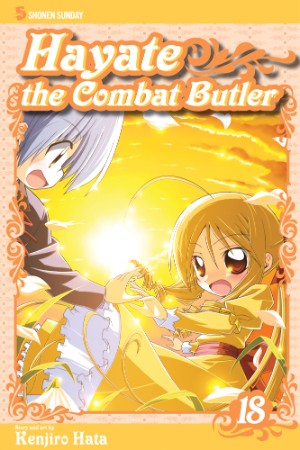
Viz also has titles! Albeit not many. But one is the 18th volume of Hayate the Combat Butler! Yes, it’s down to twice a year, and it seems to only garner bad reviews online these days (that will change when I get a hold of it), but this one resolves the ‘End of the World’ arc in a dramatic way, then kicks back to the comedy. And another final volume, as Detroit Metal City comes to a close. I kind of lost track of the series after the first couple of volumes, but I have a lot of friends who love it.

And Dark Horse is putting out the first volume of Yasuhiro Nightow’s new series, Blood Blockade Battlefront, no doubt meant to appeal to Trigun fans the same way Drifters is clearly designed to appeal to Hellsing fans. Sadly, on advice from my doctor, I can’t actually look at Nightow’s artwork anymore without a 24-hour nurse by my side, so I did not preorder it. But I’m sure hardier people than I will be willing to read it and try to figure out what the hell is happening in the panels.

(Apologies to Dark Horse… if it helps, I’ll be praising Drifters soon.)

So what intrigues you this week?