The Drab Princess, the Black Cat, and the Satisfying Break-Up, Vol. 3

By Rino Mayumi and Machi. Released in Japan as “Jimihime to Kuroneko no, Enman na Konyaku Haki” by M Novels F. Released in North America by Cross Infinite World. Translated by Evie Lund.

I am pleased to report that, at long last, this series about a break-up actually has it. As for whether it’s satisfying or not, well, I can’t speak for the characters, but as a reader it exceeded my expectations. Given that this series began with a misunderstanding because a bunch of teenage dumbasses were shit-talking at each other, so I’m amazed that in the end everything is resolved by people maturely behaving like adults. Now, this doesn’t mean that everyone is happy… honestly, the only happy one may be Seren… but it does mean that this book is blissfully free of people doing dumb impetuous things or kidnapped fiancees or any of the plot twists that happen in countless other light novels. The main complaint, as with the previous books, is that the books are still a bit too long, and Seren ad Viol are still a bit too dull. That said, this book features a speeder bike chase through the forests, which surprised me. All it needed was Ewoks.
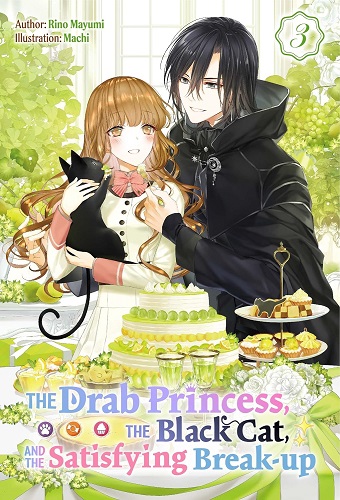
As the book begins, Seren is already ridiculously good at magic, and we see her in this book go from that to ludicrously good at magic. She’s a prodigy, and that’s honestly the only reason this plot works at all. She even manages to surprise Viol several times, especially when she takes the cart she’d been using and combines it with flying to essentially make a hovercraft. She’s also still training with the others in the salon, though her sister Marietta is starting to feel the crush of expectations, and it’s depressing her, because she’s not a prodigy like her sister. Finally, in order to get Seren to do what she’s unconsciously been avoiding and TELL EVERYONE what she’s doing, Vi reveals the truth: he’s actually Viol, something that she frankly takes much better than I expected given she’s been clutching this cat to her bosom every night. Now all she has to do is tell her family and the royal family she’s dumping them.

As I said, this *is* a satisfying break-up. Seren explains exactly what she wants to do, what was the inspiration for her studying to do it, and shows off that she absolutely has the skills to pay the bills. The reaction of her mother and father is basically “we are bad parents because she didn’t even consider telling us about any of this”, but they do make sure to tell Seren that, yes, she SHOULD have told someone else about this, and that is a fault of hers. As for Prince Helios, given that this basically arose because of one accidentally misheard conversation where he was agreeing with his dumbass friends to brush them off, he’s a bit devastated, but once he sees her resolve (and possibly her love for Viol, though that doesn’t really occur to her till the end of this book), he makes the best of things and moves on. Hell, even Marietta, who I was certain was going to snap at some point, recovers from her depression slightly and resolves to try her best.

So yes, a bit boring still, but this was probably the best in the series to date. And yes, there’s a 4th and final book in the series, which may consist entirely of sweet love-love moments, since most everything wrapped up here.

Raven of the Inner Palace, Vol. 4

By Kouko Shirakawa and Ayuko. Released in Japan as “Kōkyū no Karasu” by Shueisha Orange Bunko. Released in North America by Airship. Translated by Amelia Mason.

Usually when you see character development, it’s meant to be heartwarming, or affirming, and generally a good thing. And there is that here. Seeing Jusetsu gradually open up to being around others, helping people, and growing more comfortable in her own skin is absolutely a good thing, and the Emperor knows it. That said, the fact that she is the Raven Consort makes this a bit of a double-edged sword. The classic joke “I’m not like other girls” is eerily true here, and that’s why there’s a sense of this series moving faster and faster down a hill towards a crash that Jusetsu is not going to be able to stop. It does not help that certain factions in the court are trying to apply the accelerator rather than the brakes, and suddenly instead of being fond of Jusetsu, or looking up to Jusetsu, they are WORSHIPING Jusetsu. And that’s definitely a bad thing, give that’s she’s already a part of a god, and the other god who is the enemy may be getting back to full strength.

The main plot shows the Crane Consort’s father, Choyo, arrive at the palace, supposedly in order to apologize to the Emperor for what happened in the last book, and grace him with some of their most valuable silkworm cocoons. In reality, Choyo is there to blackmail/threaten the Emperor with the knowledge that he knows who Jusetsu is and that she should stay isolated in her own quarters. Meanwhile, the man responsible for the events of the third book, Hakurai, may have lost an eye but is not remotely down and out, and he’s here to try to kill Jusetsu *and* destroy her reputation – and nearly succeeds at the second. And, of course, these events are interspersed with the meat and potatoes of this series; a ghost is in the palace, let’s figure out why.

Generally speaking the main reason to read any of these “inner palace of the Emperor” series, be it Apothecary Diaries, Though I Am an Inept Villainess, or this one, is for the court politics, and that’s no exception here. Jusetsu is trying her best, helping people and making sure to right wrongs and save those who can be saved (and send to the afterlife those who can’t). But by the end of the book she’s basically been asked to stay shut up until further notice, and while I doubt that will last long, it feels like a loss for her. This is not to say that Choyo wins, however. Banka easily gets the most interesting plotline and the best moment in the book, as she’s seemingly ineffectual, useless, and getting sicker and sicker over the course of the book. I say seemingly because she confronts her father angrily near the end, reveals a secret she’s been holding back that upends a lot of what will be coming, and basically says “I’m not your toy anymore”. It’s great. I can’t wait to see how she nobly dies in a future volume.

Good intrigue, great characters, worrying that it will end with half the cast dead, but hey. Romance is sort of vaguely there but very much in the background. To sum up: read this, it’s good.

Maiden of the Needle, Vol. 2

By Zeroki and Miho Takeoka. Released in Japan as “Hariko no Otome” by Kadokawa Shoten. Released in North America by Yen On. Translated by Kiki Piatkowska.

I’m still really enjoying this series, possibly more than it deserves. It’s not exactly groundbreaking, being another variation on the Cinderella story we’ve seen come up a lot in light novels lately. The first volume features Yui being rescued from her terrible fate and given all the love and comfort she’s ever wanted, but the second volume shows that things are not exactly happily ever after yet. There’s still far too many curses around this kingdom, be it from the old king’s late wife or from Yui’s twisted family. But Yui is developing at just the right pace, not abusing her “I’m from Japan” buttons too much, and frankly still unable to eat more than half a plate of dinner or speak for longer than 30 seconds without coughing. I appreciate that the abuse has not gone away no matter how loved she is. As for the rest of the cast, well, this is a book filled with people discovering their old family bonds. Sometimes they were deliberately hidden, and sometimes they were nearly destroyed.

Due to her constitution, Yui is leaving Rodin’s employ for the moment and going with Argit to Menesmetlo, which has winter weather – and also a labyrinth where they might be able to find some things to help undo all the curses. Once there, all the girls quickly check out the hot springs – but what at first seems like a “wacky” comedy scene with everyone trying to stop Mimachi from sexually harassing Yui gets more serious when she accidentally activates a long-buried underwater terminal, which can apparently transport certain people to the Gods’ dwelling. No, Yui does not go to the gods – but Senri, a commoner maid who’s as normal as can be except for her superhuman strength, does, and finds out a lot of secrets about her family. Meanwhile, Yui’s old family is quickly sliding faster and faster into evil, and a purge is required.

The other girl on the cover, by the way, is Yui’s sister Meilia, who, like the rest of her family, had turned on Yui over the years, but is pretty much the only one who regrets it, and finds herself wishing she could see Yui again. The scenes with Meilia may be the best in the book, filled with subtle horror (the pain Meilia is in from the weight of the spider on her shoulder, showing that it’s turned into a monster even though she never looks at it), non-subtle horror (the end of the Nuir family itself, as well as the friendship bracelet from Yui being what saved Meilia’s life and soul), and also bittersweet redemption (Mei is saved, but has lost her memories, and the implication at the end of the book is that she’ll live the rest of her (admittedly very happy) life without ever seeing Yui again). It’s hard being a child in a dissolute family of spider monster manipulators.

Unfortunately, this series comes out VERY slowly in Japan, and the third book is not yet on the horizon. Till then, enjoy this story of fairies, spiders, and girls who don’t realize they’re descended from gods.