Written by Yōsuke Kuroda, directed by Takayuki Inagaki for Bandai Namco Pictures. Released in North America on the Crunchyroll Streaming Service.
(This review talks about plot points for the entire show, so spoiler warnings apply.)
Unlike almost every other person who watched Birdie Wing when it first came out, I grew up enjoying golf, though I never played it myself. I bought golf magazines. I watched the first Skins Game, back when they mic’d the golfers. I followed the career of Ben Crenshaw, the master of putting. As such, I did not find the premise of the show as personally offensive as other people did, despite my knowledge, later in life, of the dark side of golf. But I still had no plans to watch Birdie Wing: Golf Girls’ Story, which I had never heard of. But then I saw everyone on Anime News Network reviewing the first episode and saying “Oh my GOD”, so I was curious. I then went and looked at the creators, and saw the writer, Yōsuke Kuroda, had written what seemed like half of all anime since 1996. So I thought, why not? Reader, I had no idea that this anime would become my new obsession.
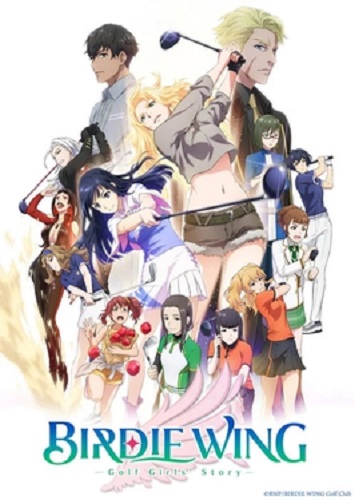
Not based on a light novel, manga, or game in any way, but an ORIGINAL STORY (gasp!), Birdie Wing tells us the story of Eve, a teenage girl who we first meet impersonating a pro golfer for money but whose main job actually seems to be “golf hustler”. She certainly has the skills, which we gradually see she got from a mentor figure (who looks like Char from Gundam – more on this later), but is far too cynical and jaded to see what she does as anything other than “hitting a ball with a stick to make money”. Then one day, on a golf course, she meets top amateur Aoi Amawashi, who is in the country of Nafrece for a tournament, and whose golf excites Eve. And the feeling is mutual. They resolve to play a match against each other to see who is best. The next 24 episodes are about the universe doing everything in its power to try to stop this happening.
Birdie Wing is a sports anime. I’m going to say that over and over again throughout this review, because I think it really has been forgotten among a number of other people who wanted this to be some other kind of anime. It manages to combine elements of both shonen and shoujo sports, with everyone shouting their golf swings like it’s an attack name. The nature of golf conveniently divides most groups into pairs, so, especially once we hit the second arc (there are three), we get a series of golf rivals who are there to briefly suggest that they could be the ones to finally make Eve and Aoi notice someone else, and then promptly get demolished, because there is no one else. Eve and Aoi only care about each other, and in the end what takes them down is not another stronger golfer, but the plot.
That said… no one started to watch this because it was a good sports anime. We watched it for the mafia golf. We watched it for Vipere, a two-bit golf villain who distracted her opponents by unzipping her top down to her crotch to let out her psychotropic “belly button perfume” (sure, Jan) and who later became the series’ version of Speedwagon from JoJo’s (she even withdraws coolly at one point). We watched it for the transforming golf course that looked like Eva-3. We watched it for the rocket launcher. We watched it for THAT scene at the end of Episode 7. We watched it for the music videos in the middle of the show (there were two). We watched it for the weatherwoman certification. We watched it for the possibility that incest would sink our ship, and rejoiced when it turned out to merely be a very fucked-up backstory. And we watched it for Aoi’s 48-incher.
But again, this was a sports anime. It was sponsored by a large number of Japanese golf associations and golf courses, as well as golf clothing manufacturer Jack Bunny (yes, that’s a real company name),. It got a ridiculous amount of hype given what it was. There was the line of golf clothing. There was the virtual museum. There was the video game that just came out last week. There’s a mobile game on the way. And then there’s the Gundam. This series was DRENCHED in Gundam references. Most obviously, Aoi’s coach (and more than that, as the series goes on to reveal) was “Reiya Amuro”, played by the Gundam actor himself. Eve’s mentor Leo not only looked like Char but was played by Char’s voice actor (the two are real-life golf buddies). Eve’s first sidekick, Lily, is obsessed with Gunpla. The tournaments are named after Gundam shows. The final boss golfer quotes After War Gundam X. It was a whole big thing.
And I didn’t even mention Madlax. Remember Madlax? It’s back. In golf form.
This is a sports anime, sponsored by golf people, so of course it’s going to want to sell golf to viewers, and it manages to do this despite being ridiculously cavalier about every single rule of golf. We meet top golfers who take one look at the way Eve swings and run away, convinced that watching her more will destroy their own golf. We meet golfers who can shut off all outside stimulation for better concentration, or who can run at the tee and take a big hack at it like Happy Gilmore. And yet, and YET, the most important episode in the entire series may be the 17th. To the delight of everyone watching, Eve is back in Nafrece, and back in the underground mafia golf complex playing golf for high stakes against a cheating underground golf opponent. And the show tells us that no, we are WRONG to want this. Eve has moved beyond this fake golf. She wants, real, passionate golf. Golf she can only get with Aoi. (Note that Aoi never intersects the mafia plotline once.)
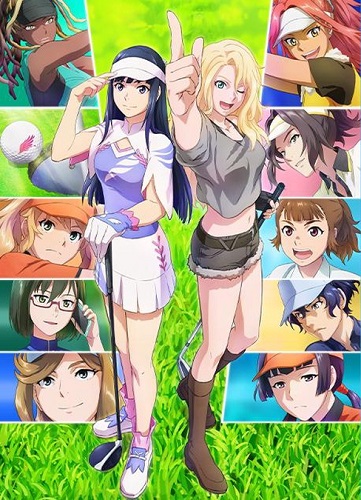
The characterization is great. Eve’s arc, going from a young girl angry at the world but who can find no way to fight against it other than hustling, to a young woman playing in the British Open against her rival, showing genuine grief at someone’s pain for possibly the first time in her life, and only managing to not win it all because… well, did I mention the golf hustling? Aoi is the second protagonist, and for the first half of the series (which ran in Spring 2022) it looked like she was merely a supporting character. But that’s because her storyline had all the non-mafia soap opera drama packed into the second half, which the producers say they did in the style of Korean dramas (I was reminded of Spanish-language “telenovelas” myself). Aoi suffers more than Eve, and loses heart more than once, but this makes her eventual triumph all the sweeter – even if it might be lived vicariously.
And then there’s Ichina, who is the best caddie ever except in the final episode when she backs off because the story demands it. (I get that – most of how Birdie Wing works is that something makes no logical sense but works perfectly as a narrative.) There’s Amane, who is a golf indentured servant who also achieves her goal and dreams. There’s Rose Aleon, a character so powerful that even after her final appearance in the 8th episode, we kept hoping the show would find a way to bring her back. Aoi’s happy go lucky grandfather, who turns out to be abusive and, of all things, a golf eugenicist. Aoi’s mother, who is so controlling that she almost kills her daughter (her line “golf is killing them all” might be the 2nd biggest meme of the series). Eve’s parents, who get a Romeo and Juliet style backstory before ceremoniously killed off. There’s something for everyone.
I have not actually mentioned the relationship between Eve and Aoi, which is another big reason that this became a cult classic. (It never did get to be a big hit and even now anime fans will still say they hadn’t heard of it till it was pointed out to them.) The two of them are drawn to each other immediately, but both stay 100% in character about it. What this means is that Eve teases and draws back and never really commits herself until the very end, while Aoi is a lot more upfront about her feelings, pines away, gets upset, and spends most of the second arc trying to beat Eve so she can get a kiss. Towards the end of the show, when Aoi collapses again, Eve is devastated, showing real grief for the first time. And then they manage to find a way to golf together even when they can’t, and Eve’s final shot, the one that wins the day, combines their two attacks. As was noted on Twitter, it very much was their child.
Does this end with a kiss? No. Does it end with Eve and Aoi saying they love each other, as a couple, or married? No. Is it yuri? Fuck yes. These two spend the entire show only seeing each other. All the other rivals are unimportant – in fact, that’s mined for humor once or twice. The show spends its entire time driving the two of them apart, by mafia shenanigans, by Love Story golf disease, by family on both sides. But the final scene shows them, years from now, still only seeing each, other, still golfing together, and having to be reminded to do so by their caddies lest they just look in each other’s eyes some more. The word “yuribait” was bandied around after the show ended. This wasn’t yuribait. Yuribait would be if the show had ended by showing them married off to some guys. It was never going to do that, because the only major male figures in this show were related to the two of them in some way, shape or form. Honestly, given the way the final episode played out, I think a kiss would have felt out of place. This is enough. They’re together forever, playing golf, just as Aoi said would happen.
Birdie Wing: Golf Girls’ Story was the definition of Must See TV. The yearlong wait we had between the first and second halves made the anticipation all the greater, and in the end it delivered. Yes, the final episode was rushed, and I wish it had been 26 episodes. Yes, the animation quality was merely “adequate”, though it never really got as janky as some other recent series I’ve seen fall to rushed production. It leaves an open ending in case they ever decide to do more (the producer, in an interview, suggested a next-gen sequel might be interesting), or in case fanfic writers want to make the implicit yuri more explicit. It’s the sort of show you immediately want to rewatch,, and I desperately hope it gets a physical release over here in North America. It was amazing. And Aoi’s ball had Pac-Man on it.
Also, it’s “Venus Line”. It’s very audible. I never got the people who misheard it. Sheesh.

