The Ideal Sponger Life, Vol. 12

By Tsunehiko Watanabe and Jyuu Ayakura. Released in Japan as “Risou no Himo Seikatsu” by Hero Bunko. Released in North America by J-Novel Club. Translated by MPT.

You don’t see it quite as much these days, but, especially in the 1970s and 1980s, there was a thing called a “backdoor pilot”. The creators had a show they wanted to get on television, but knew it did not quite have the pull with the networks to get it there on its own. So what would happen is that you’d be watching, say, The Golden Girls, and the episode would instead be devoted almost entirely to a new cast, with the members of The Golden Girls basically serving as a cameo. (See: Empty Nest, as I’m using a real example). Now, sometimes this did not work, and what you ended up with was one of the characters of your hit show meeting a whole group of people, introducing all their plot points and characters, and then we simply never see them again. I mention this because boy, this 12th volume of The Ideal Sponger Life sure seems like it’s a backdoor pilot to show off adventures here in not-Poland.

Freya, Zenjirou and company are making their way slowly back to Uppasala, but they can’t just said there on a non-stop boat ride. So they dock for a few days in the country of Złota Wolność, which is sort of like what Poland would be if it was France. There they try to relax, but are almost immediately caught up in something, as a young orphan boy has big news to tell the priest who came to his (now destroyed) village a year or so ago, and in order to see the priest, he needs people with clout. People like Zenjirou. What they find is that the port is about to be invaded, and they’ll need to rally forces to have a hope of fending it off. Fortunately, they have a royal on their side, who drops in – literally – to help them. Naturally, this has the added benefit of helping her own fight for the throne…

In many ways, The Ideal Sponger Life also reminds me a lot of Bookworm, in that Zenjirou and Rozemyne both seem to casually upend everyone’s lives without even realizing it. I imagine that Aura, like Sylvester, is going to be rubbing her head to ward off the migraine when she hears about what happened. Honestly, Zenjirou does quite well here given the circumstances – despite his “I’m just an ordinary vice-commander… erm, royal consort” talk, he’s quick enough to spot that Anna has an ulterior motive behind all of this. Unfortunately, he and Freya are not quite quick enough to pick up on how she plans to draw them into it, though this will affect Freya more than it does the Southern Continent. There’s also some very interesting history dropped into the conversation at a party which ties in to Francesca’s people, though given that she stated she won’t talk about it till they return to Capua, it may have to be put on the back burner.

All in all, the most inaccurately titled light novel ever continues to trundle along, even as this volume feels like it wants to be the start of some other series set in the same world. Next time we should actually reach Freya’s homeland.

7th Time Loop: The Villainess Enjoys a Carefree Life Married to Her Worst Enemy!, Vol. 4

By Touko Amekawa and Wan*Hachipisu. Released in Japan as “Loop 7-kaime no Akuyaku Reijou wa, Moto Tekikoku de Jiyuukimama na Hanayome (Hitojichi) Seikatsu wo Mankitsusuru” by Overlap Novels f. Released in North America by Airship. Translated by Amy Osteraas. Adapted by Vida Cruz-Borja.

The 4th volume in the series decides to lean a little less on “why is Prince Arnold so determined to go to war with everyone in the future” and focus more on “why are Prince Arnold and Rishe not admitting they’ve both completely fallen for one another? Well, they have, sort of. In their own way. The trouble with agendas is that it can be very difficult to admit explicit feelings of love when you know that eventually you’re going to destroy several countries. Or, in Rishe’s case, when you’re trying to juggle six prior lifetimes and solve each issue with them one by one to get a golden ending. That said, this book is far more explicitly romantic than the previous three, even if it does throw in the cliched “heroine is scared of ghosts” subplot. To be fair to Rishe, though, she has looped over and over. Given that’s possible, anything is.

While the romance at the start of the book is still theoretical, the wedding plans are trucking along anyway. In particular, they’re starting to get foreign visitors who will be there for the wedding, including the prince of Siguel, Curtis, and the princess, Harriet. Harriet is currently preparing for a political marriage in the neighboring kingdom of Fabrannia, a fact that Rishe knows all too well. She was a hunter in Siguel in her 5th life, and remembers Queen Harriet as an evil spendthrift who was executed and led to Siguel being forced to go to war against (who else?) Prince Arnold. As with previous books, Rishe has to fix things so that events don’t turn out that way. This time, though, there’s an added twist: Harriet is a fluffy hamster of a woman, and is highly unlikely to have been remotely evil.

There are several points in this book where Rishe is thrown off her game, but frankly they all involve Prince Arnold. Around him she gets flustered and stammering. Away from him she is, as the antagonist of the book Raul notes, “a monster”. Hell, even Raul isn’t a real antagonist, because here she actually can use all the info from her past life to save him. Harriet is trickier, but Rishe still manages to act as a sword-wielding guardsman, show Harriet that proper skincare is a great way to gain confidence, and fake being poisoned to let everyone think that she won’t be riding to the rescue with Prince Arnold, shooting down enemies with a bow and arrow and dramatically crashing through a stained glass window. Frankly, I think it’s Arnold who should be terrified of her. But this isn’t really that sort of genre.

I can’t wait for the next book. Alas, I may have to. This is the last to date, and a 5th is on Amazon Japan with a release date of “2100”. Let’s hope we can get the end of Rishe’s story.

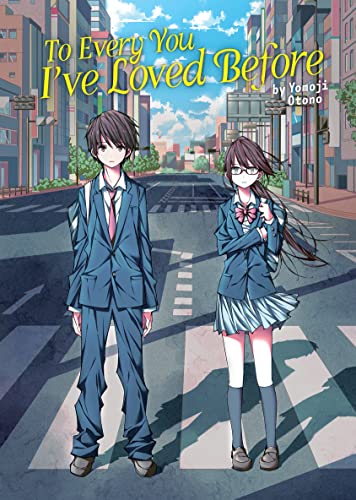
To Every You I’ve Loved Before & To Me, the One Who Loved You

By Yomoji Otono. Released in Japan as “Boku ga Aishita Subete no Kimi e” and “Kimi o Aishita Hitori no Boku e” by Hayakawa Bunko JA. Released in North America by Airship. Translated by Molly Lee.

First of all, I will note a couple of things. a) I am reviewing two linked novels here, so the titles are separated above by the & sign. b) there will be more spoilers than usual. Even summarizing them destroys the surprise. When I first saw the solicit of these two titles, I had assumed they were part of a multimedia project like so many of Yen and Seven Seas’ novel licenses these days, and that it would be another slight variation on Your Name. But no, this is instead more like Otherside Picnic or Last and First Idol, a science fiction series with a heavy helping of theory mixed into its plotlines. Get ready to understand a lot more about parallel universes than you did before. The books were advertised as something you could read in either order, and I read them in the order I give above. I recommend that order too, for reasons I will lay out later in the review. Did I enjoy it? Kind of, in a detached sort of way.

In the first book, we meet the protagonist, Koyomi. He’s a smart kid, with a father who’s an expert in imaginary sciences. They’ve discovered that we’re constantly shifting between parallel universes, and developed wristwatches to let you know when it happens. In high school he meets Kazune, a classmate and rival, and becomes friends with her one day when she tells him she’s a different Kazune from a different universe. The book shows their life together. The second book has the same premise, but here the imaginary sciences are not as developed as they were in the first world. Koyomi and his father work with another brilliant scientist and her daughter, Shiori. Koyomi and Shiori grow close, but when tragedy strikes Koyomi finds himself going down a dark path that may not have a solution.

I can see how the final scene of the first book would be a lot more impactful if you’d read the second one first, as opposed to my own feeling, which was mild puzzlement. That said, I think if I’d started with the second book I’d have dropped this halfway as being too dark and angsty. The first book is a cute romance between two nice people. He falls in love relatively quickly, she takes a bit longer (“You’ll do” was the funniest line in both books), they get married and have a child, they grow old together. The drama near the end is character-based, involving grief and how parallel universes might lead one to commit a crime over that grief. The second book is almost entirely ABOUT that, as Shiori’s death comes before the novel is even halfway finished, and we see a Koyomi who would sacrifice anything to save her. The second book also has a lot more scientific theory to talk through than the first.

Did I like them? They were both good, I had moments of emotion reading them, but ultimately all I can come up with is “yeah, they were pretty good”. This happens a lot with concept SF and me, though. There’s a book that came out last year focusing on Shiori, though, and is this does well maybe Seven Seas will pick it up.