Sasaki and Peeps: Psychic Battles, Magical Girls, and Death Games Can’t Contend with Otherworldly Fantasy ~Or So I Thought, but Now a Storm Is Brewing~

By Buncololi and Kantoku. Released in Japan as “Sasaki to Pi-chan” by Media Factory. Released in North America by Yen On. Translated by Alice Prowse.

It’s getting better. There are still a few times where I wince while reading the series, mainly whenever the neighbor girl is trying to manipulate Sasaki into sexually assaulting her (he doesn’t), but for the most part the series is doing what it does best: mashing up genre after genre and watching our deadpan salaryman crush all of them as he flies past. Sasaki may be a bit of a stoic sad sack, but the series wouldn’t work at all if the protagonist were, say, Kazuma from KonoSuba. It not only requires his experience as a Japanese salaryman to drive a lot of the plot, but also his reserve helps the reader glide through the plot without taking anything too seriously. Which is good, because this series is still mostly a comedy, but also bad, because there are a lot of things I think could do with being taken more seriously, such as getting the neighbor girl some therapy.
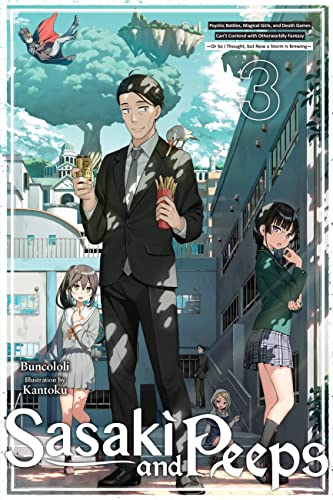
Sasaki continues to juggle the various light novel plots he finds himself in. In the fantasy world, the count’s daughter Elsa is being taken as a “concubine” by an evil Duke, so Sasaki agrees to help fake Elsa’s death and take her with him to Japan, where she can hide out in a hotel. In the “psychic” world, he continues to investigate mysterious happenings (most of which have to do with one of the other genres he’s in) while trying to get enough blackmail material on his suspicious boss. In the “magical girl” part of the book, he finds her trying to murder another psychic. Sadly, before that gets anywhere, he’s dragged into the “angels vs. demons death game” genre we started to see last time, and finally discovers what the neighbor girl has been up to. Unfortunately, everything completely is blown to hell and back due to one fatal mistake: he lets Peeps get drunk.

I do suspect a lot of the salaryman humor in this lands better in Japan than it does here – he’s constantly apologizing to the girls around him, and thanking them for their support of him, in a way that is meant to evoke the office even as it happens while they’re watching demons blow teenage girls’ heads off. The best part of the book was seeing the neighbor finally get drawn into the main plotline as opposed to being a very uncomfortable side story. She’s still very uncomfortable – I hate using the word yandere, but it does apply here, and her rape/suicide fantasies are deliberately disturbing – but now that she’s involved with everyone else, hopefully she can get a little help? Maybe? The book ends in a four-way Mexican standoff between all of the various underage girls Sasaki has pulled into his orbit – none of whom he’s remotely romantically interested in, but I see what you’re doing there. And that doesn’t even count the traditional “looks nine but is decades older” girl. Which, again, light novel trope.

It appears we’re adding aliens to the stack of plots if the cliffhanger is to be believed, though if I were Sasaki I’d worry more about calming down his not-harem first. This series is absolutely not for everyone, but if you have drenched yourself in light novel plots over the years, it can be a lot of fun.
Suppose a Kid from the Last Dungeon Boonies Moved to a Starter Town, Vol. 11

By Toshio Satou and Nao Watanuki. Released in Japan as “Tatoeba Last Dungeon Mae no Mura no Shonen ga Joban no Machi de Kurasu Youna Monogatari” by GA Bunko. Released in North America by Yen On. Translated by Andrew Cunningham.

While I would not say that the cast of Last Dungeon Kid are as bad as Seinfeld, a series where the creators had as one of their series rules “no hugging, no learning”, it is certainly true that any time one of the characters almost reaches a point where they will come to their senses and mature as a person, they immediately backslide horribly for comedic effect. Usually that person has been Marie, and it’s Marie here as well. She’s reaping what she’s sown, as Lloyd is now convinced that Marie is the LAST person that could possibly be the kingdom’s princess, mostly thanks to what a giant disaster she is. A sensible person might think that they should shape themselves up so that Lloyd might be able to see them as royalty. Marie, instead, realizes that her being a disaster means Lloyd is too attached to her to fall in love with anybody, so she doubles down on being terrible. It’s… well, they’re comedy types, Harold.

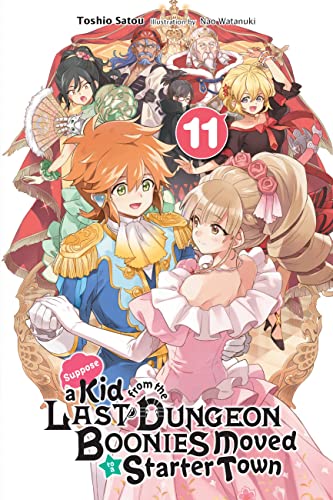
As the country prepares for possible war, our core military cast are going around to various guilds to make sure that they’ll be on the right side when the fighting starts. This includes the adventurer’s guild whose mysterious leader has been absent for years but who returns the moment Lloyd shows up. It also includes the maritime guild, whose head has been fighting with the King for years and years, apparently due to the disappearance of the Queen. The King is trying to move things forward by having a big party where he’ll reveal the return of Princess Maria, and Marie has even agreed to it, in a desperate effort to get Lloyd to believe her. Sadly, when informed that the princess loves Lloyd, he becomes desperate to find the REAL princess… so he can reject her!

I wasn’t kidding when I said that stuff happens immediately after Lloyd gets involved. When he walks in, the plot moves forward. And yes, there is still a plot. Indeed, we get an extended prologue that shows us Alka’s past from before this world’s transformation, and get closer to figuring out who was behind it and what they actually want. We also see the return of the mystery woman who Lloyd met in the “bathroom” he found several books ago. As it happens, she’s deeply tied to both the Kingdom and Alka’s past… but of course she’s also a bit of a disaster, because there really are no 100% serious characters in this book. It reminds me of reading Urusei Yatsura or Ranma 1/2. You keep wanting things to be taken more seriously, for drama, for a bit of romantic resolution. But you can get that in other series that are far less funny than this. This series is here to give us laughs, and though they may be rueful laughs most of the time, they’re still there.

That said, we have to wait another three months while this series’ narrator goes off to do his other job as narrator of Tearmoon Empire. Till then, this is always a fun read, especially if you’ve just read two awful books in a row (like I had).

Yuri Tama: From Third Wheel to Trifecta, Vol. 2

By Toshizou and Kuro Shina. Released in Japan as “Yuri no Ma ni Hasamareta Watashi ga, Ikioi de Futamata Shite Shimatta” by Overlap Bunko. Released in North America by J-Novel Club. Translated by Tristan K. Hill.

“Sean,” my readers say to me. “I’m happy that we’ve gotten a lot more yuri titles in the last few years, but what about fans of incest? Is there a book out there that looks closely at younger sisters who love their older sister and tries hard to do a deep analysis about whether it’s OK or not?”. OK, no. My readers never say that to me. That said, if that’s what you want, I have good news, the second volume of Yuri Tama is all about said feelings, and whether Yotsuba will decide to dump her new girlfriends for her sisters, or just have all of them in a giant polycule, or what. So yeah, good news for fans of that. If, on the other hand, you read the above and said “what the actual fuck?”, then you are like me and stared at this volume with dull horror. The author can certainly write. It’s just what they write that’s the problem.

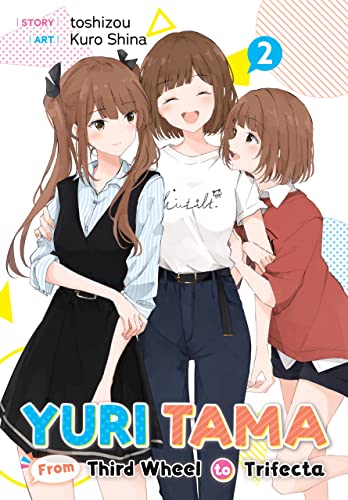
Yotsuba has managed to pass all but one of her exams, despite possessing the worst self-loathing of any light novel protagonist ever. This means she has most of her summer break free, and she plans to spend it dating her two girlfriends (separately). Unfortunately, each date is seen by one of her younger sisters, and now they’re both furious. Yotsuba is sure they’re upset that she’s “two-timing” the girls she’s dating, or they’re upset that she didn’t tell them she was dating at all. They’re not. They’re upset because they’ve been in love with Yotsuba since they were little children, and the idea that two other hussies have snatched her away is appalling. Can a family trip to a hot spring allow Yotsuba to explain? Or will it just make things worse?

So, let’s tick off the things I didn’t hate. 1) The author is somewhat self-aware that they are writing ridiculous shit, and it gets lampshaded a few times. 2) There is an attempt at discussing the differences between sexual attraction, familial love, and close friendship. It’s an attempt that is somewhat steamrollered by the plot, but the attempt is made. OK, I’m done with good things. Yotsuba remains the most annoying narrator ever, not being able to go more than three paragraphs without reminding us how awful and pathetic she is. Her sisters are, not to put too fine a point on it, creepy, and Yotsuba seriously considering loving both of them sexually boggles the mind. And unfortunately, because of this plot, Rinka and Yuna are sidelined. The dates may be the best part of the book, both because they’re not incestuous and also because Yotsuba shows an odd confidence that she doesn’t seem to be aware of herself. I want to explore that, not whether incest is OK.

I wish I could say that the series ended here, but a third volume of this came out last month in Japan. If you are really really desperate for yuri… please read something else anyway. Also, please use the word “two-timing” correctly! It’s consensual! They both know! Explain that!