Baccano!: 1935-C The Grateful Bet

By Ryohgo Narita and Katsumi Enami. Released in Japan by Dengeki Bunko. Released in North America by Yen On. Translated by Taylor Engel.

The author has said a few times that this will be the final 1930s arc, and that after that there’s just one arc in 2003 to wrap up the series. (Admittedly he said that when this volume came out… almost ten years ago… more on that next time.) And on reading this volume, you get the sense that he’s sending the series off with a bang. Baccano! is known for its big cast, but here it feels like he’s trying to have every single main character from the series show up at the same time. We get Firo’s group, Luck’s group (with several additions from Drugs and the Dominoes and Man in the Killer), All Huey’s various Lamia and Larva, Jacuzzi’s gang, the girls from Time of the Oasis, etc. As for the 1700s immortals, for the most part they’re absent from the actual event (Maiza doesn’t count at this point, he’s part of Firo’s group more than he is a 1700s alchemist) but are trying to control or destroy everything there. It’s an all-star finale.

So yeah, Ennis has (sigh) been kidnapped in order to make Firo do something dumb. Fortunately, Firo has matured a bit from the last time this happened, so he merely smolders with controlled rage. The Martillos have his back (well, most of them, Ronny is AWOL) and consider Ennis one of their own. Meanwhile, there’s also the Runorata’s big casino opening, which everyone wioll be attending so that they can watch the other shoe drop. No one is quite sure what will be happening, but they all know it will be happening there. As for Melvi, we find out who he is in this book, but frankly he’s started his downhill slide already, given that he can’t even win against Ennis in an argument about what makes someone human. And then there’s Nader, the least likely protagonist, trying to help Eve and avoid getting caught by Leeza, but also running into someone who knows of his past.

Again, so much of this is just setup. I do wish Ennis had done more (Melvi is threatening her with Czes being tortured, but as we can see, Melvi doesn’t even have Czes, something Ennis can’t really confirm) but I did really enjoy her conversation with Melvi, where she shows she’s a much better homunculus than he’ll ever be. (Speaking of the Dormentaires, we get confirmation that only three of them got immortality in 1711 – Lucrezia, Niki, and Maiza’s dad. Sorry, Lucrezia/Carla shippers.) There’s a lot of potential confrontations that haven’t happened yet (Ladd vs. Claire, Nader and Sonia meeting again) as this book is STILL almost all setup, but we do get a couple scenes we’ve been waiting for, such as Leeza and Chane working together and Huey confronting Fermet. I’d mentioned above that almost everyone from the main cast and supporting cast is here, but Elmer is mentioned but not around – one wonders if he’ll be the fuse for this explosion to come.

The arc still isn’t over, so we’ll have to wait till next time for that explosion. Till then, enjoy the discussion of what makes a human, how much the world runs on fate, and other Baccano! philosophical debates.

My Friend’s Little Sister Has It In for Me!, Vol. 9

By mikawaghost and tomari. Released in Japan as “Tomodachi no Imouto ga Ore ni dake Uzai” by GA Bunko. Released in North America by J-Novel Club. Translated by Alexandra Owen-Burns.

I’m not sure how much longer this series has to go in Japan – Vol. 10 just came out in October there – but I suspect this series is not going to get beyond Vol. 12 at the most, as it’s really starting to wrap everything up. Basically, all the secrets that everyone has been hiding come out here, and come out very publicly. In some cases this is a good thing. We’ve watched Mashiro’s character development from the start of the series, and here we see why she writes and what she takes inspiration from. She’s jealously guarded her own incredibly popular work because she worries others will change it and that it won’t be hers anymore, but coming to terms with her feelings for Akiteru has made her back off on that – and on the fake relationship, which she breaks because she feels it’s holding her back on the chances of a real relationship. She gets some of the best bits in this book… but is still probably coming in 2nd of 2.

The class has a free day, which is good because Akiteru got no sleep the night before as Mashiro, as I mentioned above, breaks up with him. That said, she’s now taking him out on a date to the not-Disneyworld theme park… you know, the one run by Iroha’s mother. Who happens to be there, and gives them free “extra special guest” passes. Of course, they’re followed by Midori, who is still fairly broken up about her rejected confession. Meanwhile, Mizuki takes Iroha to the set where they’re filming, and there they run into Otoi, who does not like Mizuki very much and it shows. After this, they too end up at the theme park, where Mizuki has a meeting. As Mashiro and Akiteru deal with a very scary haunted mansion… erm, sorry, ghost mansion… Iroha also ends up in the same mansion. How many dates is Akiteru going to have, anyway?

The best character in this volume may be Otoi, whose bluntness helps to cut through the aura of bullshit that everyone else around her carries, even if we still don’t know her first name (it’s implied to make people think of toilets). As mentioned above, Mashiro gets a great character development book, but in terms of romance it comes up short – Akiteru thinks they’re on a “real” date, whereas she thinks that they, the creators of a popular horror game, are here for research. It’s funny, but in a bittersweet way. Less funny is Iroha’s cliffhanger. The relationship between Iroha and her mother has always had an air of “final boss” to it, and here we see that Iroha is so terrified of her that when it comes time to admit out loud what she wants to do with her life, she runs away. It’s actually rather depressing.

This does sort of wrap up the arc from last time, but it also has a cliffhanger that promises us that the next book will be a flashback showing us how Akiteru and Iroha first met. After that, we basically have only two plotlines to resolve, as I said. This is a solid series, but I admit I’m more in it for the drama now than the wacky teasing.

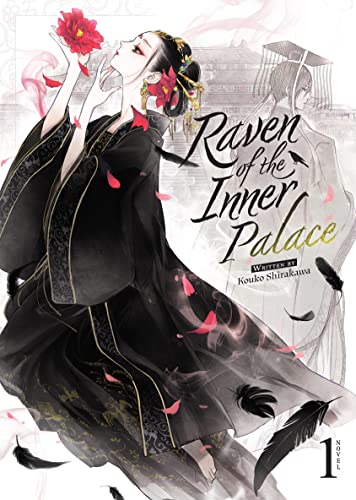
Raven of the Inner Palace, Vol. 1

By Kouko Shirakawa and Ayuko. Released in Japan as “Kōkyū no Karasu” by Shueisha Orange Bunko. Released in North America by Airship. Translated by Amelia Mason.

Sometimes people just want variations on a theme. Looks at why isekai is so popular, despite the fact that everyone you talk to seemingly hates it. Heck, look at Villainess novels, where I feel like Holt from Brooklyn Nine-Nine. “I’ve read this story before.” “AND YOU’LL READ IT AGAIN!” And now we have the mini-genre of “intrigue in the inner court palace of the Emperor and his harem”, where I’ve already got The Apothecary Diaries (mystery series with a side of toxic romance), Culinary Chronicles of the Court Flower (foodie shoujo with doomed romance very much not as the side), and Though I Am An Inept Villainess (bodyswap AND villainess AND romance AND intrigue). And now we have Raven of the Inner Palace, which has mystery, and also romance, but most importantly it has ghosts. So many ghosts, they’re honestly choking the Inner Palace. Fortunately, we have a young woman who can help them move on. Somewhat less fortunately, she’s stuck there for the rest of her life, because she is Special ™.

Jusetsu is the Raven Consort, who, unlike the other Consorts in the Inner Palace, does not spend the nights “having conversations” with the Emperor. Instead, she helps others in the court to find lost items, or to remove a curse with her mystical powers. Now the Emperor, who is relatively new to power after overthrowing the Dowager Queen (who is ludicrously evil in an almost laughable way, despite the fact that we never see her) is here to see Jusetsu to see if she can identify who is the owner of a jade earring dropped on the ground. From here, and despite Jusetsu being standoffish and prickly and the Emperor seemingly being stoic, the two grow closer, and each learns the backstory of the other.

As with a lot of mystery series, I don’t want to give the game away by talking about the plot too much. I do like Jusetsu, who different enough from the other “court intrigue” heroines to be her own person. She turns out to be socially awkward as hell, partly from her tragic past, but mostly, it’s inferred, from the training she got to be the next Raven Consot, which consisted of emphasizing that she should have a minimum of human contacts. That goes out the window in the first book. Not only is the Emperor clearly starting to fall for her (she doesn’t notice) and she gains a court lady and a second servant. This is clearly a good thing for her character development, but I suspect a lot of folks are not going to like her straying out of her lane in the future. It does help that she’s very good at the supernatural part, which is the other half of this book. The ghosts are more sad than terrifying, but I’m sure we’ll have even more of them in future.

This also got an anime in the fall (which, be warned, used the Chinese names rather than the Japanese ones as this translation does). It succeeds for the same reason the other three series I mentioned do. Not because of the genre, or because of the mysteries. It’s because they’re REALLY well written. I wasn’t planning to read more. It’s now definitely one I’ll read more of.