The Magical Revolution of the Reincarnated Princess and the Genius Young Lady, Vol. 3

By Piero Karasu and Yuri Kisaragi. Released in Japan as “Tensei Oujo to Tensai Reijou no Mahou Kakumei” by Fujimi Fantasia Bunko. Released in North America by Yen On. Translated by Haydn Trowell.

In my review of the 2nd volume I mentioned that it wrapped up the first arc in the series, to which I can only say: oops. That said, I am absolutely not complaining. This may not be the final book in the series (there’s at least two more out in Japan), but it’s definitely The Payoff. Following directly on from events in the last book, it has tons of conflict, but it’s all character-based and 100% understandable. It gets into worries about isekai/reincarnation journeys that I always love to see in those books, and also delves into the past of this kingdom and why trying to change it in the future is something that’s going to be very hard and yet absolutely necessary. Basically, this book is everything you wanted to see in this series wrapped up. Anisphia has come a long way from the Chaos Gremlin of the first book. (Not to worry, the anime starts next week, and from what I’ve seen, they’re hammering on that aspect.)
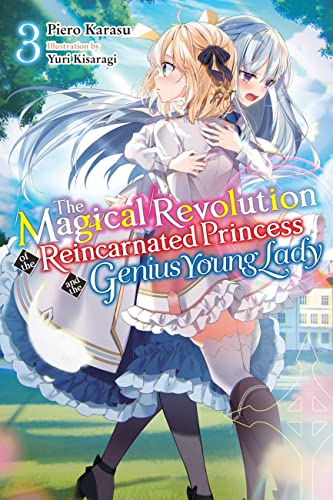
After the events of the last book, Algard has been sent off into exile, meaning that there’s only one really obvious candidate in line for the throne: Anisphia. She proceeds to put on a brave face, buckle down, and accept her fate in a way that devastates everyone around her, because they all know her far too well. This includes Euphyllia, who knows her better than anyone and refuses to accept Anisphia giving up her happiness and becoming a shell of her former self. To that end, she goes searching for a way to bypass Anisphia and find another heir to the throne… and finds there is another way, but it would involve a ton of sacrifice of her own. With both Anisphia and Euphyllia playing a weird game of chicken in trying to sacrifice their own love and joy for the sake of each other, who’s going to blink first?

As I mentioned above, my favorite part of the book was the look at Anisphia’s interiority, particularly something that she’s been half in denial about this entire time. She may have abdicated early in her life, but being a Princess is a very important part of her, and a reason that she’s constantly working herself to death. She also finally confesses to Euphyllia that she’s a reincarnation, and talks about her life back in her other world… as well as what that means to her current self. We’ve seen reincarnation isekai (particularly “villainess” titles) have our reincarnated heroine “overwrite” the original personality when they regain their memories, but here we see Anisphia’s horror at the very idea of doing that. And there’s also the fact that she was reincarnated as a royal that needs to use magic to rule but one who can’t use magic. That unfairness drives her, and also nearly breaks her. Spoiler: there’s a lot of crying in this.

But there’s kissing as well, and I was amused at the book dancing around the fact that the obvious solution is joint rule, but that would involve the country acknowledging their relationship, and I don’t think we’re quite there yet. That said, this was the best in the series by far. I don’t know if I want to see it adapted in the anime – if it is, the anime will have been quite rushed – but it’s a must-read for yuri fans.
The Invincible Little Lady, Vol. 1

By Chatsufusa and fuumi. Released in Japan as “Dōyara Watashi no Karada wa Kanzen Muteki no Yō Desu ne” by GC Novels. Released in North America by J-Novel Club. Translated by Roman Lempert.

I’ve talked before about the fact that I think avoiding cliches is an overrated issue. There have been several fantastic light novels and manga out there that use the same old thing: reincarnated in another world, noble’s daughter publicly shamed, let’s start a new high school club, etc. But as long as they keep the audience’s interest and have a good story to tell using those same old hoary elements, that’s fine. That said… I have my limits. I like to think that the artist read a bunch of popular webnovels and thought to themselves “now here’s MY spin on this idea!”. Sometimes, though, I don’t get that impression. I get the impression that the writer really has no goal or desire beyond “get clicks, get published”. And unfortunately that’s the impression I got with The Invincible Little Lady, a novel that doesn’t really put a foot wrong when it comes to fun characters and amusing scenes, but which feels like it lacks a soul.

Stop me if you’ve heard this one before: a Japanese person lives their life weak and sickly, never leaving the hospital. As they finally pass on, they desperately wish for a strong body that will never lose to anything. Amazingly, God then announces that their wish is granted. Now she’s Mary Regalia, a duke’s daughter and the apple of her father’s eye, in a fantasy land of magic, monsters and swords. As she grows older, she starts to realize that God did the job a little too well. She’s immortal, can’t be harmed, and her strength is off the charts. Same with magic. She needs a maid to cater to her every whim… because if she puts on her own clothes, she tears them, and teacups shatter in her hands if she’s not careful. These are the stats of a great hero! But all she wants to do is life a quiet, peaceful life!

So yeah, if you thought of In the Land of Leadale, or Didn’t I Say to Make My Abilities Average?, you aren’t alone. The author said in the afterword that they had read a bunch of webnovels and just sat down and started banging out one of their own, so it’s not surprising. And to be fair, it’s much better than it should be. The book for the most part avoids sexual assault, slavery, or the other isekai pitfalls. There’s not much fanservice aside from (sigh) Mary bemoaning her small chest and commenting on the chest size of others. It even attempts to have an in-world explanation for why she’s so ludicrously strong – she comes from a family that has ludicrous strength in it already, so no one is surprised. It ticks all the right boxes. But… why should I read more? What is the purpose of the series? I can’t find an answer after the first volume, and that’s a big flaw.

So yes, Sean vs. GC Novels has led to another loss for Sean. This is a well-written book that should appeal to those who want something to read on a plane or the beach. But I want more.

Haibara’s Teenage New Game+, Vol. 1

By Kazuki Amamiya and Gin. Released in Japan as “Haibara-kun no Tsuyokute Seishun New Game” by HJ Bunko. Released in North America by J-Novel Club. Translated by Esther Sun.

I think, like most people, I have no desire to go back in time and try to do things differently. Not because I’m reasonably content with all my life choices, but simply because I know that if I ever did I would be resolutely terrible at it, and probably locked away within the first week. I suppose with Haibara it helps that he’s not all that far removed from his past, but still: there’s too many ways for everything to go wrong. As indeed we find in this book, where we discover that the only thing worse than screwing up, is NOT screwing up. Fortunately, it turns out that Haibara’s old past was mostly self-inflicted, and that he’s hanging out with a nice gang of popular kids. Chitose Is in the Ramune Bottle might argue this is a bit unrealistic, but it’s not meant to be. Everyone knows what they’re getting with this teenage fantasy. And to its credit, it’s written pretty well.

Natsuki Haibara is a college student who regrets his past. He tried to reinvent himself in high school, and it was such a failure that it cost him any friends he once had. He spent the rest of his time in a self-described grey existence. And so he makes a wish to God to get a do-over… and wakes up back in his parents’ home, 7 years earlier. He’s just graduated middle school, meaning he’s still overweight, wearing glasses, and fashion ignorant. He can’t do much about the last, but he can fix the first two, and goes on a month-long binge to get himself to the point where he can have a rainbow-colored high school debut… this time with the experience of knowing exactly where he went wrong. But that experience can cut both ways, and it turns out that just because you’ve gained 7 years worth of talents it does not make you less oblivious about other people’s feelings.

I appreciated that the main conflict in this first volume is not directly about Haibara and a series of girls who kind of like him (though that is of course here as well, as that’s the genre we’re in), but about trying to reconnect with one of the few friends in high school who supported him until he finally screwed up too much, Tatsuya. Initially Haibara is really wary of Tatsuya, and it shows, but he asks his friend Reita (who is the standard “cool hot boy” in these stories) to let him work it out himself. Then, he can’t take his own advice as he’s unable to realize that, thanks to years of extra experience, he’s now TOO perfect, to the point where he makes others jealous of him. And now he doesn’t realize that the answer is mostly “let Tatsuya work it out himself”. Luckily, everything turns out OK.

This can be hard to read at times, especially if you have no desire to relive the horrors of high school interrelations, but it’s solid and avoids most of the pitfalls I was hoping it would avoid. It’s decent romcom, with a minimum of rom at the moment, though I expect that to change.