My Quiet Blacksmith Life in Another World, Vol. 4

By Tamamaru and Kinta. Released in Japan as “Kajiya de Hajimeru Isekai Slow Life” by Kadokawa Books. Released in North America by J-Novel Club. Translated by Linda Liu.

Apologies for being a broken record in the reviews of this series, but My Quiet Blacksmith Life in Another World has a “boring” problem. Yes, I know, “Quiet Life”, it’s that sort of series. I get it. And I’m used to a great deal of the book being detailed descriptions of Eizo making swords or spears or what have you. But usually the second half of the book has things pick up and gives us actual plot. That technically happens here, but… look, let me sum up what happens: they go on a rescue mission. They find the person. They escape. No one ever confronts them, and there are no fights. There’s Quiet Life and then there’s Dreary Life, y’know? What’s more, Eizo once again points out that he has no plans to have sex with anyone or get romantically involved with anyone, as he doesn’t want his line to carry on, so even though we get another addition to the household this time around, harem fans are also annoyed.

The first half of the book is essentially the Quiet Blacksmith Life part. Eizo and his family meet a beastman friend of Samya’s, fight another huge bear (this time far more successfully), and make lots of swords. They even discover a new restaurant in town… though it doesn’t seem to be doing too well. Then there’s a more troublesome problem: there’s an Empire next door, and they’re about to have a revolution of the common people. The actual problem is that they somehow got Helen captured, and Eizo has been asked to help go and save her. Can they infiltrate the Empire, find Helen, rescue her, and escape without anything horrible happening? Yes. See above paragraph.

There are other things that annoyed me here as well. The author straight up states that Helen was captured so easily and acted like a stereotypical helpless kidnapping victim so that she could “show off a more feminine side”, which made my eyes roll so far back in my head I think I broke them. Given that she’s one of the strongest women in the series, and was deliberately shown to be a badass over and over again, that’s annoying, especially as the book ends with her moving in and becoming one of Eizo’s wives… OK, they’re not romantically involved, but they want to be. I’d say this is a plot point, but it’s also not going anywhere, as he has no desires and they’re not rocking any boats. The author also introduced Jolanda and Athena as “novel only” characters, separate from the webnovel, and insists they’re there to add women to Eizo’s life that aren’t living with him. I give it 2-3 books.

Basically, I think I’ve decided to step off the bus here. This is a pleasant, nice series with a number of cute young women and a male lead who is “nice”. It’s basically the standard isekai harem fantasy, only written for 40 year olds rather than 20 year olds. If you want that, great. I’ll read something else.

Yuri Tama: From Third Wheel to Trifecta, Vol. 1

By Toshizou and Kuro Shina. Released in Japan as “Yuri no Ma ni Hasamareta Watashi ga, Ikioi de Futamata Shite Shimatta” by Overlap Bunko. Released in North America by J-Novel Club. Translated by Tristan K. Hill.

One of the strong points of Japanese light novels is that most of them are written in first person singular from the point of view of the protagonist. This is especially true of high school romcoms – when reading Rascal Does Not Dream of Bunny Girl Sempai, it is immediately striking that the narration ISN’T like this. Unfortunately, this can be a double-edged sword. If your protagonist is someone whose thoughts we find ourselves entertained by, or who provides an adept running commentary, it can be quite fun. See Kyon, for example, or Koyomi Araragi. Unfortunately, when your protagonist is annoying, spending time in their head can be unrelentingly exhausting. That’s the main issue we have with Yuri Tama. Yotsuba, the main character, is a pathetic drip who hates herself, something she reminds us about every single page. Which, y’know, whatever. Except that almost every other girl in the series is in love with her. You’ll want to cry out, “WHY?”.

As noted above, our heroine is Yotsuba. The oldest of three daughters, she’s at a very prestigious high school… which she got into entirely by chance, as she used a pencil marked with A, B, C, and D to randomly choose her answers on the entrance exam. Now that she’s a second year, she’s last place in academics, and last place in athletics. However, she does have one thing that makes her stand out. She’s friends with the school’s “Sacrosanct Duo”, Rinka and Yuna. The appearances differ, but you can think “Haruka and Michiru” and you won’t be far off. They’ve also got a fan club!… one that resents Yotsuba for being near them at all. That said, Yotsuba is relatively happy with her friends… till one of them confesses to her. And then she confesses to the other one. And, brilliant girl that she is, her solution is to try to date them both and keep it a secret.

The author previously wrote “The Sidekick Never Gets the Girl, Let Alone the Protag’s Sister!”, another series where I thought it had an interesting premise but the writing choices annoyed me. I can now assume that the author and I just don’t get along. If you’re worried about the “cheating” part of the book, I would not. First of all, I figured out how this was going to resolve about two minutes after Yotsuba hooked up with her friends – it’s really very obvious if you listen to what she’s said about Yuna and Rinka. Secondly, though, this book is broad comedy, with Yotsuba’s comedy reactions to everything being the point. That’s also likely why she is how she is – the fact that everyone loves her (including her two younger sisters, something I should also probably warn readers about) because she’s so pathetic and makes you want to protect her is the comedic gag. For what it’s worth, it does land a few times. I also liked the rare moments when Yotsuba actually was good – the story of how and why she’s friends with the Sacrosanct Duo is the best part of the book.

The yuri in this book is definitely there rather than merely suggested – there’s makeout sessions, and “no, I mean I love you in a romantic way”. And, thankfully, the childhood friends are not interested in each other, so this is more of a triangle relationship rather than an OT3. That said, your enjoyment of it will depend entirely on how much you can tolerate its wet rag of a protagonist and the fact that she reminds you she’s a wet rag constantly.

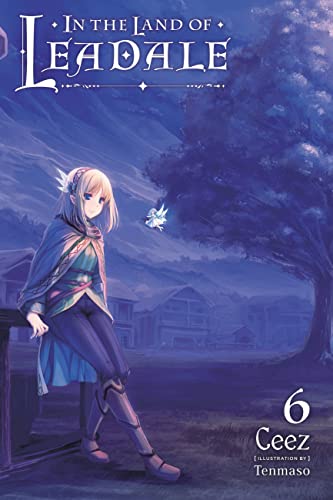
In the Land of Leadale, Vol. 6

By Ceez and Tenmaso. Released in Japan as “Leadale no Daichi nite” by Famitsu Bunko. Released in North America by Yen On. Translated by Jessica Lange.

Last time I wondered whether Opus’ introduction would lead to him explaining the plot a bit more, or just to him being a dick. As it turns out, it’s both. Indeed, the explanations come fast and furious, which is a bit of a surprise. We’ve occasionally thought back to Keina lying in her hospital bed, and how Leadale was created essentially for her. But this volume shows that goes MUCH deeper than we’d expected , and that Cayna is tied to Leadale in a far more significant way than I think she’d really like to be. I don’t want to get too much into spoilers, but suffice to say that Opus’ real-life identity was the least surprising part of it. That said, the real world is not an option for Cayna anymore, so best make the most of it and do what she does best – be a terrifyingly powerful mage who you never, ever want to see get angry. Sadlty, in this volume, Opus is at her side most of the time, so no luck there.

After recovering from her MP-draining rage attack on Opus from the last volume, Opus actually deigns to answers a lot of her questions about the true nature of this world. From there, she goes back to the village she’s now calling home, trailed by Opus and his Maid/Bodyguard/Tsukkomi Siren, who has definite opinions on what servants should be like but also is well aware of how much of an asshole her boss is. She then returns to the capital, where her granddaughter asks her to deal with a loose end… the player/bandit leader she put a punishment collar on several books ago, who has basically learned his lesson. As for Opus, he’s just starting to walk around and get back into the swing of things, but he certainly enjoys putting the fear of God into anyone he interacts with. This won’t change.

There’s a prologue where we see Keina at the hospital, interacting with her family and the programmer who’s there to tell her about Leadale, and it helps to hammer home how mentally exhausted she was in there, and also how truly immature she still is. I’d mentioned the reaction against her violence last time, and I think that’s because we’re told (as everyone else thinks) to see her as a 200-year-old all-powerful grandma rather than a teenage girl who get really, really excited simply by the fact that she can run around. As for her and Opus, leaving aside the various reveals, I am pleased to see that they have exactly zero romantic chemistry together… though admittedly that’s not what the rest of the cast thinks. It’s OK, sometimes you can just have a relationship be two antagonistic friends who have the power to destroy a continent. Cayna yells, Opus smugs, punches ensue, rinse and repeat. It’s fun.

Leadale is not for everyone, and if you didn’t like the anime I don’t think this adds enough value to recommend, but for those already invested, there’s a lot of payoff here you weren’t expecting.