The Saint’s Belated Happiness: Newly Single, Now Living with the Demon Prince

By Hari Garasumachi and Yotsuba Hanada. Released in Japan as “Iki Okure Seijo no Shiawase – Konyaku Hakisareta to Omottara Mazoku no Ouji-sama ni Dekiaisaretemasu!” by M Novels f. Released in North America by Cross Infinite World. Translated by Kai Sadler.

This is another book that falls into the category of “not a villainess, but villainess things happen to her” books. You know, dumped by her fiancee, exiled from the royal palace, etc. Generally speaking, most of the stories in this genre tend to go for the aware, savvy sort of heroine. This is not one of those stories. Honestly, the heroine of this book, Marialite, may be more on the Katarina Claes end of the spectrum – in terms of outward personality they’re not that similar, but they both have “empathy” turned all the way up to ten while “intellectual” is at about a two. Marialite is not an airhead per se… she’s just the sort of character I refer to as the “ara ara” woman. You know, Kasumi Tendo from Ranma. Every situation, no matter what it is, is met with a hand to the cheek, a tilted head, and an “ara, ara”. That’s what we’re dealing with here.
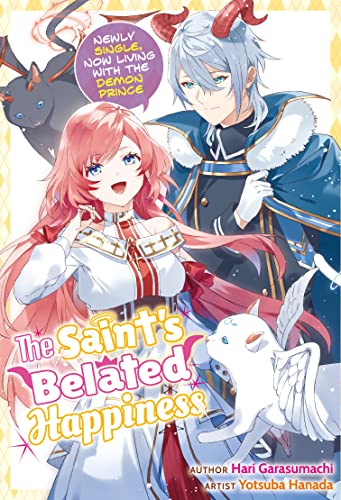
Marialite has had a pretty rough life, though if you asked her about it I doubt she’d say the same thing. Her parents are dead. When she was discovered to be the Saint, her fiancee (who was already cheating on her) was dumped and replaced with the Crown Prince. She then spend the next several years saving the kingdom with her plant-based powers. Now the kingdom has “magic tools” that will do the same thing. And she’s twenty-seven years old. So the Prince dumps her, planning to get a younger wife. Going back to her abandoned childhood home, Marialite finds a young boy hiding inside. Sorry to spoil the surprise (it’s not much of one), but he’s the Demon King of the title, and he gets much bigger very fast. He’s also over the moon for Marialite… who seems to not really realize what love is.

This book is, to be honest, highly variable. The sections with the Crown Prince are amusing if you like to see asshole misogynists get wrecked (and I do), but he’s so one-note it’s hard to really be happy. The best part of the book involves Cornelia, the daughter of a rival dukedom to the Demon King, who is a) an obnoxious ojou-sama, b) with fire magic, c) with cat ears, and d) secretly weak to characters like Marialite, who she can’t intimidate. Everything about her is great, though I wasn’t that wild about the “now she’s a maid” subplot. As for Marialite herself, her naivete about love is presented as the fault of her past relationships, both of which were terrible, but she also admits she doesn’t think she was in love with them either, so there’s little to no hurt feelings or devastation about them. This makes her something of a blank slate, to be honest. I suppose if we can have harem protagonists who are potato boys, we can have the same with shoujo romance protagonists. I just wish she had more personality.

This book does not really have a definite ending, and there may be more coming, but if so it’s not immediately obvious. Till then, if you like “dumped by the asshole prince and finds a better life” stories, or cat-eared red-headed girls who yell a lot, this is worth your time.

Reborn to Master the Blade: From Hero-King to Extraordinary Squire, Vol. 6

By Hayaken and Nagu. Released in Japan as “Eiyu-oh, Bu wo Kiwameru tame Tensei su. Soshite, Sekai Saikyou no Minarai Kisi ♀” by HJ Bunko. Released in North America by J-Novel Club. Translated by Mike Langwiser.

Several characters over the course of this series have noted an odd disconnect between Inglis and, well, everything she says or does. We, the reader, know the reason for this, i.e. she’s a reincarnation of an ancient King. Of course, that’s not entirely the explanation, because the previous King was honestly nothing like Inglis – this seems to be that King unfiltered, with “fight fight fight eat eat eat” as their main theme song. Sometimes, though, this disconnect ends up happening to the reader as well, because some of the events in this volume feel like straight up horror, or tragedy, but they’re not written that way at all. They’re written the Inglis way. Which is to say “Aw, shame that happened, anyway, next battle plz”. And the effect can be jarring. I already have tremendous trouble with remembering anyone in this series who is not Inglis or Rafinha, I need my books to be uncomplicated. And what happens here… is, but that’s the problem.

To sum up this entire volume: “what if Smaug was a woobie?”. Inglis and the others have found an ancient sleeping dragon, but it’s hard to wake him up, so they decide instead to cut off his tail and use it to feel the starving people of that area (well, and feed Inglis and Rafinha, who gets first shot). The tail grows back, so no issues there. Finally the dragon does wake up, and he’s really, really pissed off at Inglis. Sadly for him, Inglis not only really wants a good fight, but is good enough to back up her talk. What follows is almost bullying, and it’s only resolved when the dragon finally decides “why am I bothering?” and stops rising to her taunts. That said, Inglis may have a bigger problem… the folks in the town they’re staying in want to execute Pullum for her brother’s crimes.

As I said, I liked the dragon. He was clearly being led by the nose by Inglis, and his solution to the problem was funny. Even the cast thinks that her plan was “become friends with the dragon”. That’s why the sudden ending of that plotline left such a bad taste in my mouth. It feels like it should be terrifying, sad and awful, but this author cannot really seem to do convey that mood, so it comes out, as most things in this series do, as “OK, so that happened”. Similarly, Ian’s story, which is similar to what happens to the dragon’s, comes to a sudden fatal end here, but there’s no real time for any emotions or grieving because we’ve already moved on to the next crisis. I get that they’re at war, but it’s not letting the reader connect with any of this either, and the result is that we don’t care.

This is still a good book if you like meathead girls who love to fight. But it’s very, very shallow.

Loner Life in Another World, Vol. 3

By Shoji Goji and Saku Enomaru. Released in Japan as “Hitoribocchi no Isekai Kouryaku” by Overlap Bunko. Released in North America by Seven Seas. Translated by Eric Margolis. Adapted by Veles Svitlychny.

Increasingly reading Haruka’s narration in Loner Life is sort of like trying to solve a puzzle. Class Rep actually lays it out for us midway through the book: Haruka simply is incapable of seeing anyone’s actions except in the absolute worst way – and that includes his own. It’s especially true of him, in fact, because – with the exception of Angelica, who he has a very different kind of relationship with – he does not want to have anyone get too close to him or even like him all that much. For all that he complains about constantly getting lectured or having no money, it’s a situation he deliberately engineers himself. And I hate to break it to him, but the ship has definitely sailed with some of the girls – Class Rep, if no one else, certainly has feelings for him. But it gets to the point where even a spy sent to see what Haruka is like gets the absolute worst impression of him… at least till everything blows up.

After getting back from the Ultimate Dungeon, Angelica in tow, Haruka and his friends now have to go around trying to clear out all the other, lesser dungeons that lie around their town. Haruka’s casual, vicious approach to this makes everyone feel incredibly sorry for the monsters who just happened to be in his way. That said, he’s also casually doing things like saving the livelihoods of a dying hamlet by getting rid of the dungeon (and also giving them medicine and food, something he fails to mention in his tortured narration) or converting the general store in town into a 5-story department store with the latest fashions (also created by him, which prompts the girls to wonder when exactly he read so much about fashion). But when the “Stalker Girl”, aka spy, arrives from the noble city that financially cripples their town, it’s Haruka who sees the larger picture as to what’s going on.

It’s not quite as jaw-dropping as the speech from When Supernatural Battles Become Commonplace, but Haruka’s breakdown near the end of this book is startling in how (seemingly) out of character it is, as for once he briefly breaks his facade to try to convince the girls that they’re all in serious trouble here. The corrupt lord ruling the area is not above sending soldiers to wipe them out, and he’s also certainly going to kill the spy once she gets back and delivers her report. He spent the entire time he was dungeon crawling with the spy at his absolute trashiest and worst in order that she could go back and say that he’s not worth caring about, but when this didn’t work he finally snaps and has to fix things. Class Rep and the others get it, even if Haruka doesn’t want them to – she says he and Angelica “destroy tragedies”, and that’s as good a description as any.

One last thing: yes, this is the one with the vibration magic. Between that and Haruka’s “nighttime activities” with Angelica, the light novels are 200% hornier than the manga equivalent. The manga is still probably a safer bet, but the light novels remain a fascinating but flawed experience.