Strike the Blood, Vol. 21

By Gakuto Mikumo and Manyako. Released in Japan by Dengeki Bunko. Released in North America by Yen On. Translated by Jeremiah Bourque.

For once I have actual things to talk about in this volume of Strike the Blood, which is fairly low on cool action sequences. And by “fairly low” I mean there are still about 50% action scenes in the book. However, Kojou being depowered means that he can’t participate in them – indeed, for once, HE is the damsel in distress, as he makes a Faustian bargain that ends up biting him in the ass… gosh, where have I heard that before? So it’s up to Natsuki to get the band back together, as all of the girls who are in love with Kojou and also superpowered (and yes, this includes the two grade schoolers, though at least an objection to this is raised) band together to offer themselves as blood servants. All this so that he can control the new beast vassals inside him, regain his vampiric nature, and this series can FINALLY wrap up in the next. book.

There’s a bit of poignancy at the start of the book, as Kojou is forcibly reminded (by his childhood friend, no less) that giving up his powers means he is no longer the protagonist and therefore he needs to just go away. Of course, that does not stop him trying to think of ways to save Avrora, and he’s helped in this by the First Primogenitor and his servant, who could use a good laugh… erm, I mean, genuine have a desire to see Kojou succeed. Unfortunately, this goes so badly that Kojou has to literally be put on ice for twelve hours while Yukina and company try to gather twelve blood servants who can help to fight and quell Kojou’s twelve new beast vassals. Unfortunately, some of them are easier to persuade than others.

I’ve talked before about how Strike the Blood’s humor frequently is painfully unfunny,l though it’s gotten better recently. (It’s hard to top the record holder in “bad humor in light novels”, A Certain Magical Index.) As for this volume, well, it has a really solid joke that made me laugh. The way that Asagi gets the Second Primogenitor to cooperate with them is genuinely hilarious and also true to character. I will therefore forgive the “we have to fight while dressed in bunny girl outfits” bullshit, which is as lame as it sounds. And doesn’t work. Honestly, girls, it’s been twenty-one books and you’re still trying to figure out what makes Kojou aroused? Even hardcore yanderes would have given up and and found another love interest by now. We also seem to be confirming, in case you hadn’t guessed, that future Kojou is going to have multiple wives – my guess is twelve, though hopefully they will not include his sister. Or his teacher. Or the tank-driving grade-schooler. (Sadly, pretty sure it will include the succubus grade-schooler.)

Strike the Blood is never going to rise above the level of “solid”, and this volume also had some boring parts where it tried to give backstory and explain the villains, which I expect few readers care about. But it sets up the finale and gives the anime fun stuff to animate. That’s really all you can ask.
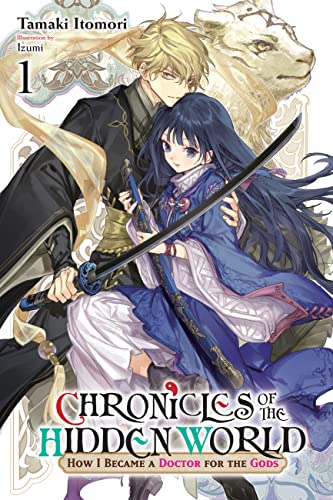
Chronicles of the Hidden World: How I Became a Doctor for the Gods

By Tamaki Itomori and Izumi. Released in Japan as “Kakuriyo Shinjuku: Isekaide, Kamisama no Oishasan Hajimemasu” by Kadokawa Beans Bunko. Released in North America by Yen On. Translated by Luke Hutton.

Given the huge explosion of villainess stories we’ve had in the last few years, I’ve actually seen some people describing the genre as “isekai for girls”, which is ridiculous. Mostly it’s ridiculous because we already have a well-established isekai for girls genre, called, well, isekai. My god, it’s as if Fushigi Yuugi never existed. This sort of isekai usually involves a young girl transported to another world, discovering that she has powers no one else does, and also attracting the attention of a number of handsome young men, all of whom are usually either divine spirits of some sort or at least supernatural. And aside from the fact that Yae is reincarnated into this world rather than being transported, this new series hits all of those buttons. Fans of Kamisama Kiss and the like will enjoy this greatly… though possibly the other big difference is in our heroine, Yae, who has a heaping helping of self-deprecation that’s destroying her life, even if she’s not aware of this.

Yae, in Japan, lived a relatively unhappy and unassuming life where she spent most of her time accepting whatever anyone else pushed onto her because she was “nice”. (This may sound familiar to the target reader for this series.) She then dies and is reincarnated in Kumo, a land that seems to be connected to Japan in many ways but is also very different and filled with divine beings and cursed beings. The world is no stranger to isekai reincarnation, and Yae is eventually taken in by a village chief, the typical solution to such matters. Sadly, Yae is NOT like those other isekai girls. She retains her memories of Japan, and she also lacks a “nature”, which helps to define a person in this land. As a result, she feels like an outsider in her village. Then, one day, while doing a yearly ritual, she ends up freeing a divine spirit…

This is one of those books that’s all about the worldbuilding. Yae can be a bit over the top in her moping, and the revelation that it’s actually her who’s distancing herself from everyone else rather than the other way around is not exactly a news flash. Arai, the divine spirit, and his brother Sui, are both fairly standard types for this sort of story as well. However, the world itself is amazing, with artifacts from Japan ending up here changed in size and use – Yae’s new house she settles down in is not literally named as such, but it’s clearly a Coke can the size of a house. I also really liked the way that she uses her “doctor” abilities to cure those with afflictions and curses, which again involves some really cool descriptions and imagery.

The series clearly sets itself up to have Yae and her two boys wandering the land seeking out others who are suffering and “naming them”, in a way that will sound VERY familiar to anyone who’s read Natsume’s Book of Friends. That said, it’s been two years, and this is the only volume in this series, so we’ll just have to hope for more down the road. I definitely enjoyed this one, though.

Konosuba: God’s Blessing on This Wonderful World!: God’s Blessing on These Wonderful Adventurers!

By Natsume Akatsuki and Kurone Mishima. Released in Japan as “Kono Subarashii Sekai ni Shukufuku o!” by Kadokawa Sneaker Bunko. Released in North America by Yen On. Translated by Kevin Steinbach.

After a couple of volumes where I felt that perhaps the page count did not justify the limited content within, this final book in the main KonoSuba series seems to be just right. The final battle against the Demon Lord contains just about everything you’d want in a KonoSuba book. Kazuma wins by being kind of scummy and tricky; Aqua wails and whines but is also kinda lovable; Megumin casts explosion so much that the overuse of magic makes her nose bleed (at least I hope it’s due to overuse of magic, as otherwise that’s one weird fetish); and speaking of fetishes, Darkness is Darkness. The only thing missing is Yunyun being toyed with; she’s here, but mostly functions as a real competent person. As for the plot, it’s pretty much what you’d imagine, and the one big surprise I had with the book was not seeing one of the characters killed off, but when it happened.

We pick up where we left off last time, with our heroes getting most of the Demon King’s minions out of the castle by simply having Megumin carpet bomb it to death. And yes, she does this with Yunyun and the other heroes IN the castle. Then they’ve got to go find Aqua, which Kazuma does almost immediately, as he overthinks a trap for dumb people and therefore picks the dumb option. We then get a series of KonoSuba-esque scenes, which involve fighting minions, arguing, and comedy, until everyone reunited and takes on the Demon King and his most powerful supporters. Unfortunately, the Demon King is not named that for nothing; he’s pretty much impossible to kill, unless Kazuma does something that he’d really rather not do, as he was told that if it happens again there’s no turning back…

I’ve spent several reviews discussing the romance, such as it is, in KonoSuba, and it’s therefore amusing how little it actually matters here. Megumin’s still in the lead, yes, but that’s mostly by default, and it’s mentioned that darkness is turning down the many marriage proposals she’s getting for a reason, and that, after the final battle’s legend is passed around, Princess Iris has more of a crush on her “older brother” than ever before. But the romance is irrelevant because it’s secondary to the family. This whole adventure came about not because they actually wanted to kill the Demon King, but because Aqua was depressed. By the end of the book we’ve solved that, although I think Aqua wishes there was a way to do that that involved less of her sobbing desperately. The series ends restoring everything to the status quo, although things will presumably be easier with the lack of a Demon Lord making all monsters stronger than they should be.

There are many other unlicensed spinoffs in this series, featuring Darkness, Dust and Yunyun, Cecily, etc. The author also says he has ideas for sequels – this volume has several final battles, both in Axel and at Iris’ castle, but we don’t actually see any of them, and it’s hinted he may write that as well. That said, aside from the upcoming fanbook, I think Yen On is finished with KonoSuba novels for now. This is a very satisfying conclusion, and all fans should enjoy it.