The Saga of Tanya the Evil: Viribus Unitis

By Carlo Zen and Shinobu Shinotsuki. Released in Japan as “Youjo Senki” by Enterbrain. Released in North America by Yen On. Translated by Richard Tobin.

Credit to the author for knowing his key strengths. He is very good at having our heroes assume something about the enemy, and then cutting to the enemies’ viewpoint and seeing that this is 100% incorrect. Missing the real point and assuming the worst are The Saga of Tanya the Evil’s bread and butter, and we get a ton of that in this volume. Tanya is seriously thinking about defecting now, but worries that she doesn’t bring anything to the table and other countries don’t know who she is… despite her being the most infamous soldier of them all. She and the rest of the battalion assume that the Commonwealth are sending their new recruits to be meat shields as part of some sinister plan… but it’s just the fact that the battalion catches them completely flat-footed. And everyone on the Empire’s side is trying to see how to end the war in a way that will not destroy the country or inspire a revolt among the populace… but this war is no longer winnable.
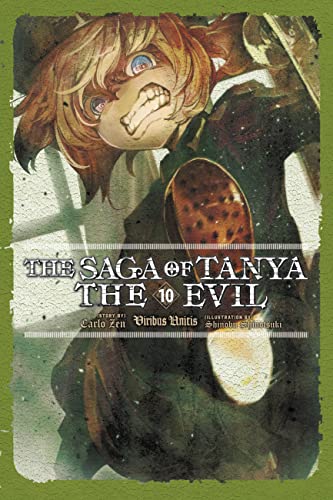
Tanya is all over the place this volume with her battalion. First she travels back to the Federation side where she has to help with a very clever and convoluted plan of Zettour’s that requires her to essentially be a decoy. Then she has to go all the 3way back to the West, as Romel has a master plan to hit the Commonwealth where it hurts, in their Navy… a plan which also requires Tanya and her group to essentially be a tasty distraction. Both times things work a bit too well simply because Tanya and her fellow soldiers have gotten inhumanly good at what they do. Sadly, this book is no longer about military victories but about political victories. And those are in short supply. The military can’t help there. The foreign office, with all the diplomats, is trying to do something about three years too late. And Rudersdorf still seems very hung up on a plan that is 100% treason.

Fans of Visha will be happy to see she gets some time here, mostly hanging by Tanya’s side during the battles, though we also get Tanya trying to lecture Visha on how to end the war, something that does not go very well – Visha, like the rest of Tanya’s soldiers, is a bit of a meathead when it’s not about battle. There’s also a lot of focus here on Drake, the Commonwealth soldier who’s currently allying with the Federation… at the request of the Commonwealth, which makes it all the more irritating they think he might be turning communist by simply being near them. One character is interesting merely by her almost total absence. Mary Sue is here, but we don’t see her except as a sheer force – literally. Once again she sees Tanya and goes for the kill, and no one can stop her. She doesn’t need a face, or even a name anymore. She’s pure magical vengeance, here to smite Tanya down. I don’t know when the final confrontation between them comes, but it won’t go well.

There’s a new translator here as well, and the book still reads pretty well, though it’s a bit more… staid, I guess. It can be hard to make the dry military chronicle parts of this book sing on the page. Still, definitely looking forward to the next volume, as we see if we really will go down the dangerous route we’re headed.

High School Prodigies Have It Easy Even in Another World!, Vol. 6

By Riku Misora and Sacraneco. Released in Japan as “Choujin Koukousei-tachi wa Isekai demo Yoyuu de Ikinuku you desu!” by GA Bunko. Released in North America by Yen On. Translated by Nathaniel Hiroshi Thrasher.

I am tempted to simply cut and paste the first paragraph of my last review here, because it applies even more. The middle section of this book is some of the bleakest, most cynical stuff we’ve seen in this series to date… and it’s a series that’s rooted in cynicism, so that’s pretty impressive. The Reform Party leader is seen as well-meaning but naive, and gets taken to the cleaners by the more experienced nobles. The leader of the interventionist party is a figurehead who has no idea what her supposed allies are planning behind her back, and when she finds out, well, bad things happen. (More on that later). As for Tsukasa and company, well, they get the confirmation they need that something is rotten in Yamato, and have to make a graceful retreat courtesy their powerhouse Aoi. It would be a dark but strong book in the series… were it not for the climax. Instead, I almost feel like dropping it.

Meeting with the leaders of Yamato, and after a brief game of Spin the Bottle that is the sole attempt at humor in this book, Tsukasa and the others get confirmation that, indeed, the nation is so peaceful and happy because of mind control – and that Princess Mayoi is driven by a fierce hatred and contempt for everyone around her. Making their escape, they end up reconnoitering with the resistance unit, which has far more resistance than Tsukasa expected. At the same time, the election heads to its conclusion, and unfortunately is being entirely controlled by Glaux, the noble who is manipulating both sides, plotting murders, and also selling out his country to boot. Fortunately, the cover up of one of his murders is not as smooth as he thinks, especially with Keine on the scene.

The dramatic revelation of just how evil Glaux really is was predictable, but well-handled, and Tetra’s murder was brutal and tragic. I knew Keine was going to be involved in some way, and when she didn’t show up until later I assumed it was going to be to help with the time of death at the autopsy, which it was. That said… Tetra showing up alive at the end of this book is jaw-dropping in its awfulness, and feels like a betrayal of the reader. I already don’t like Keine to begin with because she strikes me as the biggest sociopath among the prodigies, but I acknowledge she can work miracles. But there’s miracles and then there’s impossibilities, and please do not stab someone through the heart, then chop at their neck, then leave them for days, and expect be to be happy that they were somehow resurrected. It’s absolutely ludicrous, and makes the whole election feel pointless. I hated it.

At the time of this review the 7th volume of High School Prodigies is not solicited yet, and perhaps that’s for the best. I need a break to get the taste of this book out of my mouth.

High School DxD: Ragnarok After School

By Ichiei Ishibumi and Miyama-Zero. Released in Japan by Fujimi Fantasia Bunko. Released in North America by Yen On. Translated by Haydn Trowell.

If you’ve read the previous volumes, you know what the plot of High School DxD is: breasts. Everything else is secondary. That said, it is a shonen battle manga, which means that the breasts are not even there to titillate the reader or make them horny. They’re there as a weapon in Issei’s arsenal. Indeed, every new book brings with it a new breast power-up, and so we may as well talk about Issei loving breasts the way that we talk about Izuku using All Might’s Smash moves in My Hero Academia. It’s also very telling that, in universe, Issei’s shtick is popular with little kids rather than women. The kids don’t really get the sex part, they just see him busting out cool moves. It also shows off Issei as someone who really should mature a bit more before he starts getting his harem… something he seems to know anyway, rejecting Akeno’s offer to sleep with him because she “looks sad”. If you’re going to do a harem, do it properly.

Our heroes have been busy lately, as a bunch of heroes/terrorists keep showing up to try to fight them. The motivation of the other side is rather baffling till they figure out that they’re trying to force Balance Breakers by repeated combat. Which is, well, a tad unethical. That will have to wait for future books, though, because Odin is in town, supposedly here to meet with the Japanese gods but more accurately to go on a pub crawl and look at large-breasted women. (Notably, his hot Valkyrie bodyguard, Rossweisse, is not good enough – indeed, he abandons her at the end of the book.) Not everyone wants Odin to talk with other gods, though, and Loki shows up prepared to stop things by force if necessary. And he’s brought Fenrir with him. As a result, well, the subtitle of the book is accurate.

We finally get Akeno’s backstory here, and is it a bit disappointing at how normal it is. Well, as normal as a backstory can get when your relatives murder your own mother in front of you, but it really boils down to “I hate daddy because he’s never home” to a much larger degree. That said, things get resolved a bit too quickly here, and it feels like the author, having shown us how Akeno acme to hate her father, now feels it’s not necessary anymore. As for the rest of the book, well, lotsa fights. Indeed, we even get enemies teaming up, as in order to stop Loki, Vali and company are brought in, with him agreeing to put off his fight with Issei in order to fight someone equally badass. I did like his scoffing at Issei’s idea of peace, and pointing out that would be a nightmare to people who live for battle. Not everyone wants a Happy Harem After.

This was not quite as good as previous books, feeling a bit like it was filling in time. It did introduce Rossweisse, but she doesn’t do much here aside from whine and moan, so I assume we’ll develop her in later books. Average DxD, which is to say below average in terms of normal light novels.