Dragon Daddy Diaries: A Girl Grows to Greatness, Vol. 3

By Ameko Kaeruda and Sencha. Released in Japan as “Totsuzen Papa ni Natta Saikyou Dragon no Kosodate Nikki: Kawaii Musume, Honobono to Ningenkai Saikyou ni Sodatsu ” by GC Novels. Released in North America by J-Novel Club. Translated by Nathan Macklem.

This series, and really all series that star protagonists who start out as the strongest in the land and stay that way, has a basic problem: there’s really not a lot of places for their growth to occur. The titular dragon daddy has an advantage here over his daughter as he’s still learning about how humans (and indeed demons) react to things and what their value systems are. But Olivia… sigh. I love this series, but if it has a weak point it’s Olivia, who is the best kid and the most powerful kid and not much else. She can’t really start the drama. She can’t make mistakes. The most she can do here is to suggest that their quest for magical items amount to a summer visit to her friend’s houses, because no one has any idea where these items are. Fortunately, we do have a character in this book who screws up all the time and it a bit of a mess. She shines here.
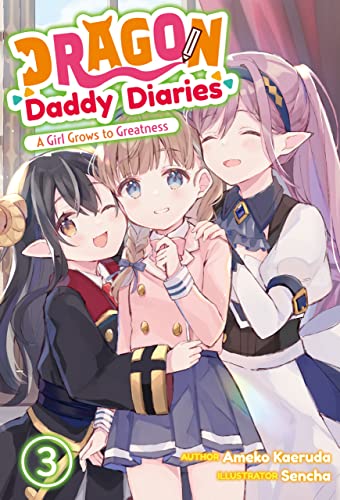
School’s out for summer, but the Queen has a project for Olivia and her father. There are several magic artifacts that need to be drained every 30 years or so, with the added bonus of granting a wish. Unfortunately, almost all of them have been missing for about a thousand years. They need to be found, despite no one knowing anything about them. So Olivia visits all her friends, and one by one she and her father see different sorts of miscommunication between parents and their children and teaching them a valuable lesson. It’s actually pretty heartwarming. Meanwhile, our resident Dark Queen is… sulking in her castle, wanting to hang out with everyone but also wanting to be a lazy shut-in. That said, she also has an idea where one of the magical googaws is… but it would involve returning to the demon realm and facing her comeuppance.

I’ve said before that I enjoy the wacky antics of Maredia and Clowria, but I enjoyed them even more here when things got more serious. OK, only a tiny bit more serious – we meet the rest of Maredia’s family, and it turns out they’re all chuuni NEET shut-ins just like her. But a lot of the behavior that she’s been trapped in a vicious cycle for was brought on by crushing expectations from the demon world, and she blames herself for failing them all. The trial that the ruler of the demon world must pass is in two stages, and the first is easy, as she elects to take it with her friends, two of whom are well-nigh indestructible. But the final test is her on her own, facing her worst fears. It can drive a person mad. Fortunately, Maredia is an old hand at screaming at herself in her own head.

As with the previous books, there’s no explicit yuri here, but I mean, Maredia and Clowria give each other rings, with Maredia even going down on one knee to do it. That’s near as dammit. I’m not sure when the next book in the series is coming out, but it’s likely the final one. I liked this a lot.

My Daughter Left the Nest and Returned an S-Rank Adventurer, Vol. 3

By MOJIKAKIYA and toi8. Released in Japan as “Boukensha ni Naritai to Miyako ni Deteitta Musume ga S-Rank ni Natteta” by Earth Star Novels. Released in North America digitally by J-Novel Club. Translated by Roy Nukia.

This third volume returns to the same structure we saw in the first, moving back and forth between Angelica’s life in the big city and her father’s life back in the sticks. Of course, neither one of them lack for things to do. On Angelica’s end, she runs into Charlotte and Byaku, the child villains from the previous book, who are trying to repent but perhaps going about it the wrong way. On Belgrieve’s end, the forest next to his little village is getting increasingly dangerous, to the point where there has to be something behind it. He goes investigating with the help of Duncan, his battle-hungry new friend, Graham, a legendary elf warrior, and Marguerite, a not-so-legendary elf who’s more of a hothead than anything else. Their paths don’t intersect this book, but rest assured Belgrieve is always on Angelica’s mind: she’s trying to find him a wife!

I compared Charlotte to Ilya from Fate last time, and it’s pretty clear that this is the Ilya from the first route. Not that Charlotte is dying from being a homunculus anytime soon (though hold on to that thought) but more that she needs a stable family life in order to be able to recover from her tragic past and her present misdeeds. Angelica provides that for now, and is a pretty decent big sister, but it’s clear that she’s going to need Belgrieve to step in, as Angelica just can’t be doing this AND taking down the strongest enemies at the same time. I also enjoyed the discussion of how Charlotte is trying to apologize for her past religious scams – giving everyone their money back and saying the amulets are phony – and the others taking the time to explain to her why that’s not working and why people are angry with her, as well as what she can do to actually become a better person.

Now, back to the homunculuses. There is a plot to this book beyond cute daddy-daughter antics, and the villains seem to be creating supervillains, though how villainous they are is a matter for future books. Certainly Byaku is one of them, and they seem to be able to remove his super powers at will, leaving him mostly just a grumpy teen. That said, he can also see what we’ve suspected since the start of the series – Angelica is no normal kid, but more like him. She, of course, doesn’t want to believe this, because her being a foundling doesn’t really matter as all her strength comes from her father. Now, it may be true that her TRAINING comes from her father, but her strength certainly seems to be something more. This should be a very interesting plot going forward.

All this and a cute elf girl, though not the cute elf girl that Belgrieve has been pining for from his past. (Sorry, Angelica, your dad has a lost love that likely needs to be resolved before you can hook him up with anyone.) This remains a very enjoyable fantasy series, with a fun and slightly airheaded lead.

The Saint’s Magic Power Is Omnipotent, Vol. 6

By Yuka Tachibana and Yasuyuki Syuri. Released in Japan as “Seijo no Maryoku wa Bannou desu” by Kadokawa Books. Released in North America by Seven Seas. Translated by Julie Goniwich.

One of the better things about this new volume of The Saint’s Magic Power Is Omnipotent, aside from waiting till near the end of the book to justify that title, is that it’s committed to trying to figure out how the magic in this world works, rather than just seeing it as a stat. Of course, it IS a stat here, and we get lots of talk of HP and MP, But Sei realizes here that potions and medicine are not the same thing, and that in fact the use of potions may mean that diseases and maladies that might otherwise have been researched and analyzed are completely glossed over. That said, medicine takes years of testing and watching for side effects, and may not be all that potent, whereas potions are a magic cure-all that you just need to drink down. I don’t see one supplanting the other, especially given that Sei manages to invent the bestest potion of them all. The secret? Apples.

The bulk of this book concerns itself with the arrival of a visiting dignitary from the nation where Sei got her Asian food last volume, which continues to be very much not-China. One of the many princes in this country, he is here to study herbs and medicine, and despite the best efforts of the kingdom to hide Sei whenever he’s around, it’s pretty inevitable that they eventually run into each other. While she’s able to conceal her identity as the Saint to a certain degree, she can’t help but find a kindred spirit in the Prince, who really seems to know his herbs… and is also searching for a specific kind of cure. Can Sei manage to figure out what it is that the Prince’s mother has wrong with her? And if not, is there a way that she can weaponize her OPness to save the day?

The cover art shows off Prince Ten’yuu as a handsome bespectacled young man, but what I noticed more was the internal illustration, which showed him with the “spiral coke-bottle glasses” common to Chinese stereotypes in Japan (see Ranma 1/2 for the most famous instance). Fortunately the stereotypes seem to end there, with the main plot instead revolving around him as a sort of villain (everyone’s trying to stop him seeing Sei and figuring out who she is) who eventually becomes sympathetic (when we find the reason he’s there in the first place). It also reminds us that keeping Sei under wraps just is not going to fly as a long-term plan for much longer. Marrying her off to keep her in the Kingdom seems like the obvious answer, but again, she’s still in the ‘blushing maiden’ stage, and Albert is not inclined to push the matter. The politics remain boiling quietly in the background.

This is apparently one of the top ten light novel franchises in Japan right now, and I can see why. It’s solid and has likeable characters, and Sei is overpowered without being boring about it. She puts in the work.