Prison Life Is Easy for a Villainess, Vol. 1

By Hibiki Yamazaki and Tetsuhiro Nabeshima. Released in Japan as “Konyaku Haki kara Hajimaru Akuyaku Reijou no Kangoku Slow Life” by Enterbrain. Released in North America by J-Novel Club. Translated by Sean McCann.

We’ve seen enough villainess stories by now that we’re used to the subgenres and deconstructions. We’ve seen ditzy villainesses, crafty villainesses, fleeing villainesses, and depressed villainesses. We’ve seen women who are aghast at how the relationships have changed around them, and other women who have no idea that they’ve become a beloved and cherished young lady. That said, for the most part even the most excessive of the villainess books has had a similar theme, which is “I am a villainess and I want to stop being one”. But what if our heroine is in fact a terrible person? What if she has not awoken to her past memories but simply been holding back her true self naturally? What if the world she lives in is, in fact, a cartoon? This novel is here to answer those questions. If you’ve been dying for some gaslighting, gatekeeping, and girlbossing, Rachel Ferguson is here for you. Even if she’s also behind bars.

Despite the villainess tag, there’s no past life from Japan or otome game hijinks here; it just describes our protagonist. Rachel is the duke’s daughter and the fiancee of the prince… however, he accuses her of bullying his new love, Margaret, and (as the King and Queen are conveniently away) tosses her into a cell. A… strangely full cell. What are all those packing crates doing there? Why is Rachel sitting on a chair eating canned food and sipping wine? Why does she have a COUCH? Most of all, why is she not sobbing and begging for mercy? Unfortunately for Prince Elliott, it turns out that Rachel’s somewhat detached, doll-like demeanor was hiding her true self… which everyone but him (and the other men Margaret is manipulating) seems to know about. And now that the beast has been let loose, Rachel is going to destroy him. Peacefully. While enjoying her prison life.

As noted, this book works best if you think of it as a cartoon, with Rachel as Bugs Bunny and Elliott as Yosemite Sam. The main reason for this is that if you try to find sympathy for any of these people, the story will collapse. The author wants the reader to be delighted at Rachel torturing people for her own amusement. Fortunately, for the most part, I am. Rachel is a bitchy delight. Elliott is the perfect dumb clown villain the book needs (it would not work with anyone smart of likeable). Oddly, Margaret, the commoner-turned-baroness’ daughter who started all this, ends up coming off as oddly cute, possibly as she’s clearly meant to be an innocent teenage brat rather than a scheming vixen. The book expands a lot on the original webnovel, and the author freely admits in the afterword that when you have a scene that doesn’t star Rachel in prison, it’s new to the light novel. These scenes don’t work quite as well, but they’re also fine.

If the idea of a woman casually destroying her idiotic fiancee over the course of 240 pages makes you go “hrm, not sure”, I’d avoid this book. If, like me, it makes you say “OH GOD, YES PLEASE”, then this will delight you. Also, the next volume is the last, so Rachel won’t wear out her welcome.

Banished from the Hero’s Party, I Decided to Live a Quiet Life in the Countryside, Vol. 5

By Zappon and Yasumo. Released in Japan as “Shin no Nakama ja Nai to Yuusha no Party wo Oidasaretanode, Henkyou de Slow Life Surukoto ni Shimashita” by Kadokawa Sneaker Bunko. Released in North America by Yen On. Translated by Dale DeLucia.

Sometimes you just can’t balance a book so that the coolest, most exciting stuff happens at the climax. Oh sure, you do your best. There’s an insurmountable monster that has never been killed before, that can easily take on the magic of your two strongest characters. Good stuff, everyone has to work together to achieve victory, lots of near death experiences, etc. But then the readers get to the book and no one is talking about that. They’re all saying “Did you see the part where the tiny spider rides to the rescue on a horse? Because that is a thing that happened.” I’m not even sure how you could top that in future books. The victim being saved is even a former bad guy, and so there’s a “we’re friends now, bond between brothers” scene. Again, one of the characters in that scene is a small spider. Mr. Crawly Wawly is the real hero here.

As you can see by the cover, this book reunited Red and Rit with Yarandrala, the high elf who helped the hero’s party for a time and also had some romantic ship tease, though she is quite accepting of their relationship. In fact, she’s there to invite both of them, as well as Ruti, to come live with her in the elf kingdom… because humans will betray your trust. Yeah, she’s still not over the whole “banished from the hero’s party” thing. As for Red, he wants to get the perfect gem for Rit’s engagement ring, but that involves a long journey to the land of giants, which may not even work out. Still, it’ll be fine. Rit is with him. And Ruti. Oh, and his dwarf friend. And the former mayor of the city, who happens to be a mage. And then Yarandrala shows up with Tisse, Godwin, and Mr. Crawly Wawly. This party is even bigger than the Hero’s Party!

Despite the action sequences, this book is trying its best to be a bit more slow life than the previous one. Ruti is still trying to search for a purpose in life (yay!) and also wants to become lovers with her brother (boo). Fortunately, Red has enough common sense that I’m sure this will go nowhere. Red and Rit are by now sickening everyone they come across with their flirting, even if they’re unaware of it. There’s even time for a visit to a natural hot spring, and the whole book ends with a citywide festival. That said, there are hints that we’re starting to set up for a second arc, as the epilogue has assassins in town, and we also get a long prologue reminding us of the large number of other kingdoms that are also trying to defeat the demon lord. Ruti may be adventuring only when she wants to for now, but can she keep that up?

Overall, good book, and those who watched the anime can start here. Long live Mr. Crawly Wawly.

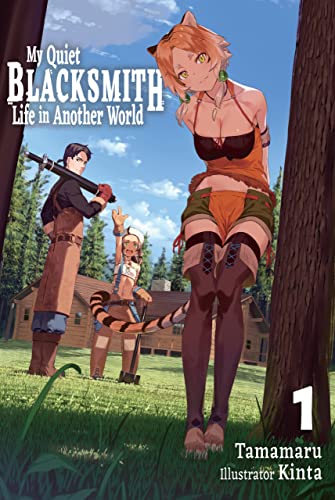
My Quiet Blacksmith Life in Another World, Vol. 1

By Tamamaru and Kinta. Released in Japan as “Kajiya de Hajimeru Isekai Slow Life” by Kadokawa Books. Released in North America by J-Novel Club. Translated by Linda Liu.

Obviously one should not read too much into the life of the author from the work they are writing. But sometimes it can be pretty easy to see that the creator is a little bit older than most light novel creators. Especially these days, where Truck-kun has been going after beleaguered office workers rather than shut-in high school NEETs. There’s a lack of gaming terminology and dungeon crawling. The harem, if there is one (there usually is) tends to be more familial than horny, at least on the part of the lead. And, of course, despite having super amazing powers and the ability to save the world, our protagonist wants to do nothing but relax and putter around the house doing what they love best. This is all very well and good. In this book, it turns out what the protagonist (and the author) love best is DIY. You will be reading about making swords and knives. You will be reading about building additions to houses. You will be reading this a LOT.

The setup is cookie-cutter. Our hero, Eizo, dies after saving a cat (but not himself) from a truck while on his way home from his crippling IT job. Turns out the cat was a goddess, and that it was not Eizo’s time to die. To try to salvage this, the goddess sends Eizo to a fantasy world, 10 years or so younger than he was (so about thirty). Eizo wants to be able to create things, so he gets knowledge of blacksmithing and the like, as well as some self-defense skills and magic. And then he’s dumped by a cabin in a forest. He wastes no time setting up shop, and quickly gains two companions: Samya, a beastgirl that he saves after she was savaged by a bear, and Rike, a dwarf who sees his handiwork and demands that she become his disciple. Because yeah, turns out he’s not just a normal blacksmith, he’s The Best There Is.

The edges of this book are interesting. There’s a prologue and an epilogue taking place many years after the main events that play this as “the creation of legends”, complete with a hero vs. demon lord scenario, that I found worked really well. We get two side-stories at the end that show the POV of other characters, and it’s interesting, particularly Helen, who is introduced to us (from Eizo’s POV) as something of a meathead swordswoman, but who turns out to be far more serious and practical when we get inside her own head. Unfortunately (and this is a common problem with slow life books) most of the book is from Eizo’s POV, and Christ, he’s dull. Show, don’t tell is left to die at the side of a ditch here, as we get page after page of him making swords, making knives, doing woodworking, chopping trees, all of which goes on forever. Even the fight near the end, where he takes on a massive bear, is fairly tedious as fights go.

As I said, there’s the hint of a good story around the edges of the book. I may read the second volume. But I think the author would be better off getting into woodworking and metallurgy themselves rather than have their creation tell us about it in excruciating detail.