I’ve Been Killing Slimes for 300 Years and Maxed Out My Level, Vol. 11

By Kisetsu Morita and Benio. Released in Japan as “Slime Taoshite 300 Nen, Shiranai Uchi ni Level MAX ni Nattemashita” by GA Novels. Released in North America by Yen On. Translated by Jasmine Bernhardt.

I read this volume immediately after a volume of The Saga of Tanya the Evil, and I highly recommend it, because it probably made the book feel better than it actually is. That said, there are other reasons this is a very solid book in the series. First of all, the stories are slightly longer, which allows for a bit more depth to a series for which depth is eternally absent. Secondly, the side stories at the end move to focus on Laika, and I am far happier to read about Laika at Lillian Girls’ Academy (or whatever its name is here, MariMite is clearly what it’s supposed to be, though) than I ever was with Halkara. Seeing Laika wound up so tightly is both nostalgic and also a bit bittersweet – at least we know she has a peaceful future ahead of her. As for Azusa, well, she’s discovering that just because she’s resolved to take it easy and relax in her next life doesn’t mean she has to do that all the time.

Stories in this volume: our main cast has a moonlight picnic, which unfortunately leads to an existential crisis for the newest cast member Canimeow caused by our other newest cast member, Wynona; Azusa learns that, in fact, this world does have actual physical laws that she cannot break, so a trip to the moon is not happening soon; The cast take a day off by visiting the demon world’s main town, and help Fighsly raise a slime child… pet… whatever; after Azusa is paying too much attention to an injured Sandra, Falfa and Shalsha decide to run away from home; Halkara wondering what it would be like to eat a slime leads to a jellyfish that feeds off negative emotions; the aftermath of that, as Halkara, freed from her base desires, is super annoying; and the entire cast run a relay race.

The most interesting story was probably the relay race. Pecora has been reading yuri romances again, and declares that Azusa and Beelzebub have been “taking their friendship for granted” and not bonding the way that true friends do. Which Azusa is not going to be bonding with anyone anytime soon, she does come to a realization that she can occasionally try her hardest. Her past life doesn’t get a mention in this book specifically, but it’s clearly what has been driving her to sort of half-ass everything in this new life. She literally worked herself to death before. So of course she’s not going to want to do anything that goes near that. But at the end of the race, when she has to run faster and harder than she ever has before, she discovers that sometimes it’s OK. Sometimes you can try your hardest. Hopefully this is something that she can continue to teach her extended family in future volumes.

All this plus Laika at school, where we see her desperately trying to get out from under her sister’s shadow, and only partially succeeding. Despite the excitement of the race at the end, this is still a book for those who enjoy relaxed fare.

The Saga of Tanya the Evil: Omnes una Manet Nox

By Carlo Zen and Shinobu Shinotsuki. Released in Japan as “Youjo Senki” by Enterbrain. Released in North America by Yen On. Translated by Emily Balistrieri.

The start of this volume makes it seem like it’s going to be a breather after all the battles from last time, and to be fair there are fewer battles here, but breather is absolutely the wrong word. After nine books, it appears that Tanya and Colonel Lergen are finally on the same page. That’s not a good thing. Especially when they’re saying things like “hey, would you be OK with strafing the government and making it look like an accident?”. Then we get Tanya meeting with first Uger and then von Rudersdorf try to get Tanya to have actual, real human reactions to things and she simply… can’t. She is unable to see why people might be wanting to cry at the fact that the Empire is on the verge of ruin. She gets the danger, and in fact is already thinking of fleeing the Empire for another country, but… the combination of her previous life’s Eliezer Yudkowsky approach to everything and her current self’s being brought up in the Army literally most of her life have led to a broken person.

Now to be fair, after looking at the cover of this volume (whose Latin roughly means “the same night awaits us all”) you might be wondering what the hell I am talking about. But there is a very big difference between Tanya screaming and ranting in her head and how Tanya actually interacts with other people. The cover picture is probably meant to be her reacting to having to deal with Doctor Schugel, who has found a much better way to make mages into guided missiles than he did the last time. While most of the brigade has actual shore leave, Tanya’s core group has to go provide escort over the seas so that General Romel and his men and retreat form the South. Which means taking on a British fleet. Easy peasy. Of course, the ones left behind on shore leave are not having an easy time of it either, as the Commonwealth has decided to do a sneak attack, and the Navy is too incompetent to see through it.

Because I always talk about Visha, let me just say that I find it interesting that, while Uger and von Rudersdorf cannot seem to fathom the way Tanya thinks, Tanya feels the exact same way about Visha, wondering how she is able to blithely take care of things with a smile on her face and a song in her heart. Especially when our little team passes through “neutral” Ildoa, and has it ground into their faces how far the Empire has fallen in terms of offering even the basic staples. Just eating a delicious fish dinner is enough to nearly destroy Tanya, because she understands the message it’s sending. And this also leads back to the cliffhanger, where the Empire is being told to invade Ildoa – a seemingly impossible task. Just how many more seemingly impossible things will they be forced to do? After all, they’re soldiers, not politicians.

As always, this is the opposite of a light read, and as lengthy as ever, but if you can put up with Tanya sounding like she’s posting to “AITA?” on Reddit sometimes, it remains a rewarding series.

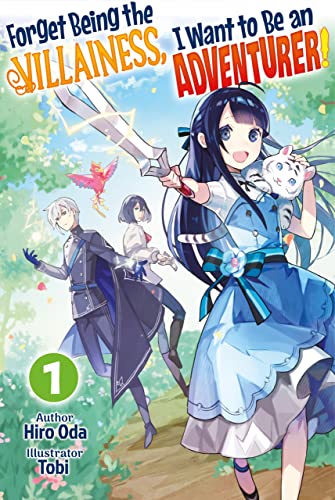
Forget Being the Villainess, I Want to Be an Adventurer!, Vol. 1

By Hiro Oda and Tobi. Released in Japan as “Tensei Reijou wa Boukensha wo Kokorozasu” by Kadokawa Books. Released in North America digitally by J-Novel Club. Translated by Kim Louise Davis.

A lot of these Reincarnated Villainess titles are deconstructions of romance novels and games. It’s baked into the premise, really. That said, some are more deconstructing than others, and it’s usually when we see the sharp edges of the original plot poking out that we get the most rewarding reading. Our heroine here is not as eccentric as other villainesses we’ve seen, and she has even revealed her secret to a few people. She’s doing all the right things. But there’s still something that’s really trying hard to have events go the way that they did in the book she read back in Japan. And if that involves breaking reality to “fix” things, well, that’s life. It ups the stakes a great deal. Especially when you realize that there’s a heroine here as well… and she’s not going to be falling in love with the villainess anytime soon. This heroine is going to get her happy ending if it kills her. Or, more accurately, if it kills our protagonist.

Serephione is a young noble girl who has memories of her past life in Japan, where she read a fantasy novel set at a magic academy. In this novel, the commoner girl heroine wins the hearts of everyone around her despite the best efforts of the powerful mage … Seraphione. Yeah. To prevent this, our girl decides she’s going to avoid the magic academy altogether. This is not as easy as it sounds. She’s loaded with powerful magic. She’s bonded with the Heavenly Beast of the West, a powerful familiar. All signs point to her following the book’s plot. But Seraphione is stubborn, and is not above asking her guardian beast to cheat the system. Now the “magicless” Seraphione is at the knight school instead, making friends and breaking all sorts of records because trust me, she’s hella strong too. But has she REALLY avoided her fate?

The other really good part of the book is Seraphione’s grandmother Erza. The Author mentions in the afterword that they had been taken to task in their last book for not giving the heroine a powerful female role model, and that’s certainly what Erza is. Indeed, the entire family seems to be known for being ludicrously OP, so one one is going to think twice about Seraphione being able to do things like one-shot knock out princes from another country with her mad combat skills. I also liked how the grandmother also starts training her other friends up, not wanting to see any knights who are unable to use both their combat power and their feminine wiles to get what they want. Though perhaps training everyone in poison resistance – by poisoning them ALL THE TIME – is a bit much.

I’m sure by now everyone who reads my reviews of Villainess books is rolling their eyes, but it really is a genre that I love. This one especially caught my eye because of the way that the narrative is trying to bend back… which may or may not be the fault of the seemingly naive and selfish “heroine” (who is named Maribella, which is not Maria but close). I’m adding this series to the stack.