Suppose a Kid from the Last Dungeon Boonies Moved to a Starter Town, Vol. 8

By Toshio Satou and Nao Watanuki. Released in Japan as “Tatoeba Last Dungeon Mae no Mura no Shonen ga Joban no Machi de Kurasu Youna Monogatari” by GA Bunko. Released in North America by Yen On. Translated by Andrew Cunningham.

Because this series is such a broad comedy, I sometimes forget that it is actually trying to have a plot too. There’s more plot in this book than in any of the previous others, as we get a lot more information… well, OK, a little more information… about the Japanese research group that apparently kickstarted whatever this world is, and where they are now. Unsurprisingly, there’s mostly a bunch of loud awkward guys, even if here they’re powerful demon lords. On a more disturbing note, Alka continues to be the gift that keeps on giving even when we don’t want her to. The revelation of her past with the hero was fine. Even hearing that Lloyd is essentially a replacement for the man she once loved, I mean, at least that explains the obsession. But in a series filled with thirsty women, Alka remains the thirstiest, with a line here that made my jaw drop. It’s not welcome.

Despite the cliffhanger from the last book, this volume has the least amount of Lloyd to date, as until the very end he’s reduced to simply standing around and reacting to others. The volume essentially consists of two things: 1) Allan muddling his way through life despite everyone misunderstanding him, and 2) the actual competition to see which clan gets to be the leader. The first part is amusing inasmuch as Allan is a schlub – if you like schlubs trying to blurt something out but failing, you’ll enjoy it. He does gain a demon lord. And a wife. Meanwhile, the competition is where most of the volume’s broad comedy comes out, as we manage to work in swimsuits, cavalry battles, loincloths and farming. The final battle is Allan vs. Lloyd, which Allan is pretty sure he will not survive, but it’s OK, as it’s interrupted by – I’m not making this up – a GIANT CRAB BATTLE where you must hit its weak point for massive damage.

Most of the forward movement in this book happens away from our main cast, who pretty much all act as you would expect them to. The supporting cast, though, are more interesting. Half of them are still recovering their memories, or simply getting used to being impossibly powerful. Alka and Eug are still on opposite sides, though it’s now being made clear that there’s someone trying to play both sides against each other. And we also meet a new player in the game at the very end, who (as with damn near everyone in the cast) is accidentally awoken by Lloyd, who just wants to use the bathroom. Despite all this, there’s a lot going on but the book feels fairly light. The setup comes out in odd bits and bobs, and the main plot is so “wacky” that a lot of it bounced off me.

Oh well, at least this arc is over, though given Allan is married now I suspect we’ll be seeing the newly introduced cast stick around for the next arc. In the meantime, this works best if you don’t think about it.
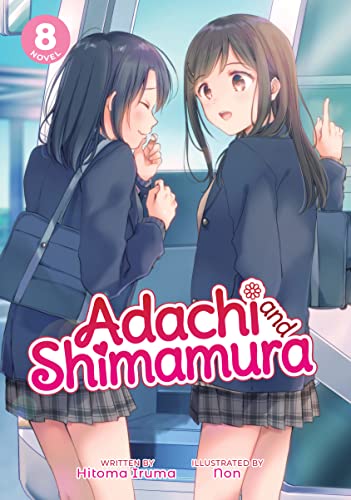
Adachi and Shimamura, Vol. 8

By Hitoma Iruma and Non. Released in Japan by Dengeki Bunko. Released in North America by Seven Seas. Translated by Molly Lee.

There was a three-year gap between the previous volume and this one, and you can sort of tell. There’s a bit of a priority shift in the way the story is being told. For one thing, while Adachi still gets the occasional POV scene, the book has finally admitted that it should be called “Shimamura and Adachi”. Shimamura gets 90% of the first-person narrative, and the entire book is about forcing her to confront how she feels about Adachi, what she wants to do in a relationship with Adachi, and what they mean to each other. The answer will not surprise you, because the book begins with a flash-forward to ten years later, when we see the two of them living together and planning a trip to San Francisco. Given the ‘alternate universes’ of the previous volume, I was expecting ‘it was all a dream’ or something similar, but no. That said, there is one sad part. Sorry, toy shippers, Yashiro and Shimamura’s little sister is not gonna happen. She’s perpetually ten.

The non-flash-forward part of the book is also about a trip – the school trip, which is going to Kitakyushu. Naturally, Adachi is a combination of nervous wreck and jealous child, but for once we don’t really dwell on her. Instead we focus almost entirely on Shimamura, who is dealing with several problems. She’s in a group with Adachi and the three girls she briefly made friends with at the start of the school year, and things are… awkward, mostly as her new relationship is not nearly as secret as she’d like. Yashiro has stowed away in her backpack like a Doraemon invention. And an evening at a hot spring means that she is suddenly very aware that Adachi not only loves her in a romantic way but loves her in a sexual way. Being Shimamura, she’s not sure what to do about any of this, but she does come away with one thing – she wants to be with Adachi for the foreseeable future.

As noted, this book came out after a three-year gap, and it shows in the writing (and not just because Yashiro throws in a Demon Slayer reference). For one thing, Shimamura is asked point blank if she’s a lesbian, something I don’t think would have happened in this series even a few years earlier. (As you might guess, she doesn’t give a straight answer, but it leans more towards “Adachisexual”.) In the same conversation (it’s the best part of the book, and it did not escape my attention that that may be because Adachi’s not in it) Shimamura is also called a “hot mess”, and I laughed because it’s true. But she’s actually trying to fix that in real ways, being more tactile with Adachi, suggesting things like holding hands or snuggling, and trying to tease her without having Adachi take it the wrong way. As for Yashiro… well, if you don’t like her, this is not the book for you. She’s in this more than any other book, and she even has some good philosophical advice for Shimamura. She’s part of the writer’s world.

The flash-forward does show that Adachi is no longer a ball of vibrating gay whenever she’s around her girlfriend, which is good, though I hope I don’t have to wait ten years for that to kick in. In the meantime, Shimamura has gone from a creature who tries to emulate human emotions but can’t work up the energy to a real live human being. I can’t make fun of her anymore.

My Happy Marriage, Vol. 1

By Akumi Agitogi and Tsukiho Tsukioka. Released in Japan as “Watashi no Shiawase na Kekkon” by Fujimi L Bunko. Released in North America Yen On. Translated by Kiki Piatkowska.

Brief content warning: this book features an abusive family, and unlike other light novels we’ve seen to date in this genre, they do not vanish after the first 20 pages. The marriage, though, is not abusive.

It’s rare that a book affects me so much that I think to myself that I may have to drop another, similar series for being thoroughly inadequate, but that’s sort of how I feel. After reading the first volume of My Happy Marriage, I suspect any time I try to get back into I’ll Never Set Foot in That House Again!, a book with a very similar premise, I will come away thinking it shallow and boorish. Because My Happy Marriage is wonderfully written but also amazingly painful, the story of a woman who has spent most of her life being thoroughly abused by her family suddenly finding herself in a marriage that turns out to be the best thing that ever happened to her… and feeling that she doesn’t deserve any of it. Miyo’s pain and suffering suffuses this first volume.

Seemingly set in a Meiji-period Japan where some families have superpowers, this is the story of Miyo Saimori. Hers is a Cinderella story, but that also means it starts out the way Cinderella’s does as well – after her mother dies and her father remarries, she’s despised by her stepmother, and her younger sister is raised to hate her as well, particularly as she seemingly has no powers of her own. She has a maid on her side… till the maid is fired. She has a childhood friend who has a crush on her… but he’s too cowardly to do anything. She’s reduced to worse than a servant. So when she’s suddenly told she’ll be engaged to the powerful Kiyoka Kudou, she doesn’t know what to think. He’s been looking for a bride for some time, and has rejected all of them. Will Miyo be what he really needs? And can he possibly help her out of the deep pit of self-loathing and despair that is her life?

This book is very compelling but also very hard to read, as you are drenched in Miyo’s POV, and she is an abused woman. Despite being taken to Kiyoko’s house near the start of the book, we continue to focus on her family, who are losing power and influence and desperate to get it back. Fortunately, once she gets to Kiyoko’s house, she does start to have some allies. Kiyoko is, as his reputation says, cold and dismissive at first, but that’s mostly because he’s had a succession of women after his position and power. In fact, once he opens up to Miyo he becomes quite the loving fiancee. His elderly maid is also wonderful, and the first person that Miyo really opens up to. As for her supposed lack of power… it’s heavily implied in this book that she does indeed have strong powers, and that they just awaken late (something her mother was trying to get across to her father before she died). I suspect future books will go into this.

I also hope that future books will better try to match the title of the series. I want to read more of My Happy Marriage, but that’s mostly as I really want to see the happy part. This was good setup, and very much needed to get a good look into Miyo’s psyche, but it’s not what I would call a “light” novel. (Actually, given there are no internal illustrations, it probably should be classified as a light novel at all.)