I’m in Love with the Villainess, Vol. 4

By Inori and Hanagata. Released in Japan as “Watashi no Oshi wa Akuyaku Reijou” by GL Bunko. Released in North America by Seven Seas. Translated by Kevin Ishizaka. Adapted by Nibedita Sen.

Last time I mentioned that it felt awkward to start a new volume of the series when it could easily have ended in Book 2 with “and they lived happily ever after”. Oddly, towards the end of this book Claire’s father thinks much the same thing, trying to send Rae, Claire and their family back home because “they’ve done enough”. Not in a negative way, though Claire initially takes it that way, but n the sense that the country of Nur is quickly about to become super-dangerous. That said, as events unfold in this book one gets the sense that this world is not about to let either of them go live a quiet, happy life very easily… though it has no such qualms about quietly shuffling most of the new cast we met in the third volume off to the side, to the point where I wondered if this were a Christie novel set on a faraway island. As for why? Well… revolution. Again. Come on, it’s in the game title.

The general thrust of this volume should be familiar to readers of the series. We start off with a lot of cute, fluffy things, like a fantasy cross between Iron Chef and the Great British Bake-Off, and we then start the balls rolling down the hill until you reach a climax that can be summed up by “great googly-moogly, it’s all gone to shit”. Part of the problem is that while Dorothea is amusing as a strong as heck, emotionally blunt empress, she is also a somewhat terrifying dictator, and does not particularly care if that means that the country is hated by everyone around it. As for her daughter, after being the comedy girl with a crush at the start, Philine’s development is actually one of the strongest parts of the book (though I’d argue it does come a bit too fast). Which is better, speaking softly or carrying the big stick?

As with previous books in the series, there are occasional digressions in order to discuss modern gender politics. Rae gives a good explanation of gender identity, and one of the subplots later in the book also resolves around this sort of thing. On the down side… there really is an awful lot of “brainwashed to be evil” in this book, and indeed in this series, though some of it is less “I am here to kill you” and more “I am here to threaten you on behalf of the Church”. Fortunately, the main reason to read the books is Rae and Claire, and they’re both excellent. There’s a recurring theme of Claire being beloved by all (including her daughters) and Rae getting either slightly less attention (her daughters) or outright dislike (one of her classmates). It’s amusing but also makes sense, as Rae’s personality is the sort that is difficult to trust… the exact opposite of her partner.

The book ends on another cliffhanger, and seems to indicate the 5th will be the last. Till then, this remains for the most part a well-plotted and compelling series with excellent LGBTQ content.

Oh yes, and mamas, don’t let your babies grow up to be tsunderes.

Bottom-Tier Character Tomozaki, Vol. 7

By Yuki Yaku and Fly. Released in Japan as “Jaku Chara Tomozaki-kun” by Gagaga Bunko. Released in North America by Yen On. Translated by Winifred Bird.

If you don’t want to know who Tomozaki ends up with at the end of this book, be warned I talk about that, but not till the third paragraph.

There’s a lot of metatext in the Tomozaki series. To a degree, it’s deconstructing these sorts of high school romcom series, especially the way that the lead tends to be this asocial schlub who nevertheless has the plot revolve around him. As we’ve seen, it’s only when Tomozaki makes an effort that he gets noticed and gets romantic attention. That said, the series has not forgotten that it’s also a real story and that realistic things need to happen, and as such we get a resolution here to the love triangle between Tomozaki, Mimimi and Kikuchi. But there is a little niggling thought at the back of the reader’s head, because at its core this series is about two people: Tomozaki and Hinami. It’s not a matter of “first girl” or anything, it’s a matter of who gets the most narrative attention. And therefore the most interesting part of the book is when Kikuchi, who sees things from an author’s perspective, tries to abandon her own ship and pair Tomozaki with his *real* girlfriend.

Gumi is on the cover but is just a minor part of this book, which revolves around the culture festival. Tomozaki is dividing his energies between Mimimi and her comedy routine and Kikuchi and her play. What’s more, Hinami is setting him goals that require him to enter one of the girls’ “routes” by the end of the festival, without waffling or putting it off. The trouble is, Tomozaki is still trying to figure out how love and romance work. This can be quite funny, especially when he asks Nakamura for advice, but it’s also really making him miss the forest for the trees. In addition to this, Kikuchi is having trouble with the character Hinami is performing in her play, so she and Tomozaki interview people from Hinami’s past… with some very confusing results. Then we get the festival itself… and Tomozaki realizes he may have been rejected by a “Dear John” play.

I have to feel absolutely horrible for Mimimi. She’s a great kid, and a wonderful character, and her reaction to Tomozaki choosing someone else is very well-handled (possibly as it’s not Hinami he chose). But come on, when someone has to choose between two girls and you come in third, that’s just mean. Kikuchi gets it, though. Mimimi isn’t even on her radar, she knows where the narrative of this story is going, and it’s Hinami. That said, thanks especially to Mimimi kicking his ass, Tomozaki won’t let this lie, and reminds Kikuchi that “this is a story” can only take you so far. I also really liked the idea that it’s possible to be an idealist *and* be selfish, and that it’s not wrong to want to have it all. As a result, by the end of the book, he and Kikuchi are a couple.

Will they be a couple by the end of the series? Mmmmmmm… questioning. After all, there sure was a lot of Hinami baggage dropped in the middle of the book and then just left there. She is the other protagonist in this book. (Also, notably, Tomozaki never said “but I’m not romantically interested in Hinami” or tried to contradict Kikuchi’s play, which surprised me.) For the moment, though, Kikuchi is best girl, and they do make a great couple. As for Mimimi fans… at least she gets the manga spinoff?

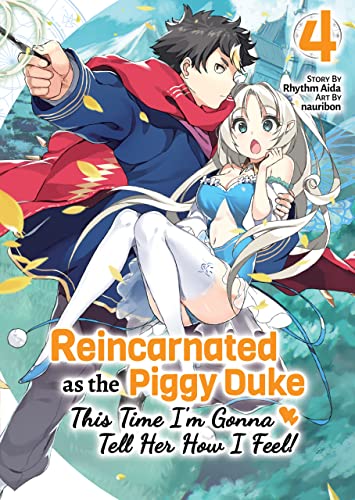
Reincarnated as the Piggy Duke: This Time I’m Gonna Tell Her How I Feel!, Vol. 4

By Rhythm Aida and nauribon. Released in Japan as “Buta Koushaku ni Tensei shita kara, Kondo wa Kimi ni Suki to Iitai” by Fujimi Fantasia Bunko. Released in North America by J-Novel Club. Translated by Zihan Gao.

As each of these books have happened, the title has been less and less accurate, because Slowe has slowly but surely been losing a lot of that weight. It’s possible the author realizes this, as in this book Slowe spends the majority of the time disguised as an orc – which means he has pig-like features. That said, everyone seems to think he’s turned the corner in terms of popular opinion – everybody but Slowe, who is not really ready to take up the mantle of the heir after blowing it off in the past. For one thing, he still needs to stop the anime plot from happening, and for another, he has a much better idea than his old friends as to just how much he torched his reputation, and how much more it will take to get that back. Especially if he blows off the Queen because another disaster is about to take place… yet, the books aren’t self-contained anymore. Cliffhanger time!

Slow is disguised as an orc, and Charlotte as a pixie, in order to infiltrate Charlotte’s old kingdom, which is now overrun with monsters. Slowe is there to try to head off the next big event of the anime, where one of the antagonists murders a pixie ambassador and helps to jumpstart a war. To do so, he makes contact with an Orc King and his village, as well as the ambassador, Elyas, passing himself off as an Orc Mage – something that is theoretically impossible, given orcs are barely above goblins on the fantasy monster hierarchy. Elyas is trying to have all the monsters unite to defeat the human who’s destroying them. Unfortunately, not only is the human stupid powerful, but Shuya and Alicia (well, just Shuya really) decide to take a shortcut through the monster-infested country and end up in the mix as well!

I’ve said before that I think this series is solid, not great, and that trend continues, though it’s still very readable. Having a “monsters are people too” volume after the previous three is an interesting way to go, and you get the sense that we’ve reached the “the series is successful, you can plan for the long future” part that most Japanese media face. That said, Shuya and Alicia are still very generic, as fits the anime that they belong to, and Slowe and Charlotte’s fight is filled with teenage angst that is more interesting to have read than to be reading. That said, the ending fight is really very well done, and the book promises more of that sort of thing in the next volume. There’s some good humor too, as Slowe is both drawn to and exasperated by his “orc brothers”, who are cliched as heck but in a good way. I hope we see them again.

If you like fantasies with this sort of cliched plot, you could do a lot worse than this.