The Holy Crown of Marielle Clarac

By Haruka Momo and Maro. Released in Japan as “Marielle Clarac no Seikan” by Ichijinsha Bunko Iris NEO. Released in North America by J-Novel Club. Translated by Philip Reuben.

While they have not realized they are in a series of fictional romance novels, the cast of the Marielle Clarac books have certainly figured out what’s going on around the heroine. Even with Simeon trying his best to keep Marielle away from anything remotely resembling danger and excitement, it always finds its way to her. What’s more, things can’t even be kept secret from her – she’s far too clever and makes too many connections, guessing the plot at times before it can even be explained to her. Fortunately for Marielle, though unfortunately for her husband, most of the actual physical injuries in this book happen to her husband. This is not to say that Marielle is not in peril, as she is, constantly, through much of this book. But, having knifed her in the arm in the last book, the author is content to emotionally abuse her by having Simeon shot, then go off a cliff, then get shot AGAIN. Again: potboiler.

Things that were simmering in the previous volumes are still simmering, as there’s war going on between two neighboring countries. No, Marielle isn’t going there – instead she’s off to the funeral of a very old relative of Simeon’s, who lived a long, happy life but who needs her, since Simeon can’t make it, to pay respects. Then… stuff happens. There’s a torrential rain, which causes a lot of the nearby commoners to be evacuated to the vicinity. Then Simeon DOES show up, along with the prince, as they’re looking for a missing royal… in fact, he’s the heir to the throne of Orta, though the monarchy was overthrown a couple of decades ago. Then some old enemies show up. Then the missing heir loses his memory. And then there’s the matter of the missing holy crown, which is the standard “we won’t believe you’re the heir without this” item. Is there a way to resolve everything without it all revolving around Marielle?

Well, no, but who wants to read a book where Marielle just hears about things afterward? She even muses that life has been too good to her lately, as someone who is unfamiliar with her treats her poorly and it makes her feel nostalgic. That said, as I noted, most of Marielle’s issues in this book are emotional rather than physical. She’s still seen as much younger than her age, and worries that Simeon is treating her like that as well, especially when they get in an argument midway through the book. She’s thinking about children, and wonders whether a boy or a girl would be easier for the noble succession/peace of mind (delete where applicable). And seeing Simeon is peril, and at one point not waking up after a horrible fall, makes her break down completely – for all her intellectual savvy and quick wit, Marielle is still very innocent at heart, and was not ready to see the love of her life near death.

All this and Lutin too. And he may stick around for the 8th book, which does not have a release date here yet but promises to finally have us meet the crown princess’s royal fiancee. That’ll go well, I’m sure. Safe and fun. In the meantime, if you love silly adventure stories, this is right up your alley.
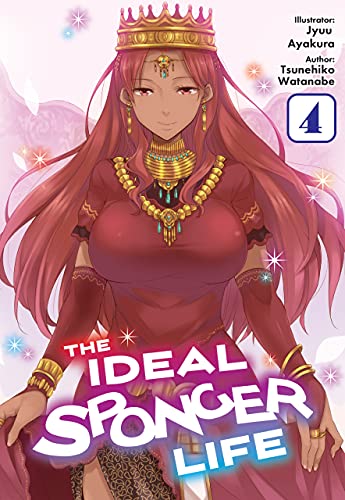
The Ideal Sponger Life, Vol. 4

By Tsunehiko Watanabe and Jyuu Ayakura. Released in Japan as “Risou no Himo Seikatsu” by Hero Bunko. Released in North America by J-Novel Club. Translated by MPT.

One of the reasons I really enjoy this series despite its unrecommendable premise is that it really seems to want to dig into the nitty gritty of everything. The genetics of magic are in full force here, and we see how that can also be political for various reasons, and also how it’s likely to affect Aura and Zenjirou’s marriage down the road. The stuff Zenjirou brought from Japan is also proving to be both very good and also very dangerous, as he gets to impress a princess (who’s really a science nerd deep down), but also manages to upend the power balance by explaining concave and convex lenses to her, something that is a huge thing but also so obscure he has to explain to his wife why he screwed up. All this and their newborn son has come down with fantasy world measles. The baby has a 90% chance of surviving… which means a 10% chance of dying, something that makes no one happy. Do they have to use another rare healing stone?

Despite the occasional break in the storyline to fight raptors (who are far more numerous than expected), the bulk of this book is taken up with the arrival of Prince Francesco (who is basically Tamaki from Ouran Host Club) and Princess Bona (no close relation, she’s his minder and the aforementioned science nerd). Dealing with Francesco is somewhat exhausting, especially as they’re trying to figure out why he’s not in the line of succession… and also how much of his airhead act is just an act. Princess Bona is high-strung, but much easier to deal with… possibly a bit TOO easy, as Aura notices immediately that she and Zenjirou seem to naturally bond. That said, it’s their child’s illness that brings them all the answers they want, as Francesco reveals his background and magic abilities… something that also is going to make it even HARDER for Zenjirou not to take a concubine.

You know it’s a good Sponger Life when even the maid side-stories, usually the low point of the book, are interesting. The three goofy maids are busy playing video golf, which is the funny part, but the narration also points out that by learning about birdies, par and bogies, and the value of each, they’re being taught zero and negative numbers, something well outside what they would normally learn. That said, they’re all airheads, so I’m not sure if it will actually crop up later on. I also enjoyed seeing Aura fight (mostly successfully) against her jealousy. She points out that she worries constantly about making Zenjirou angry, as unlike everyone else in her kingdom, he doesn’t really WANT anything, so can’t be bribed to get back on his good side. Fortunately, despite his good relationship with Bona, she’s highly unlikely to be a concubine (the book seems to be pairing her and Francesco, though it’s subtle).

By now I imagine every reader who was hanging around waiting for more sexytimes has abandoned ship, leaving those who love the series’ political intrigue. This is a very good volume for that, and makes me interested in the next book, which… does NOT have Aura on the cover! Gasp!

I’ve Been Killing Slimes for 300 Years and Maxed Out My Level, Vol. 10

By Kisetsu Morita and Benio. Released in Japan as “Slime Taoshite 300 Nen, Shiranai Uchi ni Level MAX ni Nattemashita” by GA Novels. Released in North America by Yen On. Translated by Jasmine Bernhardt.

It’s the 10th volume of Killing Slimes for 300 Years, and that means that big, earth-shattering changes are in store. OK, no, that’s not what it means. This book is exactly the same as the previous nine. Anyone reading this to see characters change or grow is a glutton for punishment. Despite that, this is a very good volume, avoiding some of the series’ usual pitfalls. Azusa doesn’t even have to point out that she’s not gay! Instead, you get a lot of cute, fun stuff happening and the cast either causing it or reacting to it. Heck, even the Halkara side stories, which I have ragged on the last two books, are better than usual. The one thing that does happen in these books is the addition of new cast members, and we see that here, as we get a fortune-telling Moon Spirit. We also see Azusa’s estranged slime daughter Wynona, who pops up several times in this book and, despite her best efforts, ends up being part of the extended family.

Stories in this volume: they all go to a sweets fair, where Falfa and Shalsha try to sell the edible slimes as sweets; they see a fortune teller who is surprisingly blunt, and she reveals she’s yet another spirit, though she’s not really sure what she should be doing; Wynona asks Azusa and Laika to party with her for a competition in a dungeon, and shows off her seemingly aloof self (and her obsession with the color white); everyone goes to a peach festival, with Momotaro references galore, an 18+ exhibit Azusa has to stop everyone from going to, and so many peaches; Muu from the ancient civilization requests the help of Flatorte to help with an encroaching plant problem; after this, due to what happened, Flatorte is suddenly extremely calm and efficient; and Beelzubub shows off her new demonic credit card… though there’s still a few bugs in the system. Meanwhile, Halkara and Flatorte struggle with local cuisine, and Halkara gets sent by the goddess to Japan, where she runs into Azusa pre-death.

I mentioned that no one expects character development, though that isn’t strictly true here; by the end of her stories, Wynona is decidedly less tsun and more dere towards her “step” mother. That said, the highlight of the book is definitely Flatorte. She hasn’t been able to fight or blow off steam in a long time, and has been getting even more eccentric as a result. The solution to Muu’s problem, which involves using her freezing breath more than she ever has before, also leads to her suddenly being polite, calm, and competent; Azusa even compares her to a butler! That said, We Want Our Jerk Back, so it doesn’t stick. There is also an amusing Lovecraft pastiche towards the end, describing events we’ve already seen as if they were the most terrible things imaginable. Halkara’s stories aren’t great, and I wish she’d actually interacted with Japanese Azusa, but they didn’t bore or irritate me. Plus, they’re the last of that spinoff – next time Laika gets the side stories.

So yes, cute fluffy, relaxing, nothing earth-shaking happens. A good book to read after you’ve read something dark and brooding.