Slayers: Delusion in Crimson

By Hajime Kanzaka and Rui Araizumi. Released in Japan by Fujimi Fantasia Bunko. Released in North America by J-Novel Club. Translated by Elizabeth Ellis.

It can be somewhat annoying to come at the Slayers novels from someone who grew up with the anime and realize how a huge chunk of them are Lina, Gourry, and one-off characters. Zelgadis and Amelia stuck around for a bit, as did Xellos, but they’re gone now. We’ve had Luke and Mileena come in with an attempt to add a new supporting duo to the cast, but they’re more of the ‘we keep running into each other’ sort than actual party members. They’re also not in this particular book either. We do get a villain from two books ago… but she doesn’t appear, she’s just an offscreen catalyst. It can be rather disheartening. Where’s the wacky fun times? Where’s Lina accidentally destroying things? Where’s Gourry being rock stupid? But this isn’t the anime, these are the light novels. And because of that we get something here which the anime almost never tried to do unless it was a huge world-shattering crisis: we get a straight up tragedy.

Lina and Gourry arrive at a city that is telling any and all sorcerers to report to the local sorcerer’s council at once. Doesn’t say why, and does not appear to be from the government. Lina, who has just been through sorcerers trying to take over a city a book or so ago, thinks we’re seeing much the same thing here, and she’s mostly correct. She teams up with Aria, a young woman who is trying to rescue her sister from the lord who killed her fiancee and forcibly married her, and Dilarr, a passing adventurer who just seems to like Aria, though he does find Lina somewhat terrifying, to her displeasure – her reputation is now that death and disaster show up whenever she arrives. Sadly, this book does not really change that reputation. Once they arrive at the city where Aria and her sister Bell live, we get a Chthulhian nightmare featuring lots of monstrosities and lots of death.

Despite the fact that these books frequently seem as if they’re written without an outline by the author simply going to the typewriter and typing till he stops, there is some decent character work here, particularly in regards to Aria’s sister Bell. Set up as the unwilling victim through most of the book, the reality is far darker than we’d expect. The second ‘series’ of light novels were never adapted to the anime, and this one shows why – the sister who is forcibly married after her fiancee is killed sends her little sister off to safety because she loves her, but also has hatred in her heart, as her sister is safe and can be happy while Bell is trapped. It’s a very real look at family dynamics that can stem from a family member being abused. Unfortunately, Slayers is still a fantasy, not a realistic look at power dynamics and coping mechanisms, so we get a massive bloodbath.

As Lina and Gourry walk away at the end, both are subdued and disturbed, and the reader has to agree. This is on the darker side of the Slayers novels, a series which is already much darker than its anime equivalent. I hope the next book has a bit more jollity.
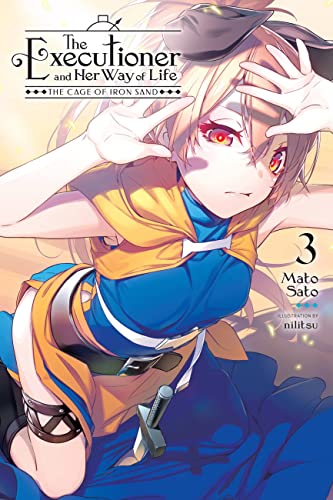
The Executioner and Her Way of Life: The Cage of Iron Sand

By Mato Sato and nilitsu. Released in Japan as “Shokei Shoujo no Virgin Road” by GA Bunko. Released in North America by Yen On. Translated by Jenny McKeon.

This series continues to go back and forth between things I quite enjoy and things that kind of irritate me, and in this book they’re about fifty-fifty, meaning it gets a reluctant recommendation. There’s far less Akari in here than I’d like, though her scene with Momo was the highlight of the book, and promises good things for the book after this. We also get an amusing new addition to the cast, a colleague of Menou’s who seems to be a airheaded flirt, though it’s implied throughout that this personality is a front. Which is a shame, as I liked it better than the personality that showed up later. There’s lots of cool fights, all of which seem to point to the value of “being pretty good at everything because of working really hard” rather than “has an innate natural gift”. Which I’d appreciate more if it was not undercut by the implication that the supposedly hardworking woman is in reality Very Special Indeed.

Menou and Akari are making their way through the desert, which turns out to be another area that was completely devastated because of a Japanese isekai gone horribly wrong. Things start off badly as Akari has already been kidnapped as the book begins, and Menou has to infiltrate a criminal organization to rescue them. There she runs into an old colleague from the orphanage, Sahara, and the three of them proceed to a nearby oasis city, with Menou now having to suffer the attention of *twp* bokes. Arriving at the city, she and Momo get the help of Princess Ashuna, who is essentially in this book to be cool and not much else. Unfortunately, she and Menou have to fight off a dangerous crime lord, so Menou sensibly leaves Akari back at the hotel. Which ends up being the biggest mistake she makes in the book.

The problem I have with Sahara is likely down to the character skewing away from my tastes. I really like the ‘sleepy ditzy flirt’ sort of character, and when Sahara is revealed to in fact be a ball of jealousy and envy, I wonder what the point was in having her be likeable for 3/4 of the book at all except to annoy me. Then again, when the reverse happens – i.e. when Akari gets her suppressed memories back – I actually tend to like her more, so hey. And yes, everyone is angry at Menou for being ‘the chosen one’, and Menou keeps insisting that she’s not all that great and is just a fairly normal person, which is fine except it’s pretty clear that she’s also got a past that’s been completely suppressed. Which just makes me more annoyed.

Basically, it’s hard to like anyone in this series because they could turn into something completely different down the road. I know that “change is a process” is the theme of the books, but there’s a bit TOO much change. Right now, Momo is my favorite character because she’s at least consistent. That said, sure, I’ll read more.

Also, naming the new character in your desert-themed book Sahara is kind of like naming your dog Spot.

Otherside Picnic, Vol. 6

By Iori Miyazawa and shirakaba. Released in Japan as “Urasekai Picnic” by Hayakawa Bunko JA. Released in North America by J-Novel Club. Translated by Sean McCann.

After starting the series off showing us a terrifying, lethal, transforming Otherside, it is somewhat amusing to see that the parts of this book that actually do take place in the Otherside are the most relaxed. Essentially, Sorawo and Toriko decide to settle in and do some dry-walling, and they have a great deal of fun. They don’t have any terrifying experiences there because the real world, and the space between the real world and the Otherside, is scary enough as it is. Starting the book off with a Sorawo who seems to be a normal, non-urban legend loving college student, the book takes off running as our heroes battle T-san, a man dressed like a monk whose features seem to invite unreliable narration. Akari gets involved as well, and before we know it we’re dealing with someone who is perfectly happy to walk into their psychiatric hospital/prison and wreak havoc. This is Otherside Picnic: the Movie, kids, so buckle up for a roller coaster ride of thrills.

As you may have guessed, this book is one long story, involving a young (?) man (?) who is tall (?) and wears monk’s robes (?) and is currently in Sorawo’s college seminar. As I noted above, at the start of the book Sorawo has amnesia, her “Otherside” eye is not working, and she’s rather startled by these other two girls who seem to know her. That thankfully gets resolved quickly, and we’re back to our normal Sorawo who insists that she doesn’t really care about other people even if her actions belie this quite a bit. T-san the Templeborn is another urban legend, though the author, who I already suspect is making up all of their ‘cited sources’, admits this one is probably more fictional than the others. Instead of the Otherside, T-san is threatening the real world, erasing the connections between people and that universe with a shouted “HAH!”. Can they stop him in time? And are they going to need the help of an old enemy to do so?

Gotta admit, my favorite parts of this book are the parts with Runa Urumi, who is (possibly?) trying her best to be the Hannibal Lecter to Sorawo’s Clarice. She’s awake once more, bored out of her gourd locked up in DS Research, and promises to be a good girl if they just let her surf the internet a bit. Needless to say they are very distrustful of her, especially as remorse does not seem to be happening anytime soon, but a later scene where she ends up, somewhat reluctantly, helping the other inmates when T-san visits the facility makes me suspect this plotline is not going to be dropped anytime soon. As for Sorawo and Toriko’s relationship, it’s notable here mostly for Toriko’s jealousy when it comes to Akari, which is so obvious this time around that even Sorawo, never the brightest bulb when it comes to social cues, has to reassure her that she does not like Akari in that way. I also don’t see this plot going away anytime soon, though.

Oddly, for something that was supposed to be a grand movie version of the series, this was rather sedate, with only a bit of action in the final parts, and very little shooting of guns. This is, of course, because most of it took place in reality, and I suspect that the link between the two worlds will continue to fluctuate in future. But yeah, good book, go get it.