Romance of the Imperial Capital Kotogami: A Tale of Living Alongside Spirits

By Yamori Mitikusa and Tokihito Saiga. Released in Japan as “Teito Kotogami Romantan Kinrou Otome to Oshikake Juusha” by Kotonoha Bunko. Released in North America by Cross Infinite World. Translated by Evie Lund.

When I first saw that this title had been licensed, I thought that the synopsis sounded like one of Viz’s Shojo Beat supernatural titles. We’ve seen a lot of these “young human woman ends up caring for a number of yokai” series there – Kamisama Kiss, The Demon Prince of Momochi House, and Kakuriyo: Bed and Breakfast for Spirits. This one is not quite like that – the yokai are definitely serving her rather than the other way around – but it has a similar vibe. That said, it’s not a copycat, and this is certainly a wide genre to pull from. It also deals with survivor guilt, abandonment issues, and even good old fashioned murderous jealousy. Also, despite the ‘romance’ in the title, this is very much a book using the original definition of that word. Which is good, as for most of the volume the power dynamics between our heroine and any potential partner are too vast to be comfortable, and the heroine is definitely not ready for that anyway.
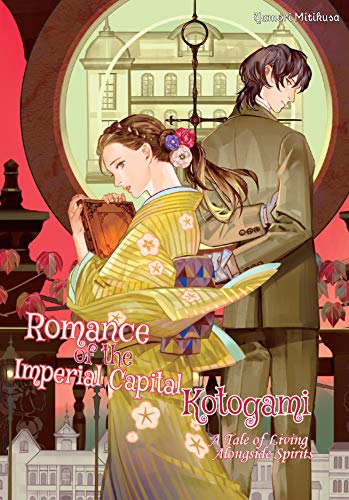
Our story takes place in not-quite-Japan around the Taisho period – the names have been changed to make it a fantasy, as this is a world where yokai are quite active. To help, the world also has Narrators, whose who can “read the story” of a yokai and control their nature, making them a kotogami. (If you think this sounds like Natsume’s Book of Friends, you’re not far off.) Our heroine Akari, however, despises all fiction and anything resembling a story. She works at a company that, among other things, makes grandfather clocks, lives in the company dorm, and avoids men telling her that she really should get married and settle down. Then one day her apartment burns to the ground thanks to a yokai on the loose. In the chaos, she runs into a police inspector and a kotogami who seem to know more than they’re saying, and ends up staying at a manor house filled with books, all with kotogami in them. Can she recover a normal life? Can she learn to enjoy fiction again? And how is this connected to her tragic past?

As with most of the best novels for women, the heroine is the main reason to read this. Akari is grumpy, practical, clearly hurting but also determined to live life the way she wants, and does not take shit from anybody. She’s also very good at her job (which is not always a good thing… there’s an underlying sexist society here, of which Akari and the author do not approve) and, as it turns out, VERY good at being a Narrator, whether she wants to be or not. Tomohito, the kotogami that she first meets, is seemingly goofy, silly, and a bit pathetic, but readers will be completely unsurprised to see this masks a very different sort of being. The “mystery” of the book is handled quite well, with revelations coming in at just the right time, along with one or two dramatic action scenes. And the supporting cast are also fun.

This is a one-shot, and I think ends on just the right note. I’d like to read more by this author (they apparently have another series out from Earth Star, this one more isekai fantasy), but am content with having read this.

The Reincarnated Prince and Felvolk’s Greatest Treasure

By Nobiru Kusunoki and Arico. Released in Japan as “Herscherik” by M Novels. Released in North America by J-Novel Club. Translated by afm.

After the end of the previous book, things are going pretty well for the Kingdom Formerly Known as In Woe. The King and his sons are running around trying to slowly fix everything that Barbosse broke, and also trying to track down the corrupt nobles who benefited from it (as opposed to those who were just threatened into obedience). Indeed, the previously unseen Sixth Prince has returned, as he was going all around to various countries trying to gain allies and also get enough evidence to get rid of the thorn in their side, only to find Hersch took care of everything first. Herscherik is buried under paperwork, because oh my god there’s SO MUCH potentially crooked stuff to review, but there’s still time to go out to his favorite outdoor market. While there, however, he runs into the grocer he likes, who asks him to talk to two clearly suspicious people – a young red-haired woman and a man disguising his huge wings. Disguising because being a beastman in Gracia is punishable by death.

Those who recall the events of the third book might be looking at the cover of the fifth book and saying “oh dear, I hope this isn’t a trend”, but no, I’d be a lot crankier in my review if it were. For the most part this book is very good, showing off how difficult it can be to take definitive action when you are running a kingdom and have to obey its laws… even when some of the laws have reasons that are lost to the mists of time. Both “Kurenai” and “Ao” (Hersch is still giving codenames to people, and is still terrible at the names) have suitably tragic backgrounds, are suitably broken and fatalistic, and are cheered immensely be Herscherik basically being himself. We also meet the sixth prince’s bodyguard, Tatsu, who comes from a land that sounds very much like ancient Japan… and he seems to know that Kuro is still hiding some secrets. But that’s future Herscherik’s problem. The current one has his hands full trying to stop another self-sacrifice that ends in death.

The book has several sequel hooks, and the afterword has the author hoping to see us again soon. Unfortunately, when series are licensed from Japanese publishers, we do not get guarantees that the series will go on until a proper ending, and rumor has it that the series has been cancelled by the publisher in Japan. This is a shame, as it has a lot of elements that I quite enjoyed, using just the right amount of “I have my memories as an office lady from Japan”, having Herscherik be ludicrously good at political intrigue but also ludicrously bad at physical and magical things, so he always needs allies to kick asses for him, and good guys you want to root for. Perhaps one day we can get more of this, but until then, I’m glad I read what I did. Plus, as the books have a bit of “and in later years” history text to them, at least we know the good guys won down the road.

My Youth Romantic Comedy Is Wrong As I Expected, Vol. 11

By Wataru Watari and Ponkan 8. Released in Japan as “Yahari Ore no Seishun Rabukome wa Machigatte Iru” by Gagaga Bunko. Released in North America by Yen On. Translated by Jennifer Ward.

My Youth Romantic Comedy Is Wrong As I Expected may not be exactly the sort of harem manga Hachiman’s read in manga or novels, but it’s still a romantic comedy in the end. It has most of the major things that these series have – Hachiman may be far more cynical and bitter than the old-school potato harem lead, but he still has two main love interests and several others who easily could also slot into that place, such as Iroha and Saki. What’s more, Hachiman has changed, much to everyone else’s relief and Haruno’s disgust. It’s gotten to the point where, even if he can’t even narrate it out loud, he knows how Yukino and Yui feel about him. Yukino knows he knows. Yui knows he knows. All three know how this is likely going to end. And Yui desperately wants to put it off as long as possible, to keep their strong three-person club bond. But we know what happens to anime characters who say “I wish this time could last forever”.

It’s Valentine’s Day! And, naturally, the Service Club are roped into it. There are several people wanting to give chocolate to Hayama, but he refuses to accept any, so they ask our heroes to come up with a way they (Miura and Iroha, of course) can give him some. They end up sponsoring a “how to make your own homemade chocolate” event at the community center, with several boys, including Hayama, invited along as “taste testers”. This is a sensible plan that does not involve Hachiman throwing himself under a bus, so I approve. Unfortunately, someone invited Haruno, and she is absolutely the wrong person to be here, especially on a day like this. What’s worse, Yukino’s mom shows up again, and makes it pretty clear that hanging out with Hachiman and Yui is going to be coming to an end – very soon. Can Yui manage to hold things together, even to the point of taking Yukino and Hachiman out on a… date a trois?

It’s interesting seeing Haruno and Shizuka getting along fairly well in this book, as they’re both trying to drag Hachiman in different directions. Haruno is the sort of person you see talking to the former assassin/soldier talking about how they’ve gone soft and lost the edge that made them cool. Shizuka is urging Hachiman to try to actually say out loud – if only to himself – everything he’s been avoiding in his head. And, of course, Yui (and, passively, Yukino) doesn’t want to give up the wonderful bond she has with the two of them. The date at the end is achingly bittersweet, especially the ferris wheel ride. But sorry, Yui, you are not in a fantasy world where the kingdom has declared polygamy legal, and this isn’t going to end with Hachiman choosing two girls. That said, if this keeps up Yukino may lose by default – Haruno may not be as evil as she’s playing, but I bet mom is.

So yeah, another book that is happy most of the way through with a bitter end. Fortunately, there are no more .5 volumes before the climax, so we’ll be back next time to see how much more things can fall apart.