Do You Love Your Mom and Her Two-Hit Multi-Target Attacks?, Vol. 9

By Dachima Inaka and Iida Pochi. Released in Japan as “Tsujo Kogeki ga Zentai Kogeki de Ni-kai Kogeki no Okasan wa Suki desu ka?” by Fujimi Fantasia Bunko. Released in North America by Yen On. Translated by Andrew Cunningham.

I can see what this volume was trying to do – well, aside from make an entire volume about Christmas and how it applies to moms and children. Because the main cast are all in their teens (even Porta), we haven’t really had much excuse to delve into the way that moms have to deal with infants and small children, and this volume gives us an excuse to do that. In addition, because Mamako is that sort of mother, we haven’t really gone into what it means to be spoiled or not spoiled in great detail since the (rather comedic) story of Mone and her mother, and combining Masato’s inherent issues, Mone’s unresolved plot and the ongoing travails of Hahako and the Kings is thematically sound. Unfortunately, the need for comedy and fanservice actually serves to turn me a bit against the book this time. I can appreciate the thought behind the plot, but didn’t enjoy reading it.
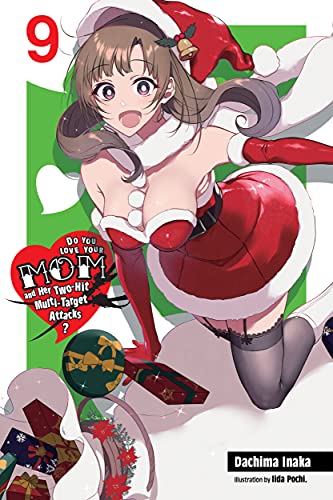
The main problem with Hahako and the Three Kings is that they’re NPCs literally written to be anti-mom, so changing their minds and accepting Hahako as their parent is well-nigh impossible. Towards that end, Shiraaase and Mamako come up with a Christmas-themed event that will hopefully help things along… especially since a mischievous Shiraaase has made it so Masato and the three Kings are infants. As the events go on, they become toddlers, then young kinds, but unfortunately there’s still a wall that can’t really be broken down between the Kings and Hahako. Unfortunately, the whole situation has to be put on hold when Mone, who’s been quiet and withdrawn through this whole event, suddenly gains a massive hole in her chest that sucks up half the cast. There’s gonna be a whole lotta spoiling going on unless Masato and company can stop it.

There are, I think, two big problems I had with this book. The first is that I’d honestly forgotten about Mone and her “spoil me” tendencies, and so having her as the mini-boss of this volume came somewhat out of left field. The other is that, for once, the parody and humor aspects of Do You Love Your Mom? work against it. There’s a few exceptions – mind-controlled Wise, Mehdi and Porta were amusing, I grant you, as was Shiraaase’s verbal disparaging of Porta’s mother throughout – but everything about Masato as a baby made me want to simply stop reading the series right there and fly to Japan to berate the writer. It’s a small part of the book, only a few pages, but I kept simmering about it through to the end. The books have nudged their way closer to a vaguely serious ending over the ppast few, and this felt like backsliding.

We have two volumes to go, and there’s a hint that the final volumes may be a two-parter, as a “demon lord” who is the final boss is mentioned. (I can guess who this is, but we’ll see.) Those who’ve been reading the series will still want to pick this up, but I was tired reading it.

Accomplishments of the Duke’s Daughter, Vol. 1

By Reia and Haduki Futaba. Released in Japan as “Koushaku Reijou no Tashinami” by Kadokawa Books. Released in North America by Seven Seas. Translated by Alexander Keller-Nelson.

Seven Seas has been circling back a bit now that light novels actually sell and has picked up a few of the books they chose to only pick up the manga for earlier. The one that interested me most is this title, whose manga I had reviewed the first volume of in 2018. Since it’s come out, we’ve seen a boom in “villainess” works, mostly helped along by My Next Life As a Villainess but with a bit of help from this series as well. Unfortunately, the novel coming out now does sort of give the reader the feeling that they’ve read this all before, even though it was one of the first to pull off this plot. That said, the isekai aspect of it is barely touched on, and it’s clear that it’s more an excuse for the author to write political intrigue and worldbuilding. To be fair to the author, they are very good at that. As is Iris, though she’s helped along by a built-in support system.

An unnamed young woman, after being hit by a car in Japan, wakes up inside an otome game she enjoyed playing. Who she was is unimportant, because unlike other villainess books in this genre, Iris Armelia is still fully in charge here. Unfortunately, she’s about to get thrown out of school after bullying the “heroine”, and then exiled to a nunnery. Iris, whose influx of isekai memories has caused her jealous heart to come to its senses, is having none of that. She goes to negotiate with her father and, after proving that she’s no longer a lovestruck young lady, he puts her in charge of their local fiefdom. And it needs someone like her in charge – the economy is struggling, there’s a huge gap between rich and poor, and even basic needs such as medicine are hard to come by. Can a former villainess manage to turn things around? And introduce chocolate to the masses?

The biggest fault here is the same as I mentioned in my review of the manga – for a villainess, Iris certainly seems to have everyone on her side already. Her behavior towards Yuri is explained away by iris (and, indeed, the narrative) as basically a temporary lapse of reason, as for the most part she’s been a sensible and kind young noble, whose ENTIRE servant group comes from orphans she rescued from dying in the gutter. (Is this where all the other books get it from?) She has a capable butler, a doting and incredibly strong grandfather, and her savvy mother, who is such fun to read about you wish that she’d get a multi-volume prequel written about her past by the same author. (Good news on that front, though it’s not licensed here.) And of course there’s Dean, whose secret identity is not so secret to anybody but Iris, but that’s fine – he’s there to save her from literally working herself to death, and also setting himself up as the one non-problematic love interest in her life. Villainess? She’s loaded with allies, and did not even need to fall and whack her head to get them.

I definitely think this is a must for fans of the manga. That said, I suspect fans of “I’m in charge of a country and must reform the nobility” books, such as Realist Hero, might get more out of this than the standard Villainess reader. I’m definitely picking up more, though.

The Demon Sword Master of Excalibur Academy, Vol. 3

By Yu Shimizu and Asagi Tosaka. Released in Japan as “Seiken Gakuin no Maken Tsukai” by MF Bunko J. Released in North America by Yen On. Translated by Roman Lampert.

It’s always the same, isn’t it? You get a thousand-year-old powerful being with a desire to take over the world resurrected, and all of a sudden the bus arrives with ten more. Still, it keeps you busy. this series continues to feel like someone wrote a Shonen Jump manga and, instead of getting it published in Jump, decided to novelize it. Well, OK, this would fit Shonen Magazine better than Jump, especially given the large number of kickass women who like to take baths with our hero. (It’s OK, he’s 10! Right? It is somewhat odd to see the “she looks 8 years old but she’s really 600” cliche used to justify underage fanservice seen in the opposite direction… again, also to help with fanservice.) Fortunately, aside from said bath scenes, this third volume is much like the first two. It will never be anyone’s favorite, but I’m probably going to be reading the next book in the series. And it is starting to show off its plot, though that relies on Leonis being dim.

We’re briefly back in actual classes at the start of the book, as Riselia and Leonis are doing team battles against a top-standing rival. This mostly serves to show the school that Riselia is not “that girl with no holy Sword” anymore, and she can kick ass and take names. She’s also a vampire queen, but that’s still pretty much a secret. The main plot, however, starts when the Third Assault Garden, Riselia’s birthplace and last seen being totally destroyed by monsters, has now floated back into vision… and there’s a distress signal. As such, our team is sent out to see what’s happened. Will Riselia be OK with digging up her past? Who’s behind the distress signal? Can we really work an elf AND an evil priest into the same book and not smack our foreheads? And gosh, who is Roselia reincarnated as, anyway? It’s a mystery…

Again, this is a good book. The girls are likeable and also take on a majority of the combat. The combat scenes are well done, and the villains are also good at being villains. There are some things I was annoyed by. After a second book where a confrontation I was waiting for didn’t happen, the same thing happens here, as Riselia is definitely set up to have a big showdown… that does not actually occur. Instead, she grabs an ancient book. Secondly, it’s gone from amusing to vexing to really really annoying that Leonis is unable to understand, as everyone else who sees her manages to do, including anyone who might see their two names side by side, that Riselia is Roselia’s reincarnation. One of the villains literally dies of happiness on seeing this, but Leonis remains clinically thick about it. As a running gag, it drives me nuts, especially as I expect it’s only going to be drawn out more. (It has been pointed out to be the two don’t look alike, and OK, I can kind of accept that.)

Still, as with previous volumes, this was good enough to warrant my reading more. If you want a great light novel, look elsewhere. If you want a book for an afternoon’s read on the beach, this would be fine.