Durarara!!SH, Vol. 1

By Ryohgo Narita and Suzuhito Yasuda. Released in Japan by Dengeki Bunko. Released in North America by Yen On. Translated by Stephen Paul.

It’s been a year and a half since the final volume of Durarara!! dropped in English, and coincidentally that’s also how much time has passed between that book and this sequel. That said, it does not really feel that all THAT much has changed. Some folks have left the city for various reasons, some others have graduated, and we have three new “main characters” to take the place of Mikado, Masaomi and Anri. Of course, “main character” in a Narita work is always a fluid title, and one could argue that this book stars Ikebukuro, in which case nothing has changed. That said, it’s definitely more story than can fit into this book, and the author apologizes for making this a multi-parter right off the bat. There’s a lot of stuff going on. A young man treated as a monster comes to the city to learn how to be human. Another young man is trying his best to be the next Izaya. And a young woman is searching for her missing sisters, both supposedly done away with … by the Headless Rider.

The first three books in the DRRR!! series proper each focused on one of the three high school students, and there’s a sign this sequel may do the same, as Yahiro is definitely the protagonist of this particular book. A young man from Akiba who has spent his life getting attacked and desperately fighting back, to the point where most people consider him to be a complete monster. He hears about Ikebukuro, a place which not only has the Headless Rider but also Shizuo (whose backstory is very similar to Yahiro’s, deliberately so) and decides to go to high school in Tokyo. But finding the Headless Rider is not recommended given the string of disappearances involved with everyone who looks for her. As for Shizuo, well, Yahiro has spent his entire life accidentally beating the crap out of people, so there may be no avoiding it. But who’s gonna win?

As noted, a lot of the “main cast” of the earlier series isn’t here or only shows up later. Shinra and Celty are on a long vacation, Izaya is still AWOL (though he does get a cameo, setting things in motion towards chaos as always), Kadota, Erika and Walker are only mentioned, etc. That said, the new characters blend seamlessly into the cast herd, and there’s so many minor characters in this series that it doesn’t feel like there’s a gaping hole missing. Yahiro is highly likeable in just the sort of way that Mikado never quite managed to be, and Kuon and Himeka also look to have promising, if twisted, stories in the future. It’s clear the city has been in stasis since Izaya left. We see Akane has grown older and is in middle school now, but Shizuo and Tom are still doing the same old thing, as is Simon, as are the Orihara twins and Aoba (he’s still not dating them, mostly as he’s just not into Mairu). Peace is good, but makes for dull storylines. In that sense, I’m grateful to Izaya for siccing Yahiro on the place.

This is a typical DRRR!! multi-parter, in that the cliffhanger ending is fairly mild, but also definitely makes you want to read more. Good news! There are three more books in the series to date. And the next one should be out soon. DRRR!! fans will definitely want to pick this up: it’s like welcoming an old friend back into your life (and then having them destroy your house again).
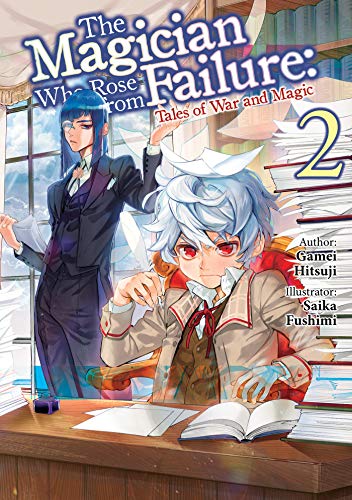
The Magician Who Rose from Failure: Tales of War and Magic, Vol. 2

By Hitsuji Gamei and Fushimi Saika. Released in Japan as “Shikkaku Kara Hajimeru Nariagari Madō Shidō! ~ Jumon Kaihatsu Tokidoki Senki ~” by GC Novels. Released in North America by J-Novel Club. Translated by Alexandra Owen-Burns.

As with the first volume in the series, I would describe this book as “solid”. It keeps things interesting, has some fun new characters, balances political intrigue and character development (the first half) with an adventure against villains with lots of fighting (the second half). The protagonist is, of course, a prodigy who is praised by everyone else in the story – need I remind you what genre you are reading? – but he’s still probably the best reason to read this, being mostly sensible but with a core of ludicrousness that pops up whenever he tries to bring in ideas from his Japanese life. Oh yes, and this is still an isekai, but it’s used pretty sparingly, mostly to show why Arcus is a better thinker than the magicians in this world. All that said… as with the first book, solid is all I can give it, and it didn’t really knock my socks off. Magic in This Other World Is Too Far Behind fans are justified in being annoyed.

The book starts off with Arcus’ big invention being shown off to the leading magicians of the Kingdom. We’re briefly shown the group before the presentation, and they’re all stereotypical eccentrics who each have their own agendas and do not get along with others. But the thaumometer blows them all away, to the point where they’d all be fighting to see who gets it first if they didn’t all get one because this was a predictable outcome. After this we jump forward two years and see Arcus as a 12-year-old. The device is still a state secret, but the other kingdoms know something is up, and there are now spies trying to get it at any cost. Arcus joins forces with Orco from He-Man… erm, a mysterious elf, his (ex)-fiancee, his sister, and his “magical partner” to take out the enemy… though he may need help from a passing pirate.

The Arcus generation are all still in their tweens, so romance is not happening yet, but it’s clear that Charlotte likes him and would like to reignite their engagement, and that Sue (who we find out here is the daughter of a duke, though that’s hardly her only secret) is really possessive of him. It’s a love triangle I’d be more invested in if the King had not blithely said he could have two wives as a reward for the magical measuring stick. (Multiple wives getting a bit overdone? Yes.) As for Arcus, he has the fantastic spells, and can sometimes make them devastating (his magic machine gun boggles the mind), but he still lacks the mana to be a powerhouse like his sister (who still adores him). That my change in the future, as he gets a temporary power-up via his elf guide, which implies the same sort of thing could happen again.

In general, the series is better then it’s doing politics and character than battle scenes, which means both volumes so far fall down in the second half. Still, it’s one I’ll be reading more of. As I said, it’s solid.

Kuma Kuma Kuma Bear, Vol. 6

By Kumanano and 029. Released in Japan by PASH! Books. Released in North America by Seven Seas. Translated by Jan Cash & Vincent Castaneda. Adapted by M.B. Hare.

Towards the start of the Bakemonogatari series, when the protagonist, Koyomi Araragi, meets Tsubasa Hanekawa for the first time he talks about how he doesn’t have any friends as they would “lower my integrity as a human”. This is, of course, the sort of self-assuring bullshit that a lot of lonely teenagers go through, trying to reframe their social ineptness as cool reserve. Eventually, Araragi grows past this sort of attitude. That said, our bear girl Yuna may have a large number of acquaintances from all over the kingdom, but at heart she seems to think much the same thing about having friends, holding herself at a remove from everyone else and telling herself that she’s really a cool, somewhat selfish teenage girl who is not remotely a great hero. Mostly, I think, as she does not want to deal with potentially tragic consequences if she does end up getting closer to others. That said, I don’t think she can keep this up forever. Sometimes you just want to buy your best friend/protege a really cool knife.

As with a lot of books in this series, there are basically two main plotlines. The first has Yuna reluctantly agree to be a bodyguard for Shia and three of her classmates as they go into the woods as part of their classwork. Yuna is only to help them in a dire emergency. That said, once again we are reminded that, to folks who haven’t met her and seen her in action, Yuna is a small girl in a bear costume. (Later in the book, Yuna angrily reminds the other students that she’s the same age as they are – they thought she was much younger.) Needless to say, by the end Yuan wins over the other students AND defeats a hideous tiger monster. Then in the second half of the book Yuna helps Anz, the girl from the seaside city who wants to start her own restaurant, as well as the four young widows who Yuna rescued from the bandits who want to start over in a place with fewer memories.

I mentioned Yuna’s social ineptness above, and it’s never been quite as visible as it is towards the end of the book. The reader may recall that the four assistants Anz has were all raped by bandits and had their families brutally murdered a couple of months earlier. (Remember, cute bear girl series, really. It’s just like K-On!.) They’re there to help Anz with the restaurant, but Yuna decides to also have them help at her orphanage, which she feels is understaffed. One of the young women is CLEARLY distraught over being around children who are presumably the same age as her own children she saw murdered not long ago, but the story is still from Yuna’s POV, and the most we get out of her is a “huh, maybe I should not have done that”. Fortunately, it all works out well, but there is a reason why I keep highlighting the dark bits in this otherwise fluffy light novel series – they’re the most interesting, character-wise.

As the book ends, Yuna is off to battle a cave of endless golems, and we are briefly reminded that this is supposed to be based on a video game. I assume Yuna will win, but… the jagged edges that surround the big pluffy bear girl are why I really enjoy reading this series.