Welcome to Monstrous Miss Sophie’s Enchanted Salon of Healing, Vol. 2

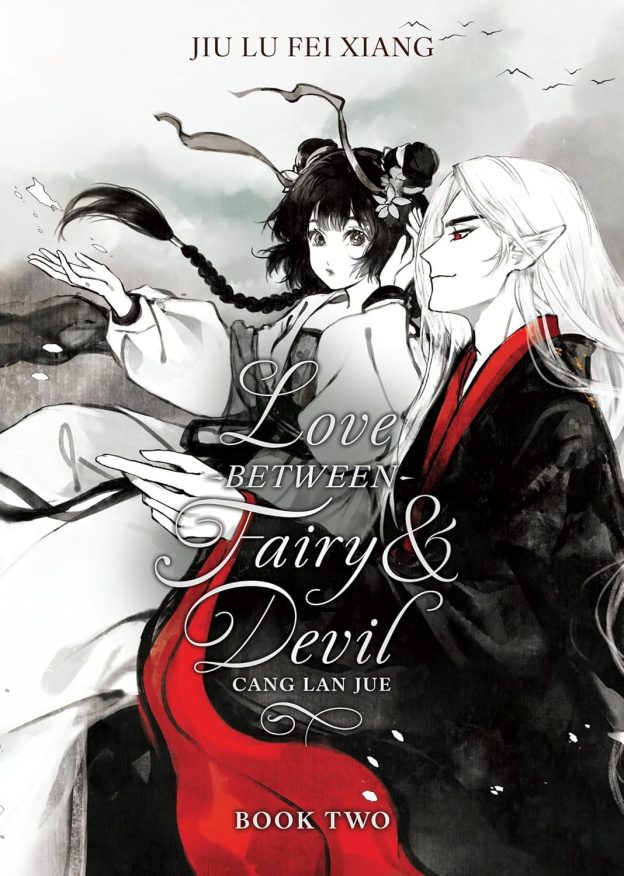
By Sachi Konzome and Harenochihareta. Released in Japan as “Bakemono Jou Sophie no Salon: Gokigenyou. Kawa Ichimai nara Naosemasu wa” by Mag Garden Novels. Released in North America by Cross Infinite World. Translated by Dawson Chen.

Endings are hard, especially when a book is only two volumes long. Honestly, I think this might have worked better as one big brick, but I can guess why the publisher didn’t want that – these are chunky books as it is. But the main issue is that the first volume was alternating between Sophie and Kurt and their budding love and Sophie essentially having a new customer every chapter with a scar and a story. The second volume also starts out this way, but it almost reads like the author was told to wrap things up, as a little over a third of the way into the book, we end up dealing definitively with Sophie’s skin issues and disfigurement, as well as her self-loathing which is preventing her from accepting Kurt’s love now that he has finally realized what emotions are and that he has them. It’s still a good book, but it feels unbalanced.

The book starts with Sophie still taking care of clients with issues. We meet two kids who claim to be lost princesses but the truth is something far more tragic and well-worn; a clown following in his grandfather’s footsteps who wears his tragedy on his face; a beastman gatekeeper who is struggling to bring up a wayward daughter; and a bartender who is troubled by her past as a pirate. Throughout this we also get Kurt, who is going off to help fight a monstrous dragon, a task so dangerous that he gives Sophie half his dog tags, something you usually only give to your wife or fiancee. She’s very, very worried about him. Then, he returns, with a nasty scar (which she heals of course), and a proposal. She rejects him bitterly due to her condition. Can something be done about that?

The book wears its heart on its sleeve, sometimes a bit too much. Sophie’s cure amounts to finding a doctor who knows what it actually is, and the psychological component of it all, which I was sure might cause her to reject an immediate cure, does not come into play – at least not like that. The little girls’ story is tragic, but also somewhat incomplete – I was expecting the story to circle around to the mother and daughters once more, but it never did. The back half of the book is almost pure fluff – the one cure Sophie administers is to a literal living magical creature that makes people happy. It’s an emotional book, but I wish it had a bit more heft to it. Everything here happens pretty much exactly as you could have guessed. And they all lived happily ever after.

Still, it wasn’t that long, and I enjoyed Sophie essentially collecting tragedies and then upending them. That’s what I’ll remember this series for the most.

Babel: The End of the Journey to Restore Language

By Kuji Furumiya and Haruyuki Morisawa. Released in Japan as “Babel III: Torikago Yori Izuru Youki” by Dengeki Bunko. Released in North America by Yen On. Translated by Amelia Imogen.

The final volume of this series delves deeply into the question of what drives humanity to succeed. In the past of this world, humanity was pushed to the brink, and feared powerful witches. These days there are no more witches, and things are relatively peaceful. But will humans make the same mistakes they made before, just because they don’t remember what it’s like to life in fear and thus innovate? If you’re nodding along to this, congratulations, you agree with the villain of this book. If you’re staring and wondering what the hell this teenage history logic is, you’re a lot more like Shizuku, who has to try to deal with this while also finding a way to return home and also deal with the fact that – as we’ve occasionally noticed since the very first book when she looked at that forbidden tome – there’s something a bit off with her. Fortunately, she has Erik by her side this time, as opposed to written out by the author.

Shizuku continues to work on her language learning aids, but there’s a new problem. Some of the kids at the castle, after hanging around the older children, regain the innate language abilities. Does this mean the thesis that she and Erik have been so carefully working on is completely wrong? That said, she has other things to worry about. She’s apparently staying up for hours at night reading the blue-covered book she has, though she never remembers doing this. A neighboring country invites her there as they want that book, and are… well, not willing to kill her, but willing to hide her body if she gets killed by something else. Worst of all, a witch has appeared and recreated a very familiar witch’s tower (well, familiar if you read Unnamed Memory), and wants people to challenge it. And she’s also going around slaughtering women and stealing their souls. That’s bad.

I have to admit, I enjoyed this series more for the plot and worldbuilding than the characterization. Shizuku and Erik’s relationship can best be described as “kinda nice”. She and Ortea (and, for that matter, she and Lars) had a much more interesting back and forth. I also note that she only says “I love you” to Ortea in this book. But no, dull love prevails. Ah well. This also sort of gives away that she does not return to Japan, though if any reader is surprised by that they must not read many series like this. The best part of the book is what is actually up with Shizuku, and how they manage to use it to save the day. That said, while I would not call her behavior suicide ideation, we do get a lot of “I must sacrifice myself to save everyone” and she jumps off a very high building – again – with worse consequences this time. You can see why Lars finds her frustrating.

There’s a sequel to Unnamed Memory that is apparently also a sequel to this, but I’ve no idea if it will be licensed given the UM anime was a dud over here. Fans of the author will enjoy this.

Villains Are Destined to Die, Vol. 1

By Gwon Gyeoeul and JINSA. Released in Japan by D&C Media. Released in North America by Ize Press. Translated by Tapas Entertainmnt Inc.

I have not really dipped my toe too much into the Korean end of the villainess market. I generally have an allergy to vertically scrolling titles that I blame on being old, and aside from taking a look at Beware the Villainess, which runs on the deep rage of the heroine, I had not been taking in the manwha/webtoon end of the genre. But I saw that this also had a novel coming out, and I like text, so I decided to give it a try. It’s decent enough, though it definitely lives and dies on how much you like the heroine, who can be a lot, especially in this first book. I was actually reminded a bit of I Swear I Won’t Bother You Again!, as abuse in a past life leads to the actions the heroine takes in this life. In the case of Villains Are Destined to Die, though, the past abuse was in Korea, and this new “villainess” runs far more on bitter cynicism than anything else.

The premise will be familiar to many: Our unnamed heroine stumbles across a mobile game called Daughter of the Duke’s Super Love Project, and gets obsessed with it, particularly the Hard Mode, where you play as the adopted daughter who is the villainess in the Normal Mode of the game. In fact, she tries to hard to beat the ending she apparently dies, and finds herself in the body of Penelope Eckhart. Her family now hate her, the servants despise and abuse her, and if she doesn’t do anything she’s going to be tortured and executed within a year. Fortunately, she has her knowledge of the game – though she never got close to winning hard mode – so this shouldn’t be too difficult… except that she’s only given three option dialogue trees, and they’re all terrible options.

Fortunately, and this happens almost immediately so it’s not much of a spoiler, she gains the ability to turn off the “you have three bad options” screen fairly quickly. She does still see affection meters, though, which are all so abysmal you wonder what Penelope was like before our heroine”s reincarnated self took over. We gradually find out, and it turns out that the heroine and Penelope have a lot in common in terms of how they grew up – which makes things more interesting, as the influence of her past abuse makes this new Penelope far too distrusting and bitter, and a few times she shoots herself in the foot in her efforts to save herself. She also has the same issue a lot of these reincarnated villainesses have, which is she sees this world as a game, and doesn’t see the others as people. She’s got a tough road ahead of her, even if she is softening a bit by the end of this book.

I didn’t even mention the men in the series – angry brother 1, angry brother 2, yandere crown prince, mysterious sorcerer, and grateful slave. That said, I also didn’t mention the game’s heroine, who has not even shown up yet by the end of this volume. Villainess fans who want something a bit more bitter may find this to their liking.