Altina the Sword Princess, Vol. 8

By Yukiya Murasaki and himesuz. Released in Japan as “Haken no Kouki Altina” by Famitsu Bunko. Released in North America digitally by J-Novel Club. Translated by Roy Nukia.

Since this volume was released on the same day as the short story compilation, you end up with two Altina reviews in a row. Fortunately, there’s a lot of ground to cover here, as we pick up right where we left off – with Latrielle having just murdered his dissolute father and consort in a fit of disgust. Naturally, this particular part is covered up, but the fact that the King is dead is absolutely not – meaning not only that Latrielle is going to be the next King, but that Altina is no longer in the line of succession. Admittedly, he’s not quite crowned yet. What’s possibly worse is that the military and the crown are finally forcing Regis to return to the capital to get his promotion and title… and no, Altina has an army, she can’t just tag along. That’s right, we’re breaking the fellowship here, and I have a suspicion it may be for multiple books. That said, those who are fond of the low-flame romantic feels in this book might be pleased.
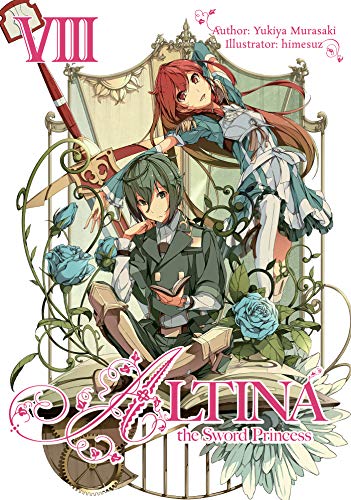
There are, of course, other things going on besides Altina and Regis liking each other and being unable to convey it properly. Regis’ impact is felt on multiple people, especially Clarisse, who may couch it in the form of teasing but clearly likes Regis a whole lot more than she’s ever going to let on. There’s also the matter of Gilbert, the mercenary that was captured last volume, and trying to negotiate so that he’ll join them rather than simply be executed as everyone expects. Unfortunately, the news of the King’s death makes negotiations fall apart a bit. Gilbert’s three sisters are still at large, although they’re a lot less dangerous on their own. And Bastian and Eliza are returning from Britannia after events in the short story collection, meaning there’s another royal to throw into this chaos. With all this going on, there is also personal defeat – Eric’s injury has injured their hand to the point of being unable to use a sword anymore, and Eric is devastated by this.

Despite all the bad news, there is quite a bit of comedy in this book, mostly stemming from Regis’ inhuman self-deprecation, which has actually become a genuine weakness – praise seems to cause him pain. Given that he’s generally considered by everyone not named Regis to be a brilliant strategist, you can imagine how he holds up when he’s escorted by a gorgeous young woman to return to the capital to get a promotion and a title – he’d rather be doing anything else. Altina is also her usual blockheaded, mildly tsundere self – please do not pull anyone into your boobs when you are wearing armor, kid. I get the feeling she’s gonna miss Regis more than he’s gonna miss her, at least in terms of the war. What’s more, given Latrielle assigning Regis as his aid for the immediate future, their separation may be longer than expected.

The author continues to write both this and How NOT to Summon a Demon Lord at the same time, which if nothing else shows off their ability to write in different styles. For those who like a fun, action-filled fantasy with much less fanservice than the other title, Altina remains a solid bet.
Altina the Sword Princess: Loose Threads

By Yukiya Murasaki and himesuz. Released in Japan as “Haken no Kouki Altina” by Famitsu Bunko. Released in North America digitally by J-Novel Club. Translated by Roy Nukia.

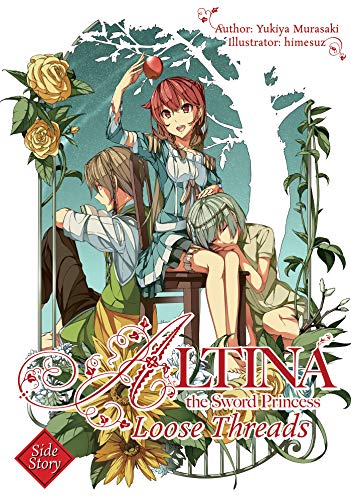
Yes, as you guessed from the title of the book, it’s time for a short story collection. That said, there’s only three stories in this volume, so they’re pretty long. The first of these stories is essentially an Encyclopedia Brown story with Regis as the title character and Altina as Sally, made all the more impressive by the fact that they haven’t actually met each other yet when it occurs. Altina is at her new command, but no one is taking her seriously yet. Meanwhile, Regis’ commander has just died and he’s busy waiting to be demoted/exiled. And then a crate of expensive wine goes missing in Altina’s camp, and they try to find the culprit. This shows off Regis’ ability to be “the smart one”, although frankly the solution to this problem was not all that hard. More to the point, it establishes the relationship he and Altina will have before they even see each other, and as such it’s rather sweet.

The second story is also a “how they met”, as we get a closer look at Eddie, the erstwhile knight protector and lover of Auguste… or rather of Felicia, the 5th princess who is pretending to be Auguste. There is some cute writing here, mostly in the author trying to have the reader think some sexytimes are happening and then having it be something totally innocent, but for the most part this is a serious story. Eddie is renowned for being a soldier who doesn’t kill, and as such is regarded as a coward and a failure, mostly as his detractors are a bit too rock-headed to see how strong you have to be to do the level of not-killing that Eddie does. The revelation that it was Felicia who started him on this path is a bit on the nose, but nice. I also enjoyed the multiple descriptions, both in this and the following story, of Altina as this monster who can lift cows by herself and is not someone to imitate at all.

The final story is the one specially written for this book (the other two were previously published), and continues the story of Bastian and Eliza from the fourth volume, who if you’ll recall were last seen near death and had a death warrant put on them by the usurper queen. They’ve managed to find refuge with one of the few families not willing to sell them out, but it’s still tough times. This story hammers home something we also saw in Eddie’s story, which is that the best way to have peace is not to fight. Unfortunately, that can be difficult, especially as Bastian’s family has been doing nothing but fighting for four centuries now. He also gets a crash course in democracy from a young student who is also having to lay low while the war is going on, and might be reconsidering the whole “noble/commoner” dichotomy. This is the most serious story in the book, and looks like it might serve as a way to get the third prince back into the main storyline.

Which we will see next time, as Altina the Sword Princess 8 is… already released! But definitely read this volume first. It’s a good collection.

Reign of the Seven Spellblades, Vol. 2

By Bokuto Uno and Miyuki Ruria. Released in Japan as “Nanatsu no Maken ga Shihai suru” by Dengeki Bunko. Released in North America by Yen On. Translated by Alex Keller-Nelson.

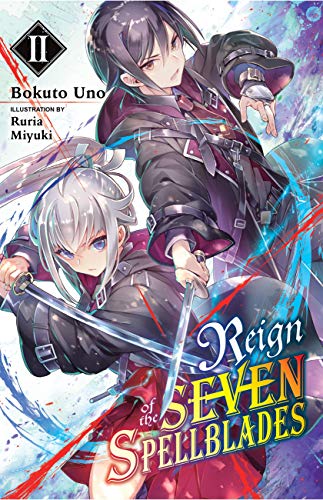
Much to my surprise, after a humdinger of a reveal towards the end of the first book, the second book in the series does not build on that reveal beyond a few ominous scenes. Instead, this book proves to be 100% magical academy adventures. This is not a flaw, as the author is really excellent at writing magical academy adventures. We get broom lore, epic sword and magic duels, wacky classwork, terrifying classwork, and more of The Labyrinth, which is likely going to take up more and more of the books as the series goes on. Here our group of six decides to make a home base inside it, the better to do all the little things they really don’t want others to find out about. Unfortunately, our kids are all Very Special People, and as such have attracted the attention of others. This means even more battles, more secrets revealed, and more magical sword battles. Unfortunately, it also means a nasty cliffhanger.

While Oliver and Nanao continue to be the “protagonists” part of the group of six, the others are getting development, and in this book it’;s Pete and Chela who get it. While I will try not to spoil too much, Pete’s plotline in particular is quite well done, and I liked the fact that everyone was understanding and that he was immediately introduced to a support group of people with similarities. And if it also feels like a “fuck you” to a certain other magical academy book writer, well, all for the better. As for Chela, her plot is tied into her family history and the way magical families work in particular. In my last review I compared her to Rin Tohsaka, and that comparison holds up very well here, even including a younger sister that she’s unable to publicly acknowledge. She continues to be my favorite of the six.

As for others, I am hoping Guy gets a book of his own soon, as he’s currently “the other one”. Katie builds nicely on the first book, and I appreciate her discovery that even groups that supposedly share the same belief as she does are not the sort of groups she wants to be involved with. This society is complex, and changing ingrown prejudices is not going to be as easy as a well-timed lecture to the head. The minor villains in the book include an arrogant not-Italian kid (in the same way Nanao is not-Japanese) who tries to show Oliver why learning the basics is bad, the aforementioned younger sister and her servant/best friend, and another guy who acts the part of an arrogant asshole because he was essentially traumatized into it. In this book, both good and bad guys have a rich characterization to them. Well, except Guy. Sorry, Guy.

The cliffhanger makes me want to read the next in the series right now, but we’ll have to wait a bit. In the meantime,l please read this, it’s one of the best light novel debuts from 2020, and 2021 proves it was not a fluke.