Baccano!: 1932 Summer: Man in the Killer

By Ryohgo Narita and Katsumi Enami. Released in Japan by Dengeki Bunko. Released in North America by Yen On. Translated by Taylor Engel.

After a very depressing 1700s volume of Baccano!, it’s nice to be able to get a book that is back at “home base”, so to speak: the 1930s. And this book is markedly lighter in tone, despite featuring a series of murders and an examination of what sort of person you have to be in order to commit said murders. It was originally written as an extra for those who bought the Baccano! anime DVDs Vol. 1-5 in Japan, then fleshed out for this book. That said, let’s face it, the main draw is on the cover art. If you asked any Baccano! fan which two characters absolutely should not meet because the world might end if they started talking to each other, Elmer C. Albatross and Graham Specter would be right at the top. Oh, don’t get me wrong, after a brief misunderstanding they get on like a house on fire. But that is the trouble. The last thing anyone like Graham, who Shaft can barely rein in at the best of times, needs is Elmer’s philosophy of life.

This takes place about seven months after Drugs and the Dominoes and about a year or so before The Slash, and features a few of the characters from both books. It also serves as an odd epilogue to The Rolling Bootlegs. There is a serial killer in the city, Ice Pick Thompson, whose nickname comes from his murder method. We meet Lester, a reporter who’s been ordered to follow the story even though he really would rather avoid it; Mark, a young boy who has decided to kill himself… till he meets Elmer; and Graham, Shaft and company, who are just hanging around the city but keep getting dragged into the plot. Is this just a crazy serial killer, or is there a method to their madness? What does this have to do with the Gandors? What does this have to do with Szilard Quates? And can Isaac and Miria really become literal time? Or money?

The thing that interested me most in this book is the villain, which makes a refreshing change from the usual villains we’ve seen in Baccano!, who tend to be very obvious from the start – art least from the reader’s perspective. This one is meant to be more of a mystery – though really, not that much of one, as there’s something fishy from the start. Which is fitting, given they’re more on the Dallas Genoard end of the villain spectrum than the Fermet end. I also want to note how impressed I am with Graham and Shaft, who are not Japanese but nonetheless make the perfect manzai team. When Sham made Shaft one of his vessels, he basically created the perfect tsukkomi, as well as the only one capable of stopping Graham – not that he ever actually succeeds. The best thing about the book, though, is probably Mark, a quiet, tragic character walking around a sea of loudmouthed extroverts.

If you enjoyed being back in the 1930s, worry not, we’re soon going to be there on a more permanent basis. But first we have to wrap up the 1700s arc, and finally find out what happened on the Advenna Avis. Next time we go to 1711 and see how Huey’s holding up after Monica’s death.

My Friend’s Little Sister Has It In for Me!, Vol. 2

By mikawaghost and tomari. Released in Japan as “Tomodachi no Imouto ga Ore ni dake Uzai” by GA Bunko. Released in North America by J-Novel Club. Translated by Alexandra Owen-Burns.

In my last review, I compared this book to McDonald’s fast food, and nothing here changes that opinion. I enjoyed it a great deal. It has characters who I enjoy reading, dialogue that’s a lot of fun, and clearly has a long-term goal in mind as opposed to just being written volume to volume. On the other hand, wow, the plot beats here make me cringe. “Let’s save the drama club!” is not something that a self-respecting series should be doing when it’s only the second book, and the ludicrous coincidences that lead to our leads ending up in the production are even worse. Now, I get the sense the author knows this, as the situation really is pretty ludicrous, but yeah, don’t read this for the plot. That said, it should make this pretty fun to adapt when it becomes an anime, and Iroha will no doubt please fans who are already over the moon for Uzaki and Nagatoro, though I warn you her dialogue is a bit slang-filled.

This volume picks up right where the last one left off, as Akiteru tries to figure out how to respond to Mashiro’s confession, and Iroha knows about this confession but has to pretend she doesn’t. Akiteru knows he has to respond quickly and decisively, because he’s read dumb romantic comedy light novels. Unfortunately, it turns out that while he tries his hardest to be the best Eliezer Yudkowsky he can be, he is not quite able to get past the fact that he’s really goddamn happy he got a confession -though it takes him most of the book to figure this out. As for Iroha, well, she’s dealing with jealousy as well, plus her dimwitted senpai not figuring out her feelings (which Mashiro sure can by the end of this book), and it’s even affecting her voice acting work. Hrm, this sounds complicated, maybe saving the drama club *is* what’s needed…

As I’ve said before, Akiteru interests me, mostly as I think he’s screwed up in a very different way from cynics like Kyon or nihilists with a heart of gold like Hachiman. His raw panic when Iroha points out he’s overslept by an hour, and desperation to get to school on time so it doesn’t mess up his regimented life, is very telling. There’s no denying that he’s excellent at directing, be it games or plays, and despite his own denials, he’s a pretty good actor too. But improvisation seems to be a kryptonite for him. The only reason he can do the play is he’s so familiar with the material, and the problems with Mashiro and Iroha that he “solves” here are done after thinking them out in bullet points in his head. The first epilogue suggests that he’s going to have to figure out a way to break through that soon, as he may need to improvise even more in the future.

Despite adding a new cast member to the game group (a classmate of Akiteru’s who is a genius sound designer), this still feels like only three of the cast are really important, and I’m hoping we’ll flesh out the others soon. Unfortunately, next time it looks like the one I didn’t want fleshed out will be getting the spotlight. I smell an arranged marriage… In any case, this is a lot of fun unless you take light novels too seriously.

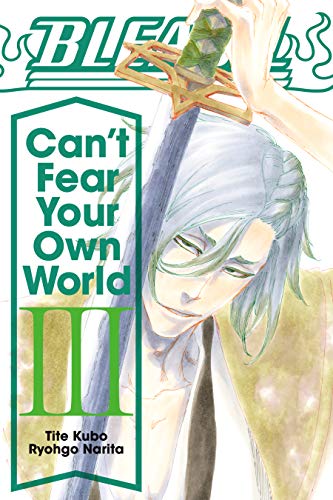
Bleach: Can’t Fear Your Own World, Vol. 3

By Ryohgo Narita and Tite Kubo. Released in Japan by Shueisha. Released in North America by Viz Media. Translated by Jan Mitsuko Cash.

The first half of this book is, to put it bluntly, a slog. It’s the giant fight against Tokinada that I’d been expecting, but for the most part it’s content to not be “Bleach, only well written” like the first two books but “actual Bleach”, which means that everything moves at the pace of a lethargic snail who’s having trouble getting going in the morning. Tokinada shows off his zanpakuto, whose gimmick is that it can copy the attacks of other Zanpakutos, which also means that he is Monoma from My Hero Academia and thus we can hate him even more. Fortunately, around about the halfway point, several things happen that make the book better. We get some lore we actually care about, Hisagi shows up to remind us he’s the star of these books, and we get some truly interesting characterization from one of the minor big bads I mentioned last time, who finally finds a thing to care about. That said, Nanao is still useless. It is Bleach after all, I guess.

The fights pretty much divide up how you’d expect. The super overpowered kid takes on Zaraki, and Tokinada takes on literally everyone else. Tokinada reveals his motivations for being the biggest smug asshole in all of Bleach (and given this is a series whose villains are ALL smug assholes, that’s a high bar), and these motivations will be very unsurprising to anyone who has read Baccano!, also by this author, as Tokinada and Fermet really do have an awful lot in common. Meanwhile, Hisagi has a chat with our overpowered child before all this begins, and reasons that the way that they’ve been raised means that they’re unable to decide anything on their own or have a moral center. He thus decides to make it his goal to raise this child right. And it turns out that he’s got a solid ally on that one, too. Now if only they could somehow stop Tokinada. Perhaps… if Hisagi finally figured out his bankai?

Bleach tends to run on cool moments, with everything in between just filler while you wait for the next one, so it’s good to see that there are a few here, the best of which is Hisagi stopping Zaraki from fighting Hikone – stopping Zaraki from a fight he’s pumped up for is damn near suicidal, but his reasoning is excellent, and even Zaraki has to agree, to the astonishment of everyone else. Hisagi’s fight with Hikone, using his newly discovered bankai, is also pretty damn cool. And I was pleased to see less death in this book than I expected, though given this is a book that resurrected damn near everyone killed off in the last Bleach arc to show they aren’t really dead, I should not be all that surprised. I also liked the lore that was given to us (which should have been in the actual manga, as is mentioned in the afterword) about the past of the Soul Society and what terrible things keep it going.

That said, Christ, this book is too long. It’s not as long as the 2nd book, but it’s still 285 pages when 185 could have easily sufficed. It’s essential reading for Bleach fans, but everyone else can easily skip it.

Oh yes, love to see Grimmjow shipping IchiHime.