A Mysterious Job Called Oda Nobunaga, Vol. 3

By Kisetsu Morita and Kaito Shibano. Released in Japan as “Oda Nobunaga to Iu Nazo no Shokugyou ga Mahou Kenshi Yori Cheat Datta Node, Oukoku o Tsukuru Koto ni Shimashita” by GA Novels. Released in North America by Yen On. Translated by Noboru Akimoto.

When I reviewed the first volume in this series, I mentioned that it was by the same author of I’ve Been Killing Slimes for 300 Years, but was its polar opposite. After finishing the series, I’ve realized that may not be entirely true. The books are both written for male audiences, but very different kinds of audience. One emphasizes masculinity, the glory of battle and the constant conquest of women. The other barely has any men in it at all, is relaxed and laid-back, and very deliberately has its heroine trying not to work hard at anything. But they are both, in the end, stories about ridiculously powerful people, who we do not really see lose a fight over the course of their series, amassing a string of young women who adore them. They’re found family in the case of Azusa, and concubines/wives/lovers in the case of Alsrod, but really, all Azusa needs now is a massive fortress to defend.

If you are here for surprising twists late in the narrative, I advise you to find some other series, as you could have predicted every single plot beat in this book before you picked it up. Alsrod puts down a rebellion against him – composed of his brother in law and his father in law – and rewards them as traitors deserve. He then pauses, as the king has decided that it’s now time for him to do the fighting, and spends time on his own demesne waiting for the inevitable failure of the royal army to do anything and their pathetic call for help. When this occurs, he is quick to fight, breezing along towards the enemy and having so few issues that his fellow soldiers remark on how easy this is. Inevitably, the king grows terrified of his power and brands him a traitor. But that’s OK, because he has a badass group of women he’s bedded, who are ready to fight wars, argue politics, and even become queen for him. (And then abdicate, because let’s face it, one can only go so far.)

I will mention to horny readers looking for sex that, while there are at least a dozen if not more scenes mentioning Alsrod getting it on with his many women, there are precisely zero that go into the act beyond “and then we did it. Afterwards, in bed, we discussed…” etc. This book is not here to arouse it is here to show you what an awesome, virile man Alsrod is. And oh yes, there’s also Oda Nobunaga. He still offers the occasional bit of advice, mostly on how to build a really good castle. But, as Nobunaga himself admits, he was murdered before he could get to the “conquer the kingdom” part, so Alsrod has gone further than him. Indeed, that might be the purpose of this book. Look, here’s our hero, and he did what Oda Nobunaga could not. And they all lived happily ever after.

The author admits that, while there might be more tales to tell, he’s not going to be doing it, so this is the last book. Which is a very good thing, as I think the book wears out its welcome exactly at this point. It is absolutely the perfect length for what it is. I recommend it to fans of Oda Nobunaga… well, OK, maybe for those who play the Nobunaga’s Ambition game.
The Invincible Shovel, Vol. 4

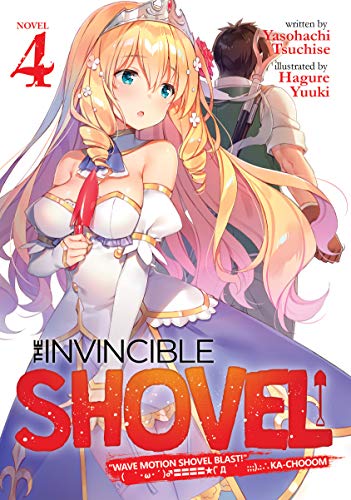
By Yasohachi Tsuchise and Hagure Yuuki. Released in Japan as “Scoop Musou: “Scoop Hadouhou!” (`・ω・´)♂〓〓〓〓★(゜Д゜ ;;) .:∴DOGOoo” by MF Bunko J. Released in North America by Seven Seas. Translated by Elliot Ryoga.

This was, to be a shovel, a much shovelier shovel than the previous shov… urgh. Sorry. But frankly, after reading the latest volume of this series you just start to do it naturally. This 4th volume has over 1000 uses of the word shovel in some way, shape or form. It begins with a half-failed attempt to make an anti-shovel device, and towards the end ends in a world that is literally made up of millions of shovels, representing Lithisia’s somewhat misguided desires. That said… and despite the continued threat of tentacle shovels molesting the female cast… this was a much better volume than the previous one. For one thing, it actually now seems to be headed for its endgame, and admitting that it has to have Alan and Lithisia talk to each other in a way that does not involve talking past each other. Secondly, the book admits that Catria is the best heroine we’ve got, and that we have the most laughs when watching her suffer.

We begin with our heroes having derailed most of the villain’s plans. They’ve already collected all the necessary orbs. The four deadly mini-bosses have all been either killed or made into Lithisia’s toy shovels. That said, there are still a few problems. The first is Catria’s continued attempts to remain vaguely normal, despite her ability to use Alan’s shovel powers getting better and better. With the help of a hellish artifact (literally), she now has to keep her shovel and anti-shovel thoughts balanced, or else had things will happen. That said, things may be worse for Lithisia, who has already noticed that Alan and Catria are bonding, and is basically a bundle of jealous insecurities. This ends up becoming a disaster of monumental proportions when the orbs grant Lithisia’s wish of a shovel world… one where even the sun itself is forced to have a shovel in it. Is this truly the end?

Lithisia has been the broadest of broad characters since about halfway through Vol. 1, and recently had been verging into actual mental disorders. At heart, though, she remains a maiden in love, and the core conflict of this series, beyond even the need to rescue her kingdom from evil, is her and Alan misunderstanding each other’s wishes. He wants an apprentice in regards to his mining. She wants love… and, perhaps even more importantly, a child. She ends up getting the first, amazingly, as Alan is able to come down from obliviousland in order to admit that he would be perfectly happy to spend the rest of his life with her. That said… this does lead to a very funny situation, as after 4 volumes of Lithisia using the word ‘shovel’ to mean sex, the idea of making a baby the normal way never even occurs to Alan. And that’s not even getting into the last-minute swerve that makes your jaw drop and also your forehead get smacked by your hand.

Despite my thinking that it was leading to an ending, this is not apparently the final book in the series. That said, it is the most recent to date, with Vol. 5 not out in Japan yet. If, like me, you were hoping to temper the shovel humor with actual character development, this is a good one to pick up. And it’s still pretty shovelly fun too.

Der Werwolf: The Annals of Veight, Vol. 11

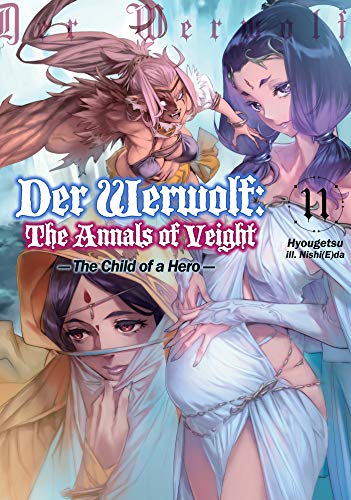
By Hyougetsu and Nishi(E)da. Released in Japan by Earth Star Novels. Released in North America by J-Novel Club. Translated by Ningen.

The last couple of books have been trying to explain why Veight is as successful and beloved as he is, and that it’s not simply “he is an incredibly strong and powerful werewolf”. As Veight notes in this volume, he could immediately solve the problem in the kingdom of Kuwol if he simply killed Zagar. He’d be justified in doing so. Zagar killed the king and framed Veight for it. But doing that would plunge the country into chaos, which is absolutely not what Veight wants. Zagar is certainly strong, and can kill anyone who is suddenly no longer useful to him. But all he wants is combat, which means he’ll never be satisfied. Veight, on the other hand, has spent the last ten books making the kingdom safe for both humans and other races, and all he wants to do is settle down with his wife and child. He investigates thoroughly. He takes the opinions of commoners into advisement, but also thinks of the nobles and their pride. He’s just really good at this.

No, don’t worry, that’s not Veight’s unborn child on the cover, but the late king’s, who it turned out had a favorite consort. This volume picks up where the last left off, as Veight tries to figure out how best to unite the nobles, stop Zagar, and not have everything explore into war. He’s helped by the return of Parker, who may have gone missing but was never really in danger, and who is perhaps at his least silly in this book. With the help of a mountain tribe and a cleverly placed fake… as well as, admittedly, the power of modern laser guns… Veight is able to win the day. This allows him to hurry home, as he’s gotten an unfortunate prophecy about Airia, who it turns out needs to have a cesarean section (completely unknown in this world) or else the touch of death may strike her and their child. Can Veight and company save the day? And will the prophecy come true anyway?

This is not the final book in the series – J-Novel Club has licensed at least through Vol. 13, and the rights to the novels were just sold to Square Enix, who will be releasing more. But it’s the end of the “main story”, and the author says that the rest of the books are essentially going to be side stories. (They’re even changing the illustrator to reflect the books “lighter feel” starting next time.) Certainly this seems like the “end of one age, stat of a new one” sort of book, especially with the last few pages of the main story showing off Veight and Airia’s child as well as the return (sort of) of a very old friend. This is why Veight is not Zagar. Zagar cannot be satisfied unless he’s fighting an enemy. Veight, though, once he’s managed to protect what he wants to, and helped others to thrive as a nation… he’s ready to relax and be a husband and father. In fact, he looks forward to it. Well, and a simple vice-commander, of course. He’ll always be that.

I have perhaps enjoyed this series a bit more than it really deserves (it might be the medium – J-NC has licensed the manga and I find it near unreadable), but I do think it rewards readers who like this kind of thing. I look forward to a more relaxed tale going forward.