Slayers: Gaav’s Challenge

By Hajime Kanzaka and Rui Araizumi. Released in Japan by Fujimi Fantasia Bunko. Released in North America by J-Novel Club. Translated by Elizabeth Ellis.

Slayers is Lina Inverse’s series, and that goes doubly for the original novels. The story is told from her first-person perspective, and while we’ve had a supporting cast around her for most of the books, I’d argue only Gourry is the one that can’t be replaced… as we’ll find out in a couple book’s time. Thus, it should not particularly be a surprise to find that this one sorcerer is actually on the mind of almost all the demons in the world, being it wanting to kill her as part of some as yet unknown plan, wanting to kill her because the plan is unknown, wanting to kill her because she killed some of their friends earlier, etc., Lina’s got a lot on her plate right now, to the point where “find out why everyone is trying to kill me” is number one on her bucket list. And yet, I’ve got to say, it’s STILL a shocking moment when an elder dragon casually asks Lina if she’s a fragment of the Biggest of Bads in the series, even Lina is shocked. (Note we never find out if this is the truth.)
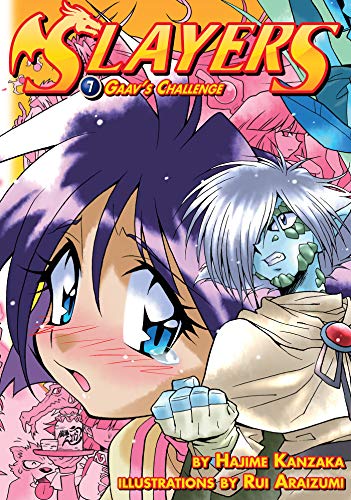
This may be the most hilariously inappropriate cover art ever. First of all, Slayers does not have a lot of romance in it. Second, almost all the romance it DOES have, including any crushes Amelia might have on Zelgadis, stem from the anime – the author has stated he avoids romance as he’s bad at it. Thirdly, Amelia is actually pretty badass in this book, punching a demon till it explodes, so I’m not sure why we get the “fair maiden” shot here. (Any Amelia fans who were always grumpy about how she was overused for comedy in the anime should definitely check out the novels.) Likewise, Zelgadis does occasionally get angry in this book, particularly when he discovers Xellos’ actual identity and the fact that Lina knew about it, but I can’t see him making this face in the novels ever – like Amelia, he’s simply far more sedate and put together.

The Slayers novels are not exactly what I would call fluffy, but this one in particular is pretty grim, with the city Lina and company are in getting devastated. Early on Lina is hunting down rumors and meets a little thief kid, who lays out some bits of plot for her. He even gets interior art, and I was wondering how he’d show up later on. Then, while fleeing the burning city, she comes across the boy’s body – he’s dead. It’s the sort of thing you rarely see this blatantly in Slayers, but it helps to show off one of the book’s main points – in a battle between demons, humans are irrelevant. When an elder dragon protects Lina from being killed, the demons trying to do it are stunned that he would bother, as humans are there to be meat shields, allies or no. This is a very dangerous world to live in – particularly if you’re Lina.

The next volume wraps up the first major arc in this series, and should be a lot of fun, as our crew tries to defeat Gaav – who I didn’t even mention in my review, despite his being in the title. Plus we’re almost at the books that never came out in English before!

The Ideal Sponger Life, Vol. 2

By Tsunehiko Watanabe and Jyuu Ayakura. Released in Japan as “Risou no Himo Seikatsu” by Hero Bunko. Released in North America by J-Novel Club. Translated by MPT.

I get the sense that the author is well aware that his core audience may not yet be here for the politics. Sure, in a volume or two the readers will be into that, but here in the second volume there’s still a lot of horny guys taken in by the premise and the title. What’s worse, Aura is pregnant throughout most of this book, so we can’t even write in her and Zenjirou making love. As a result, there are, frankly, a heck of a lot of descriptions of Aura’s large breasts, to the point where it gets to be vaguely annoying. Indeed, it’s almost a plot point – to the typical reader of this series, Aura’s tall, red-haired muscular and stacked body is exactly what they like, but in her own country, she’s not considered attractive compared to the more willowy and mild women that Zenjirou gets introduced to here. Even her own trusted aide is amazed how much Zenjirou is attracted to her. It’s hard being the Queen.

Still, while the audience may not be here for the politics, that is what they are going to get. Aura’s position is still very precarious. Zenjirou begins to emerge into actual public appearances, and the moment he does various factions try to manipulate him so they can gain power and influence. Usually this involves offering him women to be his concubine, something which is not only common here but actually expected, which leads to friction in many ways. Zenjirou is not comfortable with taking on another lover, Aura knows it’s necessary but isn’t happy with it, and then there’s the fact that he likely has the blood of two different kingdoms in him, which means their child might also have two different kinds of magic powers – a big deal in this world. Get ready for negotiation madness!

Zenjirou is far more adept and clever at this than he likes to admit to himself, but he does find it exhausting, and I don’t blame him. He’s offered a military bow, which naturally he can’t use, and is able to finagle himself out of it but comes off looking weak. Then there’s all the concubine business, which is off the table for now due to the multiple magics problem, which is ALSO solved by making him look weak and pitiful. Aura is unhappy with this, as she has rapidly come to fall in love with Zenjirou for real, but sadly, politics. that’s almost the motto for this volume, honestly. Fortunately, Zenjirou does have a few aces up his sleeve. Glass marbles, which he brought from Earth, are considered immensely valuable here (though learning how to make glass proves a bit more difficult), and his abilities at contract negotiation help when the Queen has to negotiate with another country regarding the life of their child and how they will be brought up going forward.

Fortunately, at the end of the book the child is born, healthy and hearty. I’m not sure where we go from here, but I will continue to read the light novel series with the biggest dissonance between its title and what actually happens.

Since I Was Abandoned After Reincarnating, I Will Cook With My Fluffy Friends: The Figurehead Queen Is Strongest At Her Own Pace, Vol. 1

By Yu Sakurai and Kasumi Nagi. Released in Japan as “Tenseisaki de Suterareta no de, Mofumofu-tachi to Oryouri Shimasu: Okazari Ouhi wa My Pace ni Saikyou desu” by M Novels F. Released in North America by Cross Infinite World. Translated by Emma Schumacker.

I always appreciate it when a series takes the effort to do convincing setup… well, convincing enough. This is still a reincarnated as an otome game villainess series, so I’m not asking for 100% realism, or even a thing I haven’t seen before. But you want the book to be interesting enough that you will say “yes, I will add this to my stack of villainess novels to follow”, and that’s where Fluffy Friends delivers. (If you think I’m typing out that full title again, you’re crazy.) It’s definitely a series in things for the long haul – we don’t even get to cooking with the fluffy friends till halfway through the book, and by the end of the book she still doesn’t know her husband’s big secret. But it sets out its worldbuilding, it explains why Laetitia is the way she is and why everyone thought she was evil, and her life does not magically get super easy after the memories come back.

When we first meet Laetitia,. she’s been shoved into a fountain by her fiancee, and things don’t get better from there. Despite making perfectly rational explanations for her behavior, everyone seems to be hating her and loving the other girl who’s accusing her of bullying. And so our heroine decides to simply retreat, and her father (who is 100% in her corner) arranges for her to marry the king of a nearby area, who has a reputation for hating women but needs a figurehead queen to fend off fiancees. That’s fine with Laetitia, who, now that she can recall her past life, wants to start doing what she did while in Japan: cook! That said, the cooking may also get her in trouble, as her new home not only is home to a combination of humans and beastkin, but they are at political loggerheads with each other, and even a chiffon cake can be a lethal weapon.

First off, I said “otome game villainess” was the arc, but there’s no game involved here – this isn’t a thing the heroine played in Japan or anything. That said, the way that her memories of her former life and her current life mesh together is possibly the smoothest we’ve ever seen it in these sorts of books. Laetitia does not suddenly have a different personality, nor does she have to deal with confusing new customs. Instead, it’s as if her Japanese life was unconsciously with her all along, and now she can access it. She’s also pretty overpowered for a book like this – she lacks the ability to automatically make everyone fall in love with her that a lot of these type of heroines do, but that’s OK, as she’s smart, powerful at magic, and very good at political mindgames. And, of course, there’s the relationship with her new husband, which is still mostly hypothetical here, but it’s clear that he’s going to be falling for her first.

This is mostly a serious minded slow-life romance, with the one bit of great humor coming when Laetitia’s father has to explain to her how she, like he, has a complete inability to fake a smile and just looks evil. Still, Laetitia is a terrific character, and there are a few others I found more interesting than I expected, such as Natalie, one of the king’s four marriage candidates. I realize that the pile of villainess titles to read is getting pretty high, but you should be adding this one to the stack.