Banner of the Stars: Thunder of the Empire

By Hiroyuki Morioka and Toshihiro Ono. Released in Japan by Hayakawa Bunko. Released in North America by J-Novel Club. Translated by Giuseppe di Martino.

And so we finally catch up with Banner of the Stars, a series whose last three volumes have come out over the course of the last twenty years, so I’m not sure when the next one in the series will be. This book takes place ten years after the last one, though honestly it took the author telling me that to actually make me understand it. The Abh are long-lived and don’t really age, so there’s a certain stasis to their lives, and it makes it hard to get a real sense of time. As for this book in particular, it’s very good news for those who love long, detailed descriptions of space battles, though as always these are somewhat remote, vaguely realistic space battles taken on by dry, sarcastic space elves, so don’t expect dramatic pew pew laser fights and heroes screaming out as they are killed. What we get instead is the Abh slowly trying to take back what they lost, and to regain contact with the other half of their split Empire, which is also trying its best.
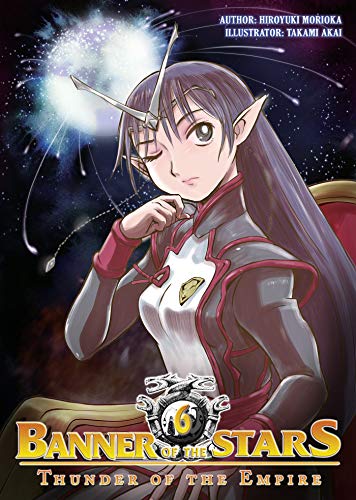
Unlike the last book, Lafier gets quite a bit to do, as she’s promoted from training the new troops (which she’s been doing since the end of the previous book) to having a fleet of her own, whose job it is to retake the capital!… wait, no, that’s not its job, much to Lafier’s irritation. Instead they’re going after a different strategic site, trying to gauge the strength of the enemy, take out the enemy, force the enemy’s leaders to surrender, and seize the day. This is not quite as easy as it sounds… but it mostly is, with the Abh winning fairly one-sidedly. The drama comes from, as I said, Lafier not being a very happy camper. She’s still inexperienced for an Abh, and knows she would not have her own fleet if she weren’t Crown Princess. She has a minder on board, with orders to relieve her of duty if she screws up. And Jint, who is still by her side, is, well, starting to look older than her.

While talking about this book on Twitter, I noted that folks who started the series reading about the adventures of Jint and Lafier, who were hoping for more scenes of them together like we saw in Crest, are probably very disappointed by now, as it’s clear that’s not remotely what the author wants to write about at the moment. It was also pointed out to me that I don’t think like an Abh, and by their standards Jint and Lafier are sickening sweethearts, which is also true, I suppose. (We do see some good shots of Sporr and Cfadiss, which is the only other relationship we see in this series anything like the one Jint and Lafier have, and I appreciated it.) That said, Lafier does think about the fact that, as the years go on, Jint is going to look older and older and she isn’t. I’m not sure that makes her happy, but not much she can do about it. Still, any furthering of the romance will likely have to wait for the end of the war.

When will that end? Well, we’re not sure, as the next book isn’t out in Japan yet. This came out in 2018. I am hoping the gap between books will be more like the 5 year gap between 5 and 6, rather than the 9-year-gap between 4 and 5. till then, this is recommended for science fiction readers who like reading about military tactics.

The Matchmaking of Marielle Clarac

By Haruka Momo and Maro. Released in Japan as “Marielle Clarac no Kyuuai” by Ichijinsha Bunko Iris NEO. Released in North America by J-Novel Club. Translated by Philip Reuben.

The author describes this book as a “calm and gentle” story, and I suppose, given that the previous book involved Marielle getting involved with pirates and her wedding had her kidnapped, falling into a river, etc. that that is correct. In reality, all it means is that all the action and danger to our heroine is packed into the last quarter of the book. Heck, even the main storyline in the book has Julianne, Marielle’s friend and BL reader, accused of attempting to poison the royal family. When you are the light novel equivalent of Murder, She Wrote, calm and gentle seems like a long time ago. That said, this novel also serves as a reminder that the only thing worse than the attitude of nobles towards commoners is the attitude of greater nobles towards lesser nobles. Marielle had to deal with this as well, of course, but at least Simeon was only an Earl. When the Prince of the Realm is head over heels in love with you, and your parents are social climbers, it can be quite the headache…

Marielle is happy as a clam as the book starts, but inevitably gets dragged into this mess. After all, Simeon and the Prince are friends, and she and Julianne are friends. She’s the reason the two even met in the first place. And the Prince is now doing his best to not act like a pathetic drip. Mostly. So it’s time to meet the parents, who are worried that a girl from a lesser barony winning over their son means she has intentions other than love. This is not helped by Julianne herself, who is firmly convinced that their classes are too far apart, and is in general far too practical to simply leap into something like this. The answer, of course, is to have Marielle around, as she is both very much a part of the royal world now and also frequently the opposite of practical. Can she get Julianne to admit her own feelings, get the King and Queen to learn what type of person she is, and not get stabbed preventing an assassination attempt? Note: the answer to the last question is no.

Yeah, as noted, this book leaves all its thriller aspects for the last quarter, and spends most of the time in mystery and romance mode. The King and Queen are both very likeable people – indeed, the whole royal family is pretty great – and the moral of the first 3/4 of the book might just be “don’t assume everyone loves dogs”. But there has always been the threat of war and politics lurking at the edge of this series, if not directly involved with it, and there is a definite anti-monarchist faction, which decides to take more decisive action. It is rather startling to see Marielle, who I have previously described as a flibbertigibbet sustain a serious injury in this book, though in best action heroine style this does not stop her from sticking around till everything is resolved before passing out. Heck, she even does the “I can’t run in this dress” clothing rip!

So yes, another strong volume, and fans of Marielle who notice that she doesn’t fangirl QUITE as much in this book will, I suspect, get more of what they want to balance it in Book 7. Will the nation go to war? And can Marielle find a way to write romance novel about it?

Fushi no Kami: Rebuilding Civilization Starts with a Village, Vol. 3

By Mizuumi Amakawa and Mai Okuma. Released in Japan as “Fushi no Kami: Henkyou kara Hajimeru Bunmei Saiseiki” by Overlap. Released in North America by J-Novel Club. Translated by Maurice Alesch.

It’s rare that you suspect that an author feels that his series has too many readers, but that seems to be the case with Fushi no Kami, which is really going to be pushing the limits of reader tolerance here in just how much the cast can praise every single thing Ash does. It really is ridiculous, and that’s not even counting Maika and Arthur, who are in love with Ash, or the maid that he gains in this book, who clearly is also falling in love with Ash. Now, to be fair, in their eyes Ash is this weird combination of Thomas Edison, Abraham Lincoln, and God, so I suppose it is perfectly reasonable in some ways. Adn yes, Ash is trying to bring back many of the ancient civilization’s conveniences, as well as ruthlessly fending off assassination attempts. Still, I would love it if in future books he gets a complete failure or two under his belt.

We start off with Ash finding a new outlet for his creativity, and this time he isn’t alone. Fellow study group friend Hermes turns out to have an obsession with planes, and has built a model that is being made fun of by the local bullies. Naturally, Ash is over the moon about this, and decides to help him build, if not a full-sized passenger plane, at least a working model. Ash is also getting rewarded, as he gets a medal for taking out the demon monster in the previous book… which promptly gets stolen, leading a vengeful Maika to do some investigating. In the most serious story in the book, some spies have been snooping around from the capital city, and they are looking for a girl. Given this is happening at the same time as Ash’s class is doing survival training, he has to protect said girl while also drawing away the spies turned assassins who have been ordered to kill her. Which… sounds like a fairly sedate book for Ash, given the previous two.

Frustratingly, we still don’t quite get all of Arthur’s backstory here, but we get enough to know why they have to unfortunately return to the capital, though I’m sure we’ll be seeing them again in the future. Much is made near the end of their rivalry with Maika, and I agree they share wonderful moments of closeness, but let’s face it, Maika is going to be married to Ash eventually, he just doesn’t know it yet. I would not necessarily call her a yandere, as she doesn’t really fit the criteria, but she’s certainly obsessed with Ash to the point where it’s almost disturbing, and moves heaven and earth to make sure that he stays by her side for future books. The book’s chapter titles all deal with planes, which makes it a bit frustrating that we only get proper plane building in the first section – I hope they return to this again. More to the point, the cast have now graduated and are essentially adults… how much more can Ash actually pull off now?

As noted, these books require a lot of patience in terms of the cast calling Ash the greatest thing since sliced bread. There’s also what amounts to a torture scene about 3/4 through the book, and the fact that Ash does not realize what he’s doing does not really make it any less (deliberately) creepy. That said, Fushi no Kami remains resolutely readable, which is one of the best qualities in a book.