Bottom-Tier Character Tomozaki, Vol. 6

By Yuki Yaku and Fly. Released in Japan as “Jaku Chara Tomozaki-kun” by Gagaga Bunko. Released in North America by Yen On. Translated by Winifred Bird.

Despite what some people may think, particularly those who watch the opening of the recent anime adaptation, these light novels are not meant to be a romantic comedy. That is not to say they don’t have elements of it – they certainly do, and that’s the subject of much of this book. Tomozaki has been kicking the dating can down the road, at first simply as he didn’t want “get a girlfriend” to be a goal Hinami sets for him to tick off, but, as she correctly points out, he needs to start examining his own feelings and ask himself if there is a girl he really likes. Because there’s certainly someone who likes him… in fact, is there more than one? This isn’t a harem comedy, but it may be a love triangle, as, after several scenes showing Tomozaki accidentally being seductive (we see it, she sees it, he does not), he gets an honest to God confession. There’s just one problem – he needs to actually have some love for himself first.

Having seemingly run out of heroines to put on the cover (sorry, Tsugumi, maybe next time), Mimimi gets a second appearance, and she gets a lot to do. The school festival is coming up, which is right in her wheelhouse, even if she doesn’t actually want to be in charge of it. Meanwhile, in addition to being on the festival committee (which he volunteered for even before Hinami assigned it to him), Tomozaki is getting into social media! Yes, he has an Instagram account now, and his job is to fill it with specific photos Hinami asks him to get. This, of course, involves him getting into situations where he can easily get those photos… some more easily than others. It’s a good lesson for Tomozaki, who needs to be reminded “this is what normal teens do, and I am a normal teen”. Meanwhile, he reads Kikuchi’s stories… and suddenly knows that they should do for the festival. A play, written by her.

The whole book is filled with great scenes (as you can see by my devoting two paragraphs to a summary of it), but two particularly stand out to me. The first is when Hinami talks to him about which girls he likes, and says the idea of “I must only love one woman and be steadfast and true” is, to put it bluntly, virgin thinking. Real life is not like manga and anime (or even light novels), and high school romance does not have to be a deep commitment. Given how earnest Tomozaki is in general, I’m not sure how much he’ll take this to heart, but hey. The other scene is near the end, after Tomozaki has gone with Mizusawa to Tsugumi’s school’s festival, with Mizusawa taking on the role of teacher this time. As with Hinami, he points out that dating someone else does not have to be a OTP commitment. But after Tomozaki gets confessed to, and tries to do his usual “but I’m just a loser” waffling, Mizusawa tears him apart, pointing out (accurately) how rude that is to the girl who likes him. I actually cheered.

We may have a long wait to resolve the cliffhanger of Tomozaki responding to this confession – the next volume is a short story collection. But honestly, I think the reader can intuit the way that it’s going to go anyway. In any case, light novel readers, particularly ones who enjoyed the anime, will love this.
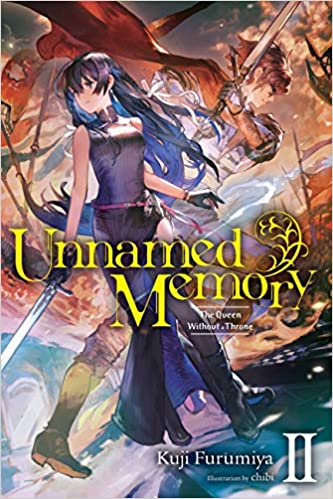
Unnamed Memory, Vol. 2

By Kuji Furumiya and chibi. Released in Japan by Dengeki Bunko. Released in North America by Yen On. Translated by Sarah Tangney.

This is a highly enjoyable volume of Unnamed Memory, although the story placement felt very odd. I joked when I was halfway through the book that I’d reached the end and the other 150 pages would just be light music. That’s because the story that covers the first part of the novel feels very much like a climax, the sort of thing you’d have to wrap things up with a bang. Instead, after that blockbuster we get a few lighter in tone short stories of varying length, followed by another longer story for the last fifth or so that gets serious and dramatic once again. Fortunately the stories all read well, and at its core the book is about the relationship between impulsive, outgoing Oscar and cool and calculating (except when it comes to Oscar) Tinasha. We’re still in the time promised in their contract, but that time is rapidly coming to a close. Can Oscar win her over? Will he even be able to, given her own past and the threats of other witches?

The book starts off in a disturbing fashion, as our heroes find a wannabe mage who killed most of a family and imprisoned their souls in daggers. This leads indirectly into the main plot of the first half, as Tinasha abandons Oscar after meeting a man from her past long thought dead – Lanak, who wants her back… well, “wants’ may given him more agency than he really has here. What’s worse, as this happens, towns across the land are having everyone in them suddenly vanish – seemingly dead. Is Tinasha behind this? Has she gone to the dark side? (No. Come on, you guessed that.) After this crisis, Tinasha fights a kraken, shows Oscar a very pretty lagoon, battles against time to stop her getting hit by an aphrodisiac, watches Oscar go behind her back to stop a brothel that allegedly uses a song that can kill you, and, in the last, more serious story, fights a god.

As with the first book, the novel’s main strength is that it lacks any of the gimmicks that light novels are littered with today. It’s a simple fantasy, with no one from Japan, no game worlds or stats, and none of the usual anime shtick. I particularly liked the story about the killer song (clearly, I suspect, meant to be based around the song “Gloomy Sunday”, which has indeed been banned a few times for supposedly making people suicidal) as it has more than one good fakeout, and also gives us a chance to see Tinasha at her most furious. She and Oscar are clearly a great couple, and he knows it, and I think she does too, but it’s going to take a lot more to get her to actually commit to it than what we have now. She does NOT want to be tied down that closely. Still, when you trust a man enough to disembowel you in the most careful way possible, that’s a keeper.

The third book ends with a brief cliffhanger showing us one of the witches is working to destroy the bond between Oscar and Tinasha, which should not be surprising – there are five witches for a reason – but also makes me wonder if the next book will actually feature their contract running out at last. In any case, those bored with isekai and harems should definitely add this to their must-read list.

So I’m a Spider, So What?, Vol. 11

By Okina Baba and Tsukasa Kiryu. Released in Japan as “Kumo Desu ga, Nani ka?” by Kadokawa Books. Released in North America by Yen On. Translated by Jenny McKeon.

Ever since the start of the entire series, there has been a certain disconnect between what the fans want to get out of these books and what the author is giving to them. Let’s face it, if the fans of the series were in charge, we’d be seeing a lot more spider and a lot less of the human side of things. And those folks are really going to hate this book, because it’s entirely on the human side of things. Yes, White gets one or two appearances here and there, but this is the first book she gets no scenes as a narrator. Instead this book fleshes out Julius, the hero of humanity and Shun’s older brother, showing his hero’s journey, his doubts, his weaknesses, and his resolve, along with giving greater depth to the rest of his party. Of course, we’re still in the past, so we know what happens to that party. But that’s probably Book 12’s problem – this one is here to remind you that the humans are also in this narrative.

The book, as with most previous books, flits back and forth between several viewpoints. The primary one is Julius’, as he starts off, despite being the hero, being dismissed and protected by the soldiers around him, who are not all that thrilled with a 12-year-old being their chosen savior. Despite this, he ends up getting involved anyway as they try to figure out why children all over the land are getting kidnapped and who is behind it. (We, as the reader, know all these answers, of course.) He has a beloved mentor figure, who gets brutally murdered halfway through the book, in the best beloved mentor tradition. He has his best friend as snarky sidekick, and a priestess who is clearly head over heels in love with him, but he’s ignoring that for now. Things are going quite well… if only the world was not gearing up for a new war, started by the Demon Lord, who is apparently so awful demons are fleeing their own lands to get away from her.

Again, it takes an entire volume that is mostly away from their perspective to remind us that this is a “rooting for the Empire” sort of story, and that White, Ariel and company are the bad guys to most of the rest of the world. This isn’t really a funny volume in the series – the comedy comes from Sophia’s diary of her life in boarding school, which is, if I’m honest, not really that funny. We get various points of view of other characters in Julius’ party, giving them depth and backstories, and showing how they view Julius as opposed to his own mostly negative thoughts. I will admit, it’s hard to deny that this book is trying to flesh out what is otherwise going to be a bunch of “who cares?’ corpses in the next book, which promises to giver Julius’ last moments from his own perspective. It’s a necessary thing, though, to give the writing better depth.

This is not to say it isn’t frustrating, and I’m sure a lot of fans really, really want the past to catch up with the present (which we last saw in Vol. 6) pretty darn quick. Till then, enjoy this look at the evil spider and her evil demon friends from a different viewpoint.