Our Crappy Social Game Club Is Gonna Make the Most Epic Game, Vol. 2

By Oriori Siki and Azuri Hyuga. Released in Japan as “Jakushou Soshage-bu no Bokura ga Kamige wo Tsukuru Made” by Overlap Bunko. Released in North America by J-Novel Club. Translated by Mikey N.

I enjoyed the first volume of this series a lot more than I expected, and I’m pleased to see that the second volume rewards my expectations by being just as good. Once again, there is technically a bit of harem comedy here, but not much – the main guy and girl like each other but are too shy, and the new girl introduced here might like the guy too, but clearly sees which way the wind is blowing. Other than that, this book once again looks at how failures from the past can cause an inability to move forward, be it in regards to a person’s passion and confidence, or in their own emotional turmoil and rage. Last time I was impressed with just how perpetually angry Eru is, and that gets even worse here, as I’m amazed that she didn’t end the book by simply killing the cast. The reason her anger soars even higher is one of the catalysts of it: new girl Aina.
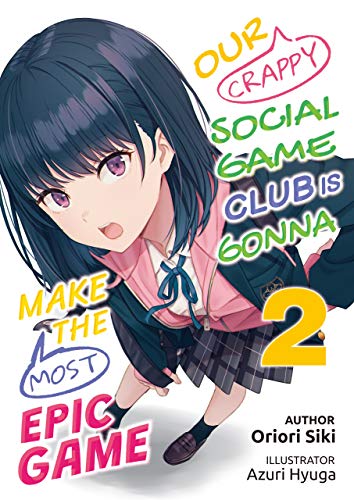
The club has been invited to a competition in Tokyo. A number of schools are there, and they’re paired in groups of two to compete with each other to see who can build the best game around a theme. Unfortunately, just as they need to buckle down, various disasters pile up, chief among them being the aforementioned Aina (who also gets the cover art), a former actress now trying to be a voice actress and someone who has a nasty past history with Eru, to the point where Eru is physically violent the first time she sees her. Fortunately, the group keeps working together, but no one can get to the heart of what the issues between them are, and neither one are talking. More to the point, Aina has a cheery, somewhat ditzy personality that proves to be a mask she takes on and off… as Kai finds out when she starts trying to manipulate him.

I will admit, I did think a lot of Ami from Toradora! as I was reading about Aina, but they don’t really go in quite the same direction. The book, for the most part, emphasizes the difficulties in getting a group like this to communicate properly – a group of artists and gamers, most of whom are introverts in some way, and with resentment and jealousy seething around. This is even true of Kai, who finds himself not only falling for the bouncy Nanaka, but also seeing her own potential, which he feels will far outstrip his own. (Kai has to be told to stop denigrating himself at least five times in this book.) Eru and Aina’s past is filled with the sort of horrible shit that teenagers do to each other, and (like a lot of those sorts of things) is resolved a little more easily than everyone expected. And there are a lot of good conversations here between Kai and the main girls, very few of which involve romance at all. Oh yes, word of warning: we not only get a tiny, drill-haired arrogant princess girl as their opponent, but there’s ALSO a minion she has to LITERALLY stand on and make herself taller. It was about eight anime cliches in the space of three pages.

Basically, if you don’t mind all the gaming talk, which can get a bit inside baseball, this is simply a fun group to read about. Even Kai’s older sister, who is written to be “the annoying one”, is not TOO annoying. Fans of series that try to examine why teenagers are the way they are should give this a try.

The Sorcerer’s Receptionist, Vol. 3

By Mako and Maro. Released in Japan as “Mahousekai no Uketsukejou ni Naritaidesu” by ArianRose. Released in North America digitally by J-Novel Club. Translated by Roko Mobius.

There is an expression, “go big or go home”, that gets used a lot, and frequently it’s warranted, but sometimes? Sometimes you want to stay small, and are rather nonplussed that everything is suddenly so big. I feel that way about this third and final volume of The Sorcerer’s Receptionist, which has had two volumes of daily life stuff with the occasional hint of dark backstory, but crams all that backstory into the third ad makes our tsundere heroine the Chosen One in about three or four different ways. It almost feels like too much, and I feel bad that we didn’t get another volume mostly filled with Nanalie sitting behind a desk. That said, the plot we do get here is certainly well-handled, the fights are exciting, and the backstory does make sense and ties in with everything else, so this is mostly me complaining that the story does not match the one I was expecting. For most folks, this is a pure shoujo fantasy ending, complete with The End of the World.

The book is for the most part divided into three chunks. The first has Nanalie and her friends going on a vacation to Hawaii… or its fantasy equivalent. Sadly, the vacation goes south when Nanalie is immediately kidnapped by a fish monster who brings her back to the Sea People Kingdom… where one of them wants her to be his bride! After this, Nanalie disguises herself as a barmaid in order to help her friend Benjamine determine if the guy she’s not quite dating yet is cheating on her. Finally, we get Wizard Olympics, as various groups from all over the world come to see who are the best in the land. Nanalie, naturally, is… not participating, she’s working reception. That said, you just know she’ll somehow be pulled in eventually. More to the point, what is draining the Ice Magic users of their energy? And just who IS Nanalie anyway?

As I said above, this book is doing a LOT. Its predecessors were long books, but this is the longest, and other publishers would probably have made it a two-parter. Throughout it all, Nanalie remains much the same. The selling point of the book is her attitude towards Rockmann, and that does not change until the VERY end of this book, when she has a chance to recontextualize everything she’s known about him and go “oh wait, no, that’s love”. It helps that there is a weird time-travel sort of event midway through the book, which is probably the most egregious plot device we get here. Better handled is her background and that of her parents, as we’d seen for the entire series that her mom remained tight-lipped about her own magic, and honestly the hair should have tipped us off. The best part of the book is the ending, where Nanalie, having saved the world, discovered her origins, and fallen in love, is offered any reward she could possibly want… and chooses to stay at her job. I could have done without the “I don’t want anything to change” part, but otherwise it is pure Nanalie to say “No, I do not want all this, I want to keep doing my dream work, thanks.

There is a sequel being written by the author on their website, but it doesn’t look complete yet, and it’s uncertain if the publisher would pick it up. Still, this is a perfectly good ending, and I’m pretty sure that even if she DOES now realize her own feelings, Nanalie will still spend the rest of her life going “aw man, it’s that guy again. Why is he always around me?”.

Zoku Owarimonogatari: End Tale (cont.)

By NISIOISIN and VOFAN. Released in Japan by Kodansha BOX. Released in North America by Kodansha Books. Translated by Ko Ransom.

Yes, this is about 3 months late, but now that it’s come out digitally, I can actually catch up with it fairly easily. The final book in the ‘Final Season’ arc, we get to have one last visit with most of the characters we know and love… or do we? Having graduated AND solved the whole Ogi Oshino problem, Araragi is at a bit of a loose end, especially as he doesn’t have his exam results yet. And then as he gets up one morning he finds himself taking a trip through the looking glass… literally. Finding himself in a seeming mirror world, with most of his reliable allies missing, changed, or unhelpful, can he find a way to get back to his own world? Or wait, is this even a mirror world at all? This final volume has all the usual NISIOISIN traits, and rambles on a lot, but mostly is here to show the growth that a lot of characters have or haven’t gotten, and where they could end up in the future.

Featured on the cover is Sodachi and… also Sodachi, and while the alternate selves in this book are largely played with lightly, Sodachi’s own arc in here is tragic, as it has to be. Featuring a girl who was adopted by Araragi’s parents, presumably after discovering her parents’ abuse, she’s well-adjuster, teasing, has a wonderful relationship with Araragi, and is, above all, happy – all things that elude the Sodachi we are all familiar with. In a book looking at things Araragi has regretted, this is his biggest regret, along with Nadeko, and just like Nadeko there’s not much he can do except just stay away from her in the long run. The other reverse character taken seriously is Kissshot Acerolaorion Heartunderblade, who isn’t a vampire in this world but that doesn’t mean she isn’t powerful… TOO powerful, as Araragi witnesses.

Not to spoil anything that’s not already obvious, but the best gag in the book is the fact that, while everyone else in the book is showing their “hidden” other side, Tsukihi is exactly the same because she has no hidden sides. As Ogi said in the previous volume, she lives eternally in the moment. The second best joke in the book is Yotsugi’s sudden expressiveness, a gag that, much like the reverse writing we get for the first few chapters, has to vanish because it’s too much of a pain in the neck. And of course we finally get our first look at Toe Gaen, Kanbaru’s mother and Izuko Gaen’s older sister, who may be dead but that’s not stopping her taking a bath with Araragi, because this is just that kind of series. The book suggests she’s there as a symptom of Izuko’s own regrets, rather than Kanbaru’s, which probably explains why she’s less nasty here than she is in Kanbaru’s dreams. Oh yes, and kudos to Senjogahara for having moved on from imitating Hanekawa on her dates with Araragi to imitating Mayoi.

And so, having fulfilled its final duty to its author – dressing Araragi up in a girls’ uniform, just like Ii-chan in Zaregoto (who is namechecked), the Monogatari Series has come to an end. Oh sure, there’s like 10 more books after this one, but they don’t have an anime, and they are all, with the possible exception of Musubimonogatari, not essential additions to the canon. Not to mention Vertical is now Kodansha Books, who seem a bit more interested in Pretty Boy Detectives and cooking/language books. Will we get more? I’d say it’s as likely as Index: New Testament! Wait, is that good news?