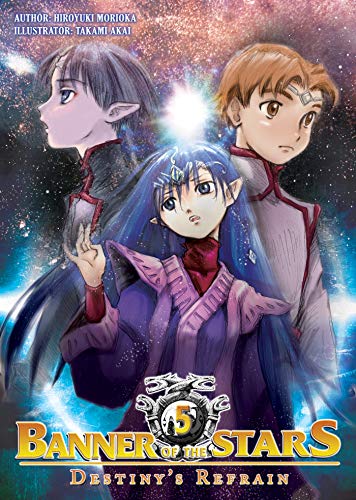
Banner of the Stars: Destiny’s Refrain

By Hiroyuki Morioka and Toshihiro Ono. Released in Japan by Hayakawa Bunko. Released in North America by J-Novel Club. Translated by Giuseppe di Martino.

I admit, I frequently have difficulty plowing through these books. I enjoy the plotting and characterization, but the writing is a bit on the dry side, not to mention all the bolded vocab. Usually I have a lot of banter between Jint and Lafier to hold me over, but in this book they appear less than they have in any of the others – and for good reason. If you ever looked at the massive Abh Empire and thought “wow, they seem arrogant, I wish they’d lose everything they have”, well, wish granted, my friend. We get an awful lot of dead cast members, though most of the ‘current’ younger generation, including our two leads, are fine. But it does mean that you’re reading an entire book about the downfall of an entire people, which can be… bleak. Honestly, it’s at times like this that I’m grateful for the Abh’s blase attitude towards everything, as this would be a lot worse if people were screaming and crying as they died.
Picking up right where the last book left off, it turns out that the Hania Federation has pulled a fast on the Empire (and indeed on its own negotiators), joining with the Three Nations Alliance. The Abh very quickly realize that they are screwed, and a good deal of the book is seeing them trying to evacuate to a safe haven as many people as possible while also having those in change (including the Empress, Lafier’s grandmother) nobly try to hold off the enemy as long as possible. Lafier’s brother Duhier also gets a subplot as he tries to be a soldier despite the entire world working to make sure he can never do anything productive – it would normally be funny, but we feel his frustration. As for Jint, he’s busy moving gravestones, which to the Abh are far more important than his own life or Lafier’s.

The book is not entirely a downer. Sporr makes a welcome return towards the end, as does her aide, and they’re as hilarious as ever, as she is essentially the Abh version of the princess-curled ojousama. Jint manages to talk to the old Baron who helped them escape from his son’s clutches, and there is some amusing teasing about his relationship with Lafier – literally everyone assumes that they are lovers, though if they are neither one communicates that to the reader. But for the most part this book is about last stands and picking up the pieces, and I suspect that the next book, when it comes (which is also the most recent book, having come out in 2018), will have the Abh taking on more of a freedom fighter sort of role. In the meantime, this is good space battle stuff, assuming you don’t mind the technical banter, the bolded words and, of course, the piles of death, most of which, like the Abh, is communicated to us very matter of factly.

I’ll Never Set Foot in That House Again!, Vol. 2

By Milli-gram and Yuki Kana. Released in Japan as “Nidoto ie ni wa Kaerimasen!” by Overlap Novels f. Released in North America digitally by J-Novel Club. Translated by Emily Hemphill.

Reading this immediately after The Saint’s Magic Power Is Omnipotent was probably a mistake, as the two series share much in common. At least the Saint is in her thirties, though. Chelsea’s age and emotional innocence are still front and center in this book, and it can sometimes be discomfiting. The complains once or twice about being treated like a child, but, well, she’s twelve, and honestly acts like she’s six much of the time. What matters most to her are Glen and delicious food, possibly not in that order. And, of course, she has a heart as big as the world and wants to save everyone. In a non-fantasy world she’d be a perfect magical girl candidate – heck, she even looks a bit like Madoka – but here it’s easy for her to be coddled. She’s protected at all times by Glen, ends up getting a new head chef, and a new set of bodyguards once Glen – who is a good 8-10 years older than she is – proposes. So yeah. Anyway, about the rest of the book…

Most of the book involves a journey to a neighboring kingdom, which is definitely having a miasma problem, apparently due to the fact that their new ruler has been cutting down sacred trees and other terrible things. Glen, Chelsea and company decide to see how the former ruler is doing – he’s still around, he just has a terrible mana-draining illness – and Chelsea being essentially a walking plot device, this is soon resolved and he returns to the throne. That said, there are a few hints that there are greater things going on here – the horrible ruler turns out to have been slightly brainwashed by a mysterious fortune teller, who turns out to be working for someone who really, really hates Chelsea – no one is quite sure why. Is this going to be the end of her slow, pampered lifestyle? I mean, no, probably not.

I won’t begrudge Chelsea having a pleasant experience with one the occasional “I did too much and passed out” to worry about, she’s had a rough life and deserves happiness after so long, but it does make the book a bit dull at times. I was amused at her grandparents’ description of Chelsea’s mother – they’re polar opposites – as well as Chelsea’s poleaxed reaction to it. The book also continues to make very light usage of its big clever idea – that Glen is an isekai’d from Japan prince – and we find the former ruler of the other kingdom, a dragon man, is also a forner Japanese person now in a fantasy world body, which leads to some amusing discussion of – as always – how to get miso in a fantasy world. That said, this also means that when Glen proposes to Chelsea he’s called a lolicon… which, well, she’s twelve. At least it doesn’t appear they’ll actually get married till she comes of age.

So yeah, like the first book, this is hit or miss for me – a bit more miss this time – but it’s still warm and fluffy at heart. Also like the first book, I assumed this second volume would be the end of the series, but there’s apparently a third volume out in Japan next month. Recommended for those who love waifs – no, not waifus, waifs.

The Saint’s Magic Power Is Omnipotent, Vol. 3

By Yuka Tachibana and Yasuyuki Syuri. Released in Japan as “Seijo no Maryoku wa Bannou desu” by Kadokawa Books. Released in North America by Seven Seas. Translated by Julie Goniwich.

One of the things that is difficult to admit for your average everyday light novel reader or reviewer is that we are unlikely to every be the savior of an entire world. The Saint, as seen here, has to deal with a bunch of difficult challenges to try not to advertise too much exactly who she is (especially now that the existence of the Saint, if not her identity, has been confirmed) while also trying to help as many people as possible by making many, many powerful potions, and also find the time to try to figure out how her powers actually work and why they only appear at unusual times. That said, sometimes even an omnipotent saint can end up being very relatable, as when Sei suddenly realizes what it is that triggers her superpowers, and… yup, so embarrassing it’s the power of love. This has been pretty obvious to the reader from Book one, but the author admits that the romance is going to be slow going, so…

The majority of this volume is spent away from Sei’s beloved potion research, but it’s for a good cause: the domain where they get their best ingredients is suffering from an attack of monsters and miasma, and therefore her powers are particularly needed. Upon arrival, after dealing with pomp and ceremony, and the fact that her cooking methods have become widespread… but only if you like meat… Sei gets down to the nitty gritty of her visit: quizzing the old potion expert they have there about ways to make a superior grade potion. As it turns out, they have the long-lost documentation that might be able to help her. That said, in order to succeed she’s going to not only have to come to terms with the fact that Albert is hot and she likes that, but also deal with a new guy interested in her… one who’s a bit more down to earth.

To be fair, I’m not sure that you can call Leo a love interest per se – he’s not interested in Sei as a person but rather in her abilities. He’s probably the funniest part of the book, being a well-meaning but tactless musclehead, apparently included by the author because muscle fetishes are in these days. The most interesting part of the book, though, shows us the diaries and research books of the Great Alchemist, which was thought to have been destroyed and lost forever. To no one’s surprise, she seems to be a lot like Sei, particularly in her attention to detail in regards to research. Given that we now have Sei’s ridiculous magic power combined with actual knowledge, I suspect big things are going to be happening in the next book. That said, I doubt one of those big things will be confessing to Albert.

This is getting an anime soon, so certainly has caught the eye of folks. It’s not the most exciting or original thing in the world, but it makes me smile, and I always enjoy reading it. It’s also a very good recommendation for folks who would normally be turned off light novels due to excess fanservice – only Leo’s muscles qualify here.