Yona of the Dawn, Vol. 27

By Mizuho Kusanagi. Released in Japan as “Akatsuki no Yona” by Hakusensha, serialization ongoing in the magazine Hana to Yume. Released in North America by Viz Media. Translated by JN Productions, Adapted by Ysabet Reinhardt MacFarlane.

While the manga occasionally dips its toes into romance, that’s not its main function. As such, it feels quite refreshing when the end of the last volume and the start of this one focus so much on the feelings that Hak has had for Yona for so long, and finally telling her in one big burst of repression boiling over. This volume focuses on the aftermath, and does a very good job of both being lighthearted and funny about it but also taking his confession and Yona’s response to it seriously. I was worried there would be a “forgot about what happened last night” plot, but nope, Hak knows exactly what he said.As for Yona, while she’s a bit poleaxed there’s no reciprocation here, at least not consciously – she’s still more concerned with doing what they do. Which is good, but it also appears that the days of the Happy Hungry Bunch are being replaced with something a bit more legendary.

We’ve spent the last few volumes seeing the Four Dragons grievously wounded and depowered, and even for the first part of this book they’re still recovering. And while that was a good and important story to tell, it’s a joy and a relief to see everyone getting back to kicking eight kinds of ass. There’s also more humor here, as Hak is trying to alter the legend to add a 5th dragon, though no one’s going along with it. More to the point, though, they’re making themselves known now to world leaders rather than just disgraced princes and poor villages, and the disguise is not working – everyone knows who Yona is. She says, and rightly so, that Su Won knows they’re alive and hasn’t done anything, but they weren’t the chosen ones then.

They’re also not children anymore. Probably my favorite scenes of the book are the conversations between Riri, who is hanging around at the palace mostly as she functions well as Su Won’s beard (something she questions him pointedly on, and he admits a lot of people do think he’s gay). In fact, she’s getting a bit TOO casual with him, as one somewhat chilling scene shows. But there’s a wonderful moment when he goes to look at a mausoleum that he had been forbidden from entering when he was a child. He’d built up this huge idea of it in his head, and is incredibly disappointed to find that it’s just a room. The cast growing up has been one of the most important parts of Yona, and that applies just as much to Su Won as it does to Yona and Hak. Childhood illusions can be powerful, but should not replace the underwhelming reality of life.

Fans of the series don’t have to wait for the next book – my reviews are running behind. But as always, everyone should be reading Yona of the Dawn, and this is a particularly good volume.
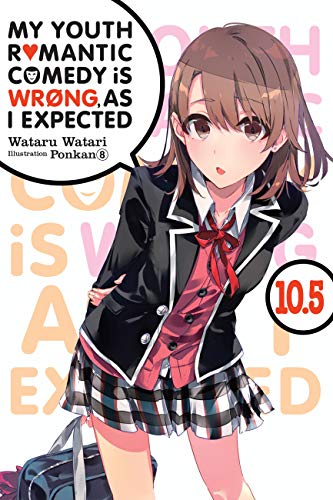
My Youth Romantic Comedy Is Wrong As I Expected, Vol. 10.5

By Wataru Watari and Ponkan 8. Released in Japan as “Yahari Ore no Seishun Rabukome wa Machigatte Iru” by Gagaga Bunko. Released in North America by Yen On. Translated by Jennifer Ward.

As with the previous .5 volume in this series, this is not really a short story volume, as all three stories are interconnected and build on each other like a normal book. If I was to guess why this got a .5, I’d say it’s probably because it does not really advance any of the major plot beats, romantic or otherwise. If you skipped this and went straight to the 11th book, you would be perfectly content… unless you’re an Iroha fan. She’s all over this book, and the costar of the second story, having essentially become a member of the Service Club without ever actually doing anything or officially joining. She just sits in the room all the time. Still, the point of Iroha is that she’s a different type than both Yukino and Yui, and in this volume, despite her supposed ongoing desire for Hayama, we see that she could be a potential third love interest for Hachiman. One that will not win, of course, but hey.

The first story in the book is the one that has the best argument for being a real unconnected short story. Zaimokuza is once again having a crisis of faith about his abilities, and decides that rather than be an author, he’ll be an editor! This leads to the Service Club researching just how hard that is. Lots of funny, biting the hand humor here. The second story has Iroha going on a date with Hachiman, ostensibly to research what she plans to do with Hayama in the future. The best parts here are those where he treats Iroha pretty much the same as Komachi, which is probably the best idea. Finally, Iroha is trying to use up the rest of the student council budget (so that they don’t get a budget cut the next year) by making a magazine to give out at school… and blackmails Hachiman into providing most of the content.

As with the previous volume, Hachiman is still in a pretty mellow mood here. The romance is also on the back-burner, except when Iroha is trying to manipulate Hachiman or get Yukino and Yui pissed off. The best parts of the book show off the contrast between cynical Hachiman and helpful Hachiman, which means the date with Iroha is the best story in the book. They may not make a good romantic pair, but they make for a good faux brother-sister dynamic. The chapter also had some great laughs, such as Hachiman deciding, on a date with another girl, that they should go to separate movies. The most interesting parts of the book, however, come near the end, as Yukino and Yui quietly, in murmured asides that only Hachiman hears, set up the remaining books in the series. The two of them are nearing a crisis point.

So yes, it’s inessential, but it’s still good. Those who enjoy the series’ razor wit will like the first story, those who enjoy Iroha the second, and those who enjoy the main trio will find the third most appealing. This is the last .5 volume, so from here on it’s onward to the end.

My Friend’s Little Sister Has It In for Me!, Vol. 1

By mikawaghost and tomari. Released in Japan as “Tomodachi no Imouto ga Ore ni dake Uzai” by GA Bunko. Released in North America by J-Novel Club. Translated by Alexandra Owen-Burns.

I’ve said this before, but sometimes you just want McDonald’s. You know that you could walk two more blocks and go to a nice steakhouse or an expensive Asian restaurant, but you can’t have that every day, and you feel like McNuggets, dammit. Sure, you’re probably going to get some bad along with the good, but you at least know exactly what you’re getting and are not surprised. This applies, believe it or not, to light novels as well. Sometimes I want to be amazed and transported to another world by wings of song, etc. And sometimes I want to read a harem comedy where the hero is as dense as lead and the heroines are all variations on “I hate you because I love you”. Good news! This book is McDonald’s. It won’t blow you away, but it will fill you up, and you know what? It came with a nice Apple Pie as a treat. (Have I finished grinding this metaphor into the dirt? Yes? Let’s get to the plot.)

Akiteru is our main character, and he has a lot on his plate. He’s the head of an amateur game development group, their new release is selling great, and he wants a job with his uncle, who runs a MUCH LARGER game company. The uncle agrees, on one condition: that he pretend to be his cousin’s boyfriend for the next year. She’s transferred schools after being bullied. And then there’s the titular little sister, who has apparently been reading the books of Takagi, Uzaki and Nagatoro and taken them to heart. She flirts aggressively with Akiteru, whose one main fault, as with most LN protagonists, is a complete inability to recognize anything as love. To him, her flirting is just plain mean bullying. And as for his cousin, well, she hates him too. Right?

To get the bad out of the way, there’s a character here who can be summed up as “shotacon”, and it’s as annoying as you’d expect. Also, the “friend” in the title gets very little to do, but I am hoping future books will change that. The reason I am hoping this is because the book’s chief strength is balancing out the love triangle that is forming around Akiteru with the game group he’s created, a tight-knit group of friends. Mashiro, the cousin, is the seeming newcomer to the group (though she has a rather obvious secret), and most of the second half is getting her introduced, loosening her up, and dealing with the bullying she had to content with at her previous school. I enjoyed that. Iroha, the little sister, is terrific, being obnoxious in the fun way rather than the irritating way. As for Akiteru, he’s hard to get a handle on. He does nice things, but his narration is basically “grumpy old cuss”, and he needs a shot in the arm of idealism. He’s not as bad as, say, Hachiman, but it can make him hard to read on occasion.

This just had an anime announced, and it’s not hard to see why – it isn’t due to the quality of the writing, it’s due to the fact that it checks a whole lot of ‘this should be an anime’ boxes. Despite reservations (see above), I think it’s the best of the three GA Bunko romcoms that J-Novel Club recently licensed. Fans of that genre who don’t mind the usual dense hero should get a kick out of this.