My Youth Romantic Comedy Is Wrong As I Expected, Vol. 10

By Wataru Watari and Ponkan 8. Released in Japan as “Yahari Ore no Seishun Rabukome wa Machigatte Iru” by Gagaga Bunko. Released in North America by Yen On. Translated by Jennifer Ward.

This may be a first for this series. For the first time, I got through an entire volume without wanting to throw Hachiman out a window. This isn’t to say that he’s all smiles and warm fuzzies, but his cynical “this is what teenage life is really ,like it’s a jungle out there man” monologues are kept to a minimum and his attempts to solve the problem of the book involve actually talking with people about the problem rather than, say, throwing himself under the bus again. This volume was adapted into the final chunk of Season 2, so also is probably the calm before the storm that will be the final arc of the series. Things are moving pretty slowly – you can tell the author wants to wrap this up before they become third years – but we are starting to think about the future, which in Japan means what “track” will the kids be taking, arts or sciences?

Haruno is on the cover, and actually has a significant presence in the book as the “not quite evil but close” antagonist. The main focus of the book, though, is Hayama, who is the perfect boy that everyone wants to hang out with/date, but he’s refusing to say whether he’s taking the arts or sciences track, which has thrown his group into turmoil. Particularly Miura, who has a crush on him but is also concerned for his well-being – nearly everyone by now can see that Hayama is wearing a mask to hide his real self. She asks our heroes to find out what his choice is, which proves to be a very tough nut to crack, and mostly involves Hachiman doing a lot of detective work. In the interim, though, there is an ominous cloud on the horizon, and we see part of that cloud here, as we meet Yukino and Haruno’s mother, who is exactly what you’d expect she would be like. Oh yes, and there’s a rumor that Hayama and Yukino are going out which has spread like wildfire.

It’s pretty clear that Yukino’s family issues are gonna be the series’ endgame (which is bad news for Yui, and indeed she once again doesn’t have much of a role here – this love triangle is a bit imbalanced). For the moment, though, we’re dealing with Hayama, whose feelings for Hachiman are very conflicted – at one point he holds out hope that Hachiman is concerned about him as a friend, only to realize that it’s for his Service Club after all. It comes to a head in the school’s marathon, where Hayama bluntly talks about how he hates Hachiman, who may be Hayama’s opposite but also has managed to draw people to his actual self, crappy though that self may be. I was also very amused at the discussion of arts vs. sciences, some of which is “what am I best at” but a lot of which is also “how can I improve my social image?”.

So yes, this was a strong volume in the series, and I also really love the brother/sister relationship between Hachiman and Komachi, which is realistic and sweet. I am totally ready for Book 11. Sadly, the author is not, so get ready for 10.5, more short stories, next time.

I’ve Been Killing Slimes for 300 Years and Maxed Out My Level, Vol. 8

By Kisetsu Morita and Benio. Released in Japan as “Slime Taoshite 300 Nen, Shiranai Uchi ni Level MAX ni Nattemashita” by GA Novels. Released in North America by Yen On. Translated by Jasmine Bernhardt.

There are many times during my reading of the Killing Slimes for 300 Years series that I realize that not only are the characters treating this world as an excuse to relax and do inconsequential things, but so is the author. The author has many, many light novel series under their belt, some of them running simultaneously via different publishers, and you get the sense that this series is the one where the author can just kick back and not have to worry too hard about plot or characterization. It’s essentially a short story collection. The biggest thing that happens in this book is that Beelzebub has finally gotten the side stories that appeared in Books 5-7 farmed out to her own official spinoff (which has already been licensed over here for the spring) and so the last sixth of the book or so is devoted to Halkara, who gets a spinoff, seemingly set before the main series, where she… reviews restaurants. Don’t expect this to get spinoff novels anytime soon.

A breakdown of this book: Sandra goes through a Flowers for Algernon-style transformation after some super fertilizer turns her into a teenager with a high IQ (that said, there’s zero angst here); Pondeli invites the cast to the new Demon Arcade that she’s opening, whose games are hit-or-miss; the hippie pine spirit who does weddings finds that the flaky God who brought Azusa over is muscling in on her territory; that same God tries to reason with a fellow, more traditional God in order not to lose followers (and Azusa ends up leveling up EVEN MORE); they return to the ghost nation’s temple and tell ghost stories, most of which have a familiar bent; Azusa gets stranded on a desert island and meets what she thinks is a native tribe; a strange butterfly woman insists of staying with Azusa a week for no reason whatsoever and not because The Crane repays A Debt or anything; and Pecora starts a Youtube stream service from the demon world.

That last one may drive home the point that, aside from having elves, dragons, and slimes, this series is absolutely uninterested in building its own world, but would much rather leech off of Japan’s own past and present. The ghost stories Azusa tries to tell, common ones from Japan, are also very well known here. the cuisine Halkara samples is essentially variations on what you can get in any mid-sized town, complete with a conveyor belt sushi place. It’s… very low bar, to be honest, but it’s also relaxing for the reader, who might get a bit annoyed at streamers being a thing in this land of Gods and demons, but will likely quickly get over it. The stories are all basically about the same – cute – though I might have critiqued the desert island one more had it not ended how it did. (At least the natives did not go “unga bunga bunga’ a la Bugs Bunny.)

It’s cute, it’s fuzzy, and you will forget about it the moment that you finish it. And sorry, yuri fans, Azusa still insists that her house is home to family, and not, and I quote, “a special, gay dimension”.

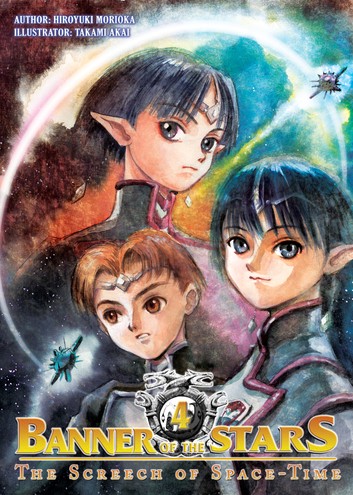
Banner of the Stars: The Screech of Space-Time

By Hiroyuki Morioka and Toshihiro Ono. Released in Japan by Hayakawa Bunko. Released in North America by J-Novel Club. Translated by Giuseppe di Martino.

In the Afterword for this book, published in Japan in 2004, the author apologizes for taking so horribly long to write it (the previous book had come out in 2001). Which makes me wonder how the next book, which came out in 2013, is going to top that. It’s also been a while since the last volume came out in English, but that’s OK, because the reader is dropped right back into one of the main features of Banner of the Stars: Epic Space Battles. Sadly, that is a mark against it for me, as I’ll be honest: I find a lot of the space battle writing in this book tedious. It is no doubt more realistic than, say, the ‘let’s fall out of our chairs’ battles in Star Trek, but there is a certain sterility to it all. Actually, this volume has quite a few marks against it. Jin and Lafier end up playing smaller roles, which is a shame as they’re the reason I read the books. More to the point, the Abh are still just not that likeable.

As I said, a lot of this book is space battles, as it reminds us that the Abh are at war with the various human federations that vie against them. But that might change soon – one of the minor players on the other side wants to negotiate a deal that might actually shift the tide and lead to the end of the war. This is good news, despite all the Abh talking about how much they love being in battle. That said, can the deal really be trusted? It helps that the idea for the deal came about watching the way that Jint handled his own planet recently, giving everyone ideas. As for Jint and Lafier, as I said, they don’t get as much time together as before, and what little there is is more down to showing off how Jint is still trying to assimilate and not quite making it. That said, given the cliffhanger the two of them will soon have much bigger things to worry about.

As I said, I like Jint and Lafier, and I like their scenes together here, but there are simply too few of them. We get a long stretch devoted to the current Empress and her discussions with aides on whether to accept the offer they’re being handed. It’s good f you like political realism, but again shows us that the Abh, in general, are simply too blase and matter of fact about everything, and it does not make for the most scintillating writing. It reminds me of bad Star Trek books that tried to write Vulcans but fell too hard on the “logical” side. At least there’s banter, and we’re reminded that the Abh basically run on it, but that’s sometimes not enough, especially when it’s not really clear if we’re meant to see them as the enemy or the protagonists.

Fortunately, we do not have a nine-year wait for the next book to come out. Unfortunately, I get the feeling I’ll be seeing a lot more space battles in it, given the events towards the end of this book. In the meantime, more Jint and Lafier being an obvious couple but never doing anything about it, please.