The Asterisk War: Struggle for Supremacy

By Yuu Miyazaki and okiura. Released in Japan by MF Bunko J. Released in North America by Yen On. Translated by Haydn Trowell.

Ooof. We are deep into “tournament arc” here, folks, which means that a) the books are really not doing anything aside from showing off some cool fights, which means I have very little to write about, and b) it is fairly easy to guess who is going to be winning each of those fights. Ayato and Julis are not going to be losing at this point in time. Heck, even the “trying to figure out what the bad guys are doing” plot takes a back seat here, though it does lead to one of the funnier not-really-a-gag moments in the book when Orphelia straight up tells the other villains “oh yeah, I told Julis our plan six months ago.” After basically being absent from the last book, Julis gets more to do here, including what ends up being the best fight, but I suspect she is going to continue to be very unhappy for the next few volumes. Fortunately, the book has a secret weapon: Saya, aka Best Girl.

Claudia is on the cover, but barely in the book itself at all. Though she fares better than Kirin, who is totally absent. We get a series of fights, after briefly seeing Julis win her Round Four battle. First we see Ayato take on Rodolfo Zoppo, an arrogant ass who we dearly want to see get the shit beaten out of. Sadly, all of Ayato’s fights in this series have involved him barely winning, and that’s what happens here. Lester fights the Black Knight, and wins, but unfortunately is too injured to continue, so Julis gets a bye in Round 6. Speaking of Julis, as stated, she gets the best fight, taking on Xiaohui, who has returned from his Vision Quest and gotten stronger thanks to an old man on a mountain who doesn’t train him but lets him watch his everyday life. It’s a good reminder that Asterisk War runs on cliches. Saya takes on a girl who’s too amusing to take seriously. We get Robot vs. Robot, and the more evil robot wins. Silvia wins her match, which amounts to song vs. dance. And Orphelia manages to not only take out Hilda, but Hilda may in fact be permanently removed from the stage – her ending is ominous.

Apologies for the spoilers, but again, none of this is a surprise. You knew most of these people were going to win. Aside from Julis, as I noted, Saya gets the best moments, as she has the 2nd best fight, but more importantly is there to deliver a pep talk to Claudia and Rimcy, who are both feeling depressed and useless. Saya points out that she is an Unlucky Childhood Friend who spends every day handing around a hot tsundere princess and a meek sword prodigy, and also has to deal with the world’s top idol singer. They are all probably better fighters than her. They are all more likely to get Ayato’s love than her. But, as Saya wonderfully puts it, “so what?”. She refuses to simply stop trying. It’s not quite the end of the book, but it makes for a great emotional climax.

Unfortunately, it’s not enough to make up for 170 pages or so of fight after fight after fight. And I suspect we’ll get more of the same next time, though the cliffhanger does at least promise some emotional torture of Julis as well. Good times!
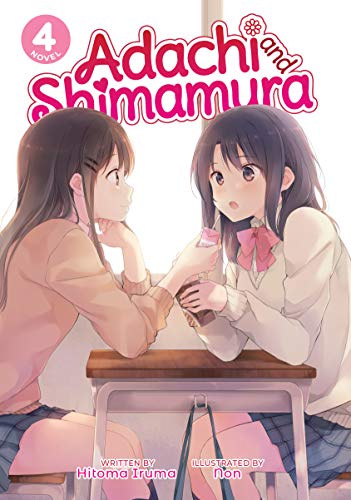
Adachi and Shimamura, Vol. 4

By Hitoma Iruma and Non. Released in Japan by Dengeki Bunko. Released in North America by Seven Seas. Translated by Molly Lee.

Since my last review, the anime has been running, and it’s due to adapt up to this volume if it keeps at the pace it’s been using. The anime has helped me come to terms with Shimamura’s monologues somewhat – it cuts out the boring bits, which is to say 80% of them, and leaves us with what is essentially a teenage girl who is constantly doubting that she is even a functional human being. Given the evidence of this book, she is correct to worry. Not that Adachi is any better, as the start of second year shows, to her horror, that despite the “I want to be BEST friends!” of previous books, just a mere class change can mean Shimamura will be happy to drift away from her without another thought. So Adachi is ready to take the initiative. Confess? A ha ha ha no. But she’s ready to ask if they can eat lunch together, and later even ask if they can have a weekend sleepover. Baby steps, really.

As you can possibly see from the cover art, Shimamura has stopped dyeing her hair and let it settle back into her natural ‘slightly lighter than Adachi’ brown. They’re in second year now, and Hino and Nagafuji are now in another class. (Not to worry, the two get their own little subplot, though I continue to wonder whether the author is also making them a couple or just having them be goofy.) Adachi is still in her class… but is still suffering from Adachiness. As a result, when three other girls ask if Shimamura can join them for lunch, she says sure. What’s more, her old childhood friend, Tarumi, has called up again after their disastrous February date, and really, really wants to try again. They hang out. They get matching bear bookbag charms! And Tarumi, as with Adachi, runs up against the massive wall that is Shimamura’s blithe indifference to almost anything.

I mentioned the subplot with Hino and Nagafuji, and there’s one with Yashiro as well. Indeed, it has been brought to my attention that almost every single character in the book who is not a regular – a fortune teller Adachi meets who gives her courage, another seeming alien girl that Nagafuji meets at Hino’s estate – is from one of Iruma’s other books. Hell, even Yashiro straight up says here she’s not the same Yashiro as the one from Denpa Onna. This is almost entirely lost on English-speaking readers (I had to have it all explained to me), but it does show off how these books are filled with “treats for the fans”, sometimes to the detriment of the actual plot. I also left out the start of the book, which is probably the best part of it, in which we realize that something important happened much earlier than we expected. It is a sign of how much this book is obsessed with the transient nature of teenage relationships that nobody remembers this.

That said, the biggest takeaway for me from this book is: man, everyone is trying their hardest to indirectly shout “I love you!” at Shimamura, but indirectness just is not cutting it. It does make me wonder how much longer, or how many more crossover cameos, this series can do before it begins to wear on the reader. Someone needs to tear down Shimamura’s wall.

Sword Art Online Alternative: Gun Gale Online: 4th Squad Jam: Start

By Keiichi Sigsawa and Kouhaku Kuroboshi, based on the series created by Reki Kawahara. Released in Japan by Dengeki Bunko. Released in North America by Yen On. Translated by Stephen Paul.

This book was always going to have a tough time living up to the previous one, and let’s face it: it does not. It’s a pretty good book, especially in the back half once the game starts, but it does show off the big flaw with this series as opposed to its parent: Sigsawa is not as good at writing Karen, Elza, etc. as he is at writing Llenn and Pitohui. He’s here for the gun battles, and all else is secondary (leaving aside the last book, which feels like an aberration at this point). As a result, when we see something that is a huge threat to Karen in this book, it doesn’t really come off as well, because we’re far more familiar with the fast pink blur whose ideal man is her gun (no, literally, she says that here) than the tall awkward rich girl. Things are not helped either by the presence of one of my least favorite Kawahara traits, now borrowed by this author as well: the smug villain who wants the girl to submit to him.

As noted, Karen is at an event her dad is attending, trying to be a wallflower, when she meets a short, fat man who tries to commiserate with her about height. They converse, he leaves, all is good. Then she gets a marriage proposal, which her dad suggests she accept. While this is going on, there’s a new Squad Jam starting. Four people is a bit small, so this time around Pitohui grabs Clarence and Shirley to fill their ranks – though Shirley wants no part of this, really. There are two big problems with this Squad Jam, at least in this first book. The first is that we have added zombie monsters, who are attracted when one of their number is killed by gunfire. The second is that Karen’s wannabe fiancee has shown up in the game – his avatar is just as wish fulfilling for him as hers is for her – and, using her real name, demands that if he beats her she has to go out with him.

So yeah, another smug guy who wants to control the woman he desires in a Sword Art Online book, yay. He doesn’t show up in the back half, fortunately, so I will put off my grumpiness till later. As I said, the back half of the story is better, and I always enjoy seeing how different the teams in the game are to their real-life personalities – Llenn’s team gets waylaid by literal suicide bombers in the Jam, who pose quite a problem, but seeing what they’re really like made it more amusing than anything else. Our team shows off good teamwork as well – minus Shirley, who cannot let go of her grudge towards Pitohui (who, to be fair, fuels it) and Clarence, who is a big goofball and not much else, frankly. And then there’s Llenn’s constant effort to finally have a showdown with SHINC, which – no surprises – gets derailed by the cliffhanger, showing, I suppose, that money can’t buy happiness, but it comes close.

So it’s a setup book where I’m not that fond of the setup. Still, Sigsawa knows how to write his gun battles. And this one is a 3-book arc, so I’d better settle in.