Unnamed Memory, Vol. 1

By Kuji Furumiya and Chibi. Released in Japan by Dengeki Bunko. Released in North America by Yen On. Translated by Sarah Tangney.

It has become increasingly rare in the Japanese light novel world to find a straightforward novel that can be called “fantasy”. Oh, the light novel market is riddled with fantasy novels, to the point where, 3-4 years ago, having anything licensed with non-supernatural content was a huge surprise. But they’re not the sort of fantasy I mean. Either they’re all based around game mechanics, or they’re literally trapped in a game-style worlds. And then there’s the Infinite Isekais, be it reincarnated souls or just “I was in my classroom and now I have a sword and three hot young girls” sorts. But there is something to be said for simply having a normal fantasy. Magic has rules, yes, but they aren’t the rules of Casting from MP. Our hero has a curse, but it’s not draining his HP bar. And that’s what we’re getting with Unnamed Memory, the story of a prince with a curse and the witch who’s trying to break it, and also the story of how the two of them are made for each other, even if she’s not admitting it yet.
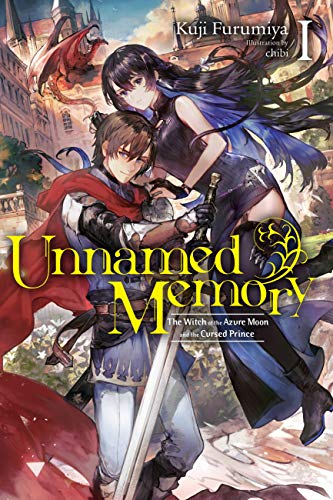
Prince Oscar is our hero, and he has a curse: a witch cursed his family when he was a boy so that any woman who had his child would die. Now 20 years old and one of the strongest in his kingdom, he goes to another witch, rumored to grant any wish to those who can climb to the top of her tower, and ask her to break the curse. That said, once he meets the witch, Tinasha, he has a better idea: she can marry him, as witches are strong enough to break this curse. She refuses to do that, but she does agree to spend the next year with him at the castle, at first as the “witch’s apprentice” and then, once her cover is blown, out in the open. Over the course of the book they solve mysteries, defeat ancient evils, fend off threats from other countries, and banter. The banter is the reason to read the book.

First up, I will say I wish that we’d had a bit more depth to Oscar at first. We get to know him a bit better as the book goes on, but at first I trusted him about as much as Tinasha does, and it’s easy to see why she brushes off his constant attempts to get her to marry him. Tinasha fares slightly better, although her past is also mostly suggested in this first book. There’s also a couple of unpleasant scenes, one being a dream – brought on by the drug of another witch – which leads to him having to strangle Tinasha, a rather ugly solution I thought could be handled differently, as well as one attempted assault on her when Oscar gets jealous. I mention these as the things I didn’t enjoy, mostly because the rest of the book is otherwise excellent. A very good supporting cast, some cool battle scenes, and the interplay between the main cast is very well done indeed. The book reads smoothly and makes you want more.

So I wasn’t over the moon with it, and I think I need another book or two to like Oscar as much as the author wants me to, but otherwise I can see why this was one of the most anticipated LNs of the year. Especially recommended for those tired of the usual game stats light novels – this has none of that.

Outbreak Company, Vol. 15

By Ichiro Sakaki and Yuugen. Released in Japan by Kodansha Light Novels. Released in North America by J-Novel Club. Translated by Kevin Steinbach.

Last time, I said that I was tired of ending each volume of Outbreak Company wondering when it would come to an end. I guess they heard me, because this is definitely the start of the endgame. For one thing, leaving aside his horny dream fantasies (which seem to be written to give the artist an excuse to draw the girls naked in an otherwise relatively serious story), Shinichi seems to be taking a bit more seriously the fact that he has three different girls in love with him. Unsurprisingly, most of his thoughts on this involve Myusel, the obvious front runner. If they do become a couple, can they go back to Japan? She is half-elf and not a citizen, after all, and while the Japanese government is happy to help Shinichi while he works for them, he suspects that this help would dry up if not turn against him. That said, given they overheat merely holding hands at the moment, baby making is still something only in dreams for now.

The main plot involves Elvia’s kingdom of Bahairam suddenly turning into a disaster area, with constant earthquakes and buildings turning into pillars of fire. The reason seems to be whatever is in the “Dragon’s Den”, a secret facility, but those who know of it aren’t talking. Even worse, Myusel’s mother is delivering supplies to the Kingdom and ends up getting trapped in the devastation. She asks Clara and Amatena to immediately go and get Shinichi, who is the one person who might be able to fix this. How? We’re not sure, and neither is he. But now the rest of the cast (sans Petralka, who is unable to get away from the basic need to rule her kingdom) head out to find out what the heck is causing this and if there is any way of stopping it. And things get even more confusing when they meet an android replica of Theresa Bigelow, a North American army officer.

There have been hints of the big reveal planted throughout the series, and they’re especially blatant here, as the first chapter opens with Shinichi showing his class a copyright-altered Planet of the Apes to demonstrate to them the idea of those “kinds of endings”. It does make things a lot more interesting, and is handled very well. There’s also some cool action scenes, though again the author’s habit of throwing in constant nudity whenever he can is a bit irritating, especially when our heroes are being surrounded by “the nekkids”, as Minori calls them. Speakoing of which, this volume changes viewpoints quite a bit, and it’s nice to hear from people other than Shinichi’s POV, though I admit it’s not always that easy to see who’s narrating at first. And, fantasizing aside, Shinichi and Myusel are very cute here. Again, I still think if this ends with a choice at all it will be Myusel.

So a very good book in general, and should lead nicely to the next one to end the arc. The series ends with 18, though there’s a short story volume after that that I’m unsure will be licensed. If you’ve been reading this series all along, there’s no reason to stop now. Also,l I’m fairly certain you cannot gain a handle on military strategy just by reading Legend of Galactic Heroes, Petralka.

A Certain Magical Index SS, Vol. 1

By Kazumi Kamachi and Kiyotaka Haimura. Released in Japan as “To Aru Majutsu no Index” by Dengeki Bunko. Released in North America by Yen On. Translated by Andrew Prowse.

Despite its name, and despite the fact that Yen On is releasing it after the main Index series, this is not particularly a short story volume. Instead, it’s four interlinked plot threads, which are presented as distinct chapters – he’s done this before. In Japan this came out between the 13th and 14th volumes of the main series, and it takes place there as well, with most of the cast worrying about what seems to be an inevitable war with the Roman Orthodox Church (which, to be fair, does happen). I am happy that we are finally seeing it here, though I will admit that a lot of its events would have had more impact if it had come out in its proper place. In particular, this volume introduces one of the main protagonists of the series – though honestly you’d never know it from the book itself, as he doesn’t even appear till 4/5 of the way in, and gets taken out by Touma like garbage. Which melds nicely with the book’s themes.

Introduced in this book: Shiage Hamazura, the aforementioned third protagonist. Sasha is also seen here as herself, rather than in “I am possessed by Gabriel” mode, though thanks to the Russian equivalent of Laura Stuart she’s walking around in a fetish outfit. We also meet Komaba Ritoku, though he sadly has the misfortune of running up against Accelerator, so he’s killed off here. He shows Accelerator the picture of a girl he’s trying to protect – his sister? Well, he’s dead now, so we will never know the identity of this mystery girl… well, unless Yen licenses New Testament. This volume also helps to solidify GROUP as part of the dark side of Academy City, and shows that they can grumpily work together when they want to – though they don’t here, as Accelerator and Musujime Awaki get their own separate fights.

There’s silliness at the start (how does Touma manage to pat Aisa on the back and knock her bra off?), which also leads to one of the few deliberately funny jokes in these books which usually try to be funny and fail – Touma’s heartfelt “I’m going to start studying English!” is a big LOL. Most of the book is introducing us to Skill-Out, a group of Level Zeroes trying to wreak havoc. Later books show them off as well, but, as Touma yells at Hamazura, they could have chosen to protect the weak (and indeed we see Komaba was doing this), instead of basically being a bad biker gang with explosives. We also meet once more Mikoto’s mother, the self-proclaimed “bisexual-disaster cougar”, who is also there for humor (not as funny) but also to possibly pull Mikoto out of Academy City due to impending war. Fortunately for the Railgun’s romantic prospects, Touma manages to impress her mom enough that she decides to leave her there. And, of course, Touma gets to punch the villain, in this case Hamazura, though notably instead of “breaking that illusion” he says Hamazura can break his own illusions himself.

So overall, this is very good setup for books 14-22, and you might want to go back and read those again if you have the time. Next time we’ll get the second SS book, which I understand is far more of a short-story volume than this one was, although I imagine they’re probably all interconnected as well.